Category: Fabrics

  • 75+ Different Types of Fabrics for Women Clothing (With Pictures and Names)

    75+ Different Types of Fabrics for Women Clothing (With Pictures and Names)

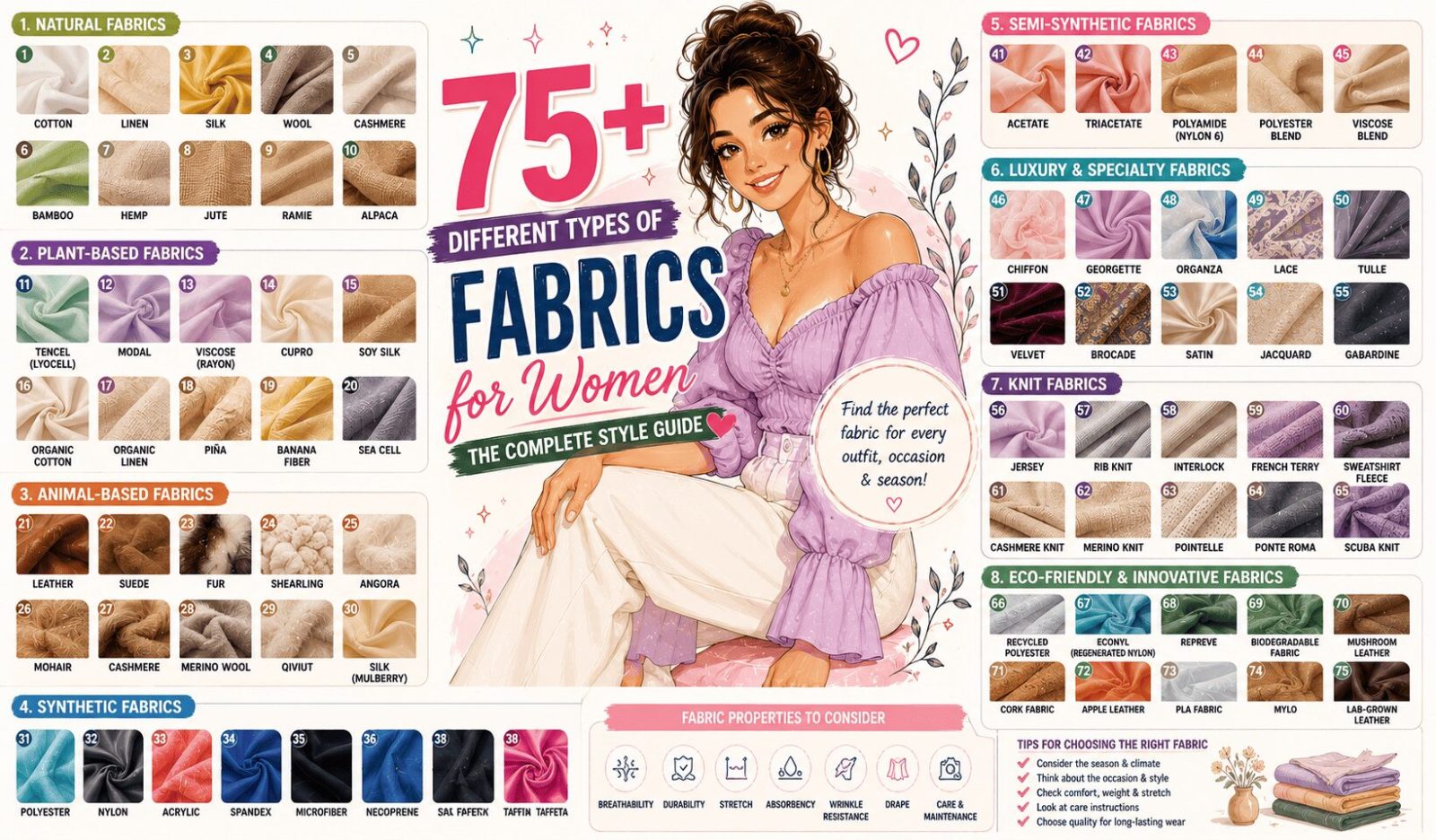
    There’s something almost alchemical about the moment a fabric choice clicks into place. Not just comfortable — right. That whisper-soft cashmere against your skin in January. That crisp linen in July that somehow keeps you cooler than everything else in your wardrobe. Fabric isn’t decoration layered on top of a garment. It’s the garment’s soul — shaping how it moves, how it breathes, how it ages, and crucially, how it makes you feel in it.

    Fabric is the first decision in fashion. Everything else — cut, colour, construction — is commentary.

    The history of clothing is, at its core, a history of textiles. Ancient Egypt elevated linen to a sacred material. The Silk Road reshaped civilizations because of a single thread. Cotton’s industrialization in the 18th century democratized dress entirely. Today, with natural fibres, synthetic blends, semi-synthetics, and technically engineered performance textiles all available simultaneously, fabric literacy has never been more essential — or more overlooked. This guide corrects that.

    The Guide

    This guide documents 75+ types of fabric for women’s clothing across 8 classification systems. For every single entry:

    • Fibre Origin

      Natural, synthetic, or semi-synthetic source

    • Season

      When it performs at its best

    • Best For

      Which garments and occasions it suits

    Start here, explore everything, and build a wardrobe informed by fabric intelligence — not just trend impulse. If you also want to explore how fabrics work across specific garment categories, our complete guide to women’s tops and our deep-dive into dress silhouettes both complement what you’ll find here.

    All 8 Fabric Categories at a Glance

    A structured breakdown of the 75+ fabric types documented in this guide.

    1. 01

      Natural Plant-Based Fibres

      14 types #1–#14
    2. 02

      Natural Animal-Derived Fibres

      10 types #15–#24
    3. 03

      Semi-Synthetic / Regenerated Fibres

      10 types #25–#34
    4. 04

      Fully Synthetic Fibres

      12 types #35–#46
    5. 05

      Woven Fabric Constructions

      12 types #47–#58
    6. 06

      Knit Fabric Constructions

      8 types #59–#66
    7. 07

      By Season & Climate Suitability

      6 types #67–#72
    8. 08

      Sustainable & Innovative Fabrics

      6 types #73–#78
    Total Coverage
    78 Fabric Types Documented

    75+ Different Types of Fabrics for Women’s Clothing

    Category 1: Natural Plant-Based Fibres (#1–#14)

    Grown from the earth — breathable, biodegradable, and the oldest textile tradition in human history

    Plant fibres are the foundation. Before synthetics, before blends, before performance textiles existed — there was cotton, linen, hemp, and ramie. These materials built entire economies and, in many parts of the world, still define daily dress. Their shared qualities: breathability, natural moisture management, and a tendency to soften and improve with repeated washing and wear.

    What works so well about plant-based fibres — and why they've endured — is that they don't need technical engineering to perform. They manage heat and moisture through fibre structure alone. A well-woven cotton shirt outperforms a synthetic moisture-wicking top in most real-world conditions simply because the natural fibre breathes. That's a fact most fast fashion marketing would prefer you didn't know. Our guide to breathable fabrics for women covers this in even more detail if you want to dig deeper.

    1. 01

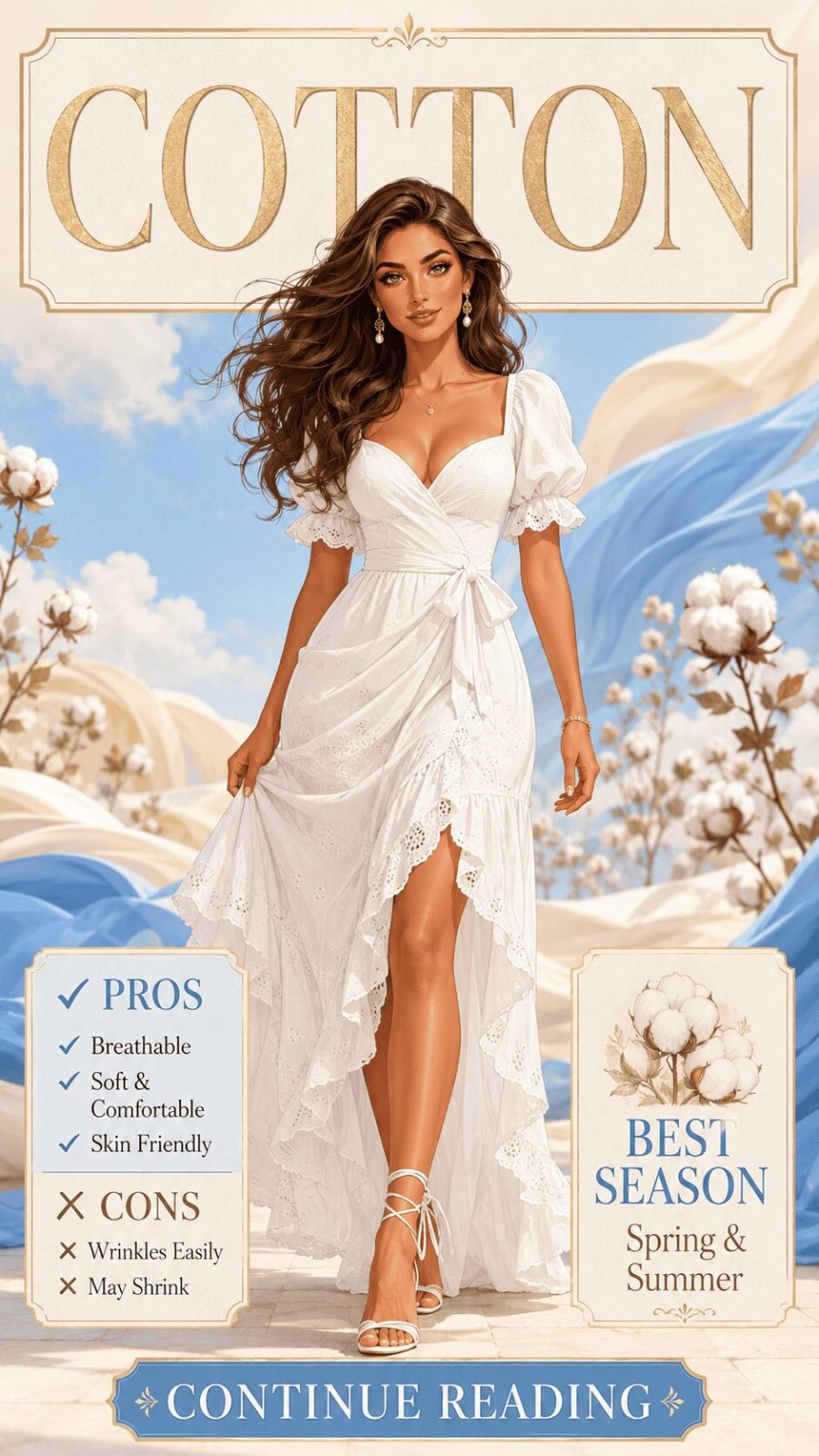
      Cotton

      Cotton Fabric for Women's Clothing

      Spun from the soft fibres surrounding cotton plant seeds, cotton is the world's most widely used natural textile fibre — and honestly, probably the most democratic too. Its cross-section is kidney-shaped, which is precisely what makes it absorb moisture so efficiently. Available in countless weave weights, from gossamer lawn cotton to heavy canvas, it adapts across every garment category and season.

      DesignMatte finish, soft hand, wide weight range from sheer to heavy
      SeasonAll seasons; weight determines suitability
      Best ForEveryday tops, dresses, skirts, casual and smart-casual wear
    2. 02

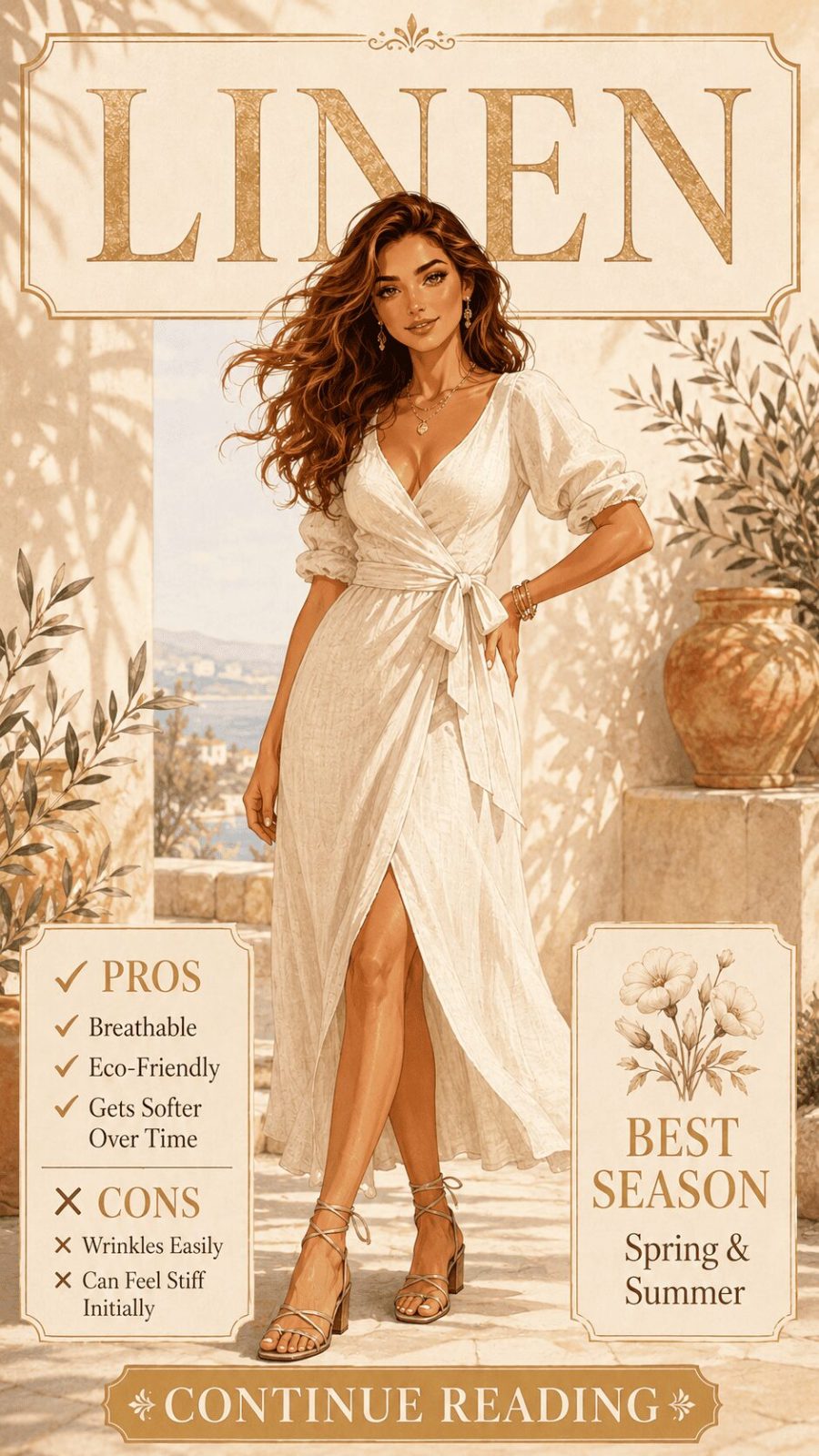
      Linen

      Linen Fabric for Women's Clothing

      Made from flax plant stalks, linen is older than civilization itself — ancient Egyptian mummies were wrapped in it. Its hollow fibre structure allows air to circulate freely, making it two to three times more breathable than cotton. It wrinkles. That's not a flaw; that's character. And it softens considerably with every wash, becoming more beautiful the more you wear it.

      DesignCrisp texture, slubbed surface, characteristic natural drape
      SeasonSpring / Summer; transitional autumn
      Best ForSummer dresses, blouses, wide-leg trousers, resort wear
    1. 03

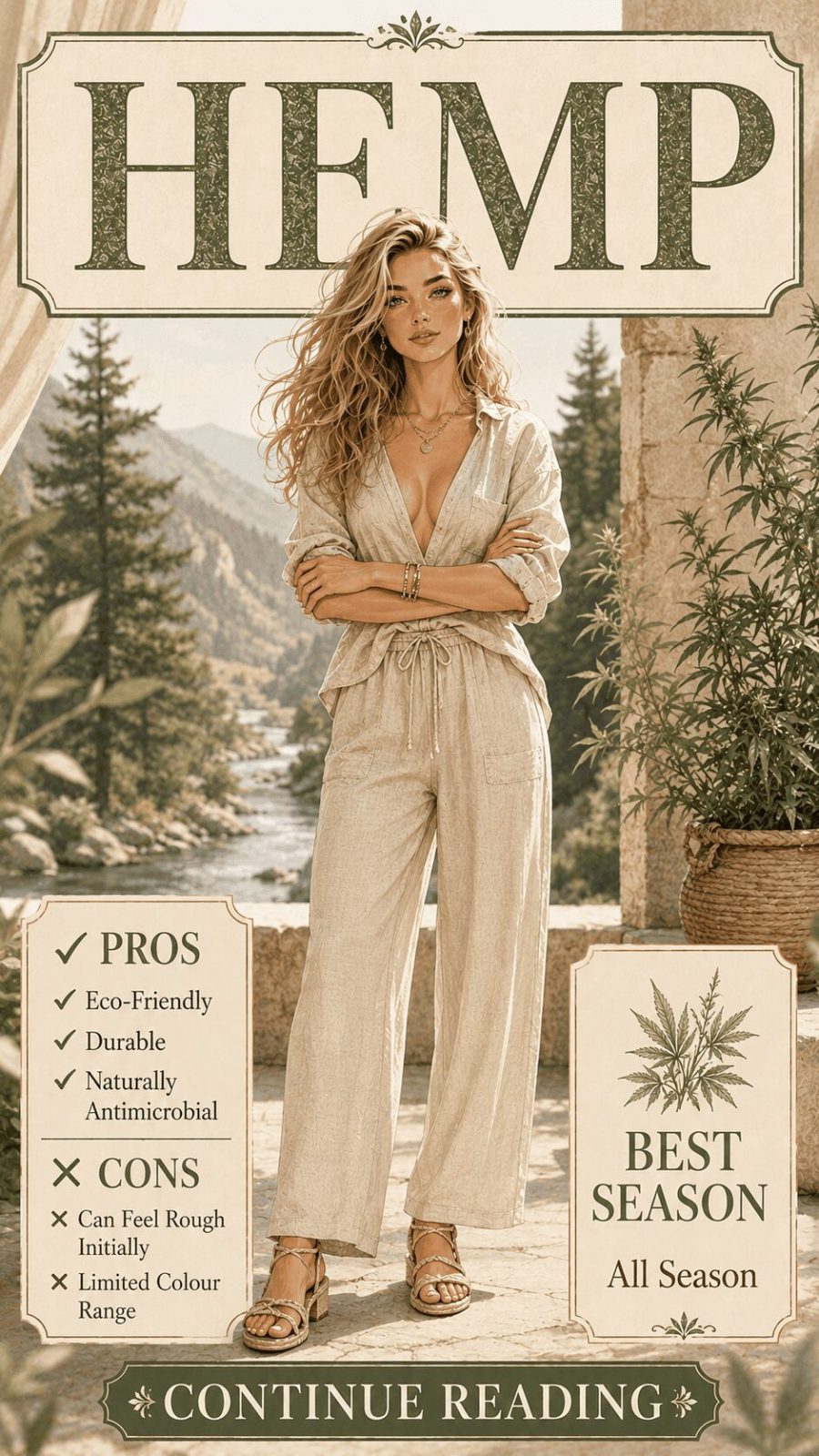
      Hemp

      Hemp Fabric for Women's Clothing

      One of the most durable plant fibres available, hemp requires no pesticides to grow and returns nutrients to the soil after harvest. Its texture sits somewhere between linen and canvas — slightly coarser when new, softening dramatically over time. UV-resistant and naturally antimicrobial, it's the working fibre that sustainability-minded fashion is finally taking seriously.

      DesignTextured, earthy hand; matte surface; often blended with cotton
      SeasonSpring / Summer / early Autumn
      Best ForCasual tops, trousers, tote bags, sustainable fashion pieces
    2. 04

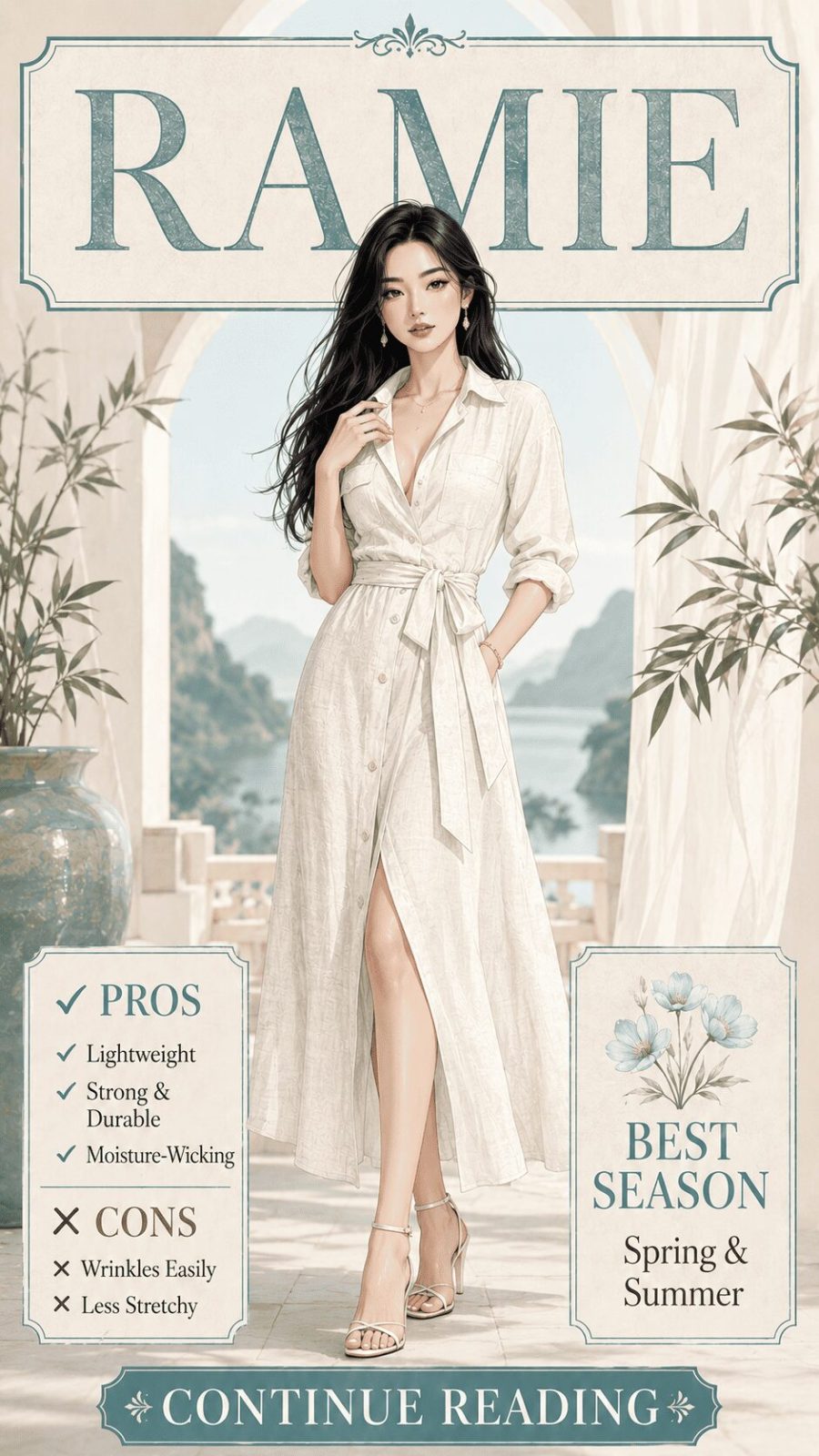
      Ramie

      Ramie Fabric for Women's Clothing

      Extracted from the stems of the China grass plant, ramie is one of the strongest natural fibres known — reportedly eight times stronger than cotton when wet. It has a lustrous, silk-like sheen unusual for a plant fibre, and excellent resistance to mildew, bacteria, and insect attack. Often blended with cotton to improve its natural stiffness.

      DesignSilky sheen, crisp drape, slightly stiffer than linen
      SeasonSpring / Summer
      Best ForBlouses, summer tops, lightweight trousers; mostly used in blends
    1. 05

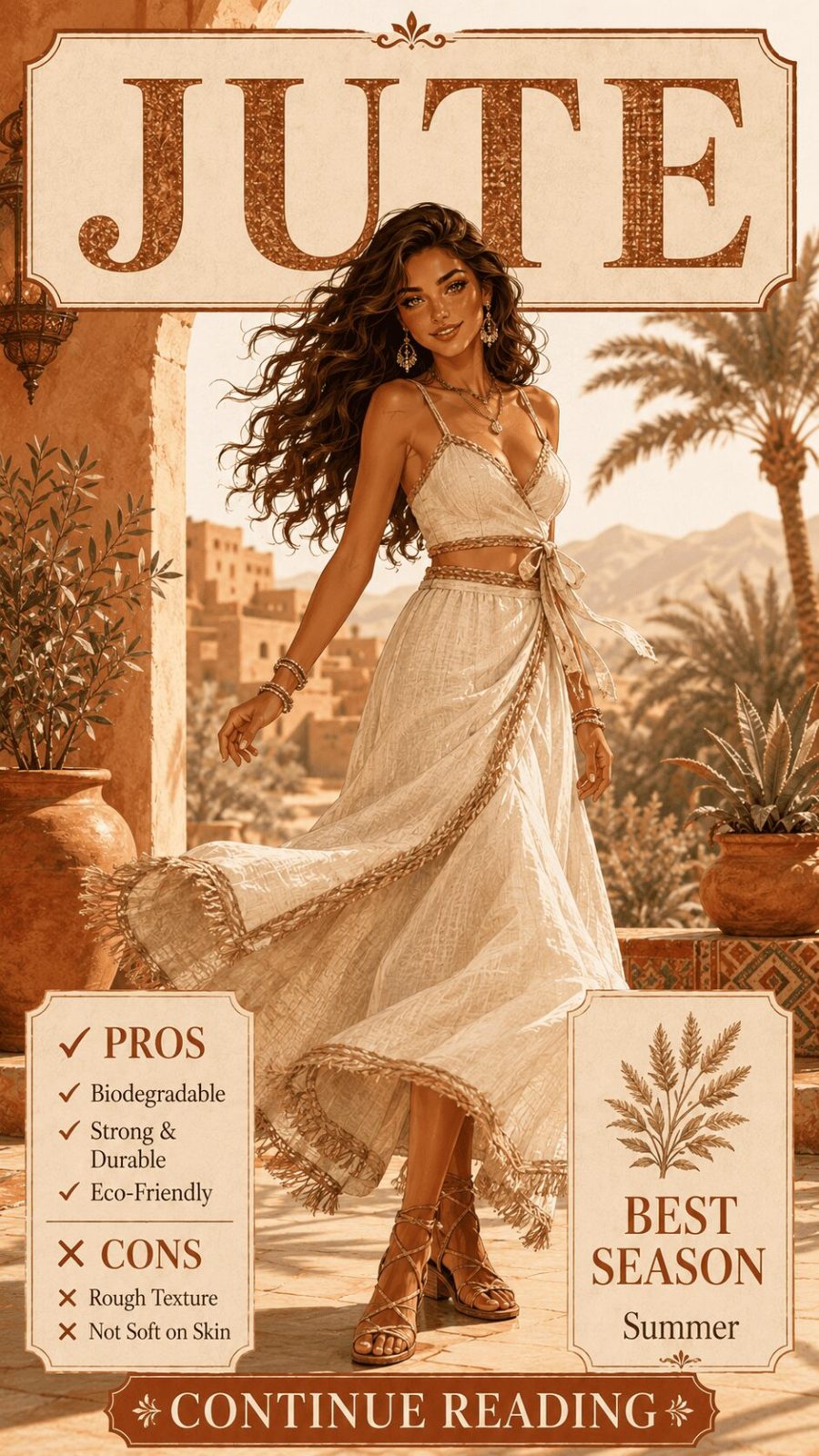
      Jute

      Jute Fabric for Women's Clothing

      Coarser than most plant fibres, jute is more commonly known as burlap in its raw form — though fashion-grade jute blends soften the texture considerably. Its golden lustre and earthy, tactile quality make it a fixture in bohemian and artisan fashion aesthetics. Biodegradable, affordable, and increasingly used in sustainable fashion accessories and statement outer layers.

      DesignCoarse texture, golden hue, visible weave structure
      SeasonSummer / Resort
      Best ForAccessories, bags, festival wear, artisan outer layers
    2. 06

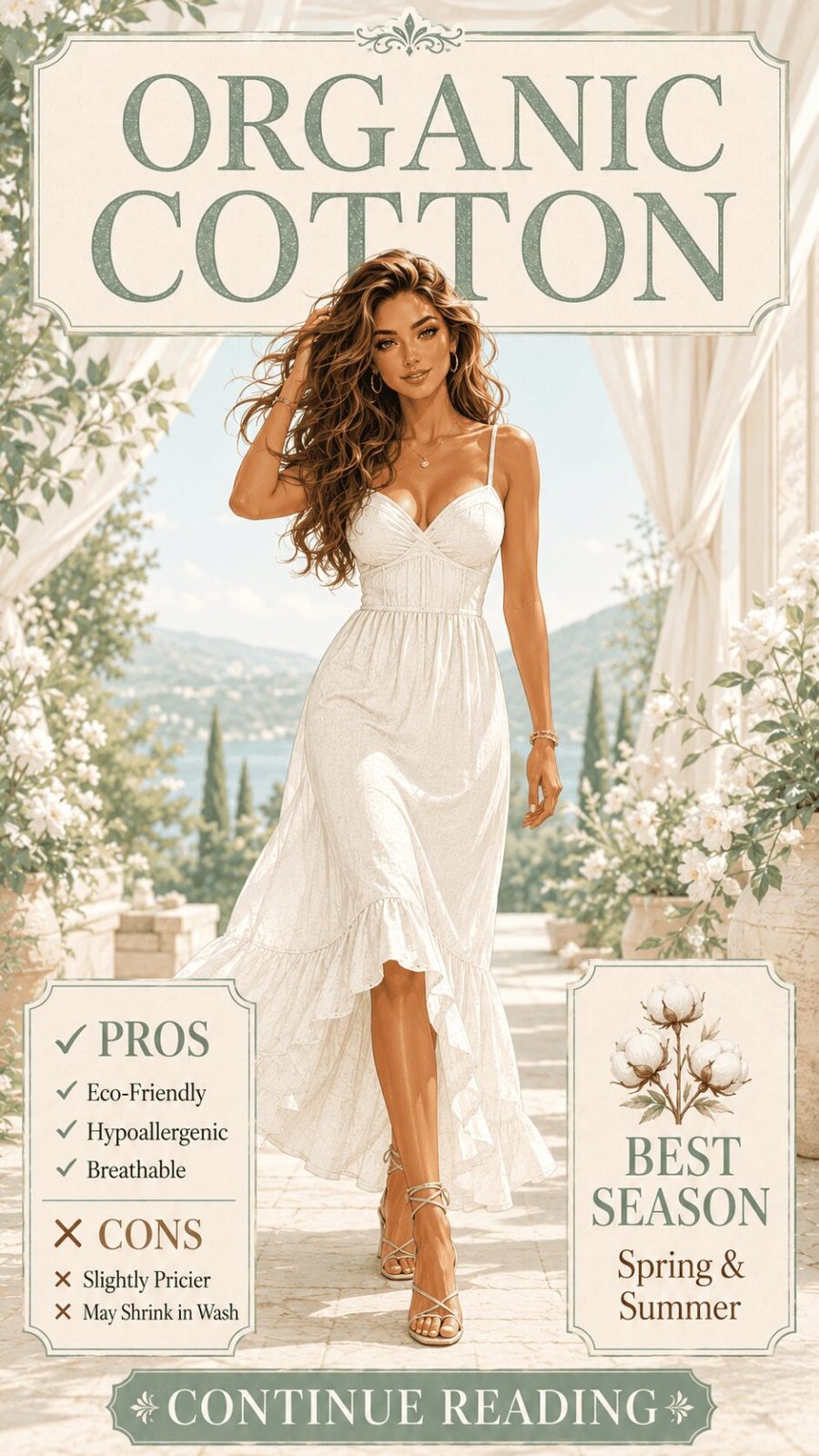
      Organic Cotton

      Organic Cotton Fabric for Women's Clothing

      Chemically identical to conventional cotton at fibre level, but grown without synthetic pesticides, fertilizers, or GMO seeds. The feel is often marginally softer — partly due to lower chemical processing — and the environmental footprint is substantially smaller. GOTS (Global Organic Textile Standard) certification is the benchmark to look for. Worth knowing: organic certification covers growing, not necessarily dyeing or finishing.

      DesignSoft, breathable, matte; indistinguishable from conventional by feel
      SeasonAll seasons by weight
      Best ForEveryday basics, children's clothing, sensitive skin, conscious fashion
    1. 07

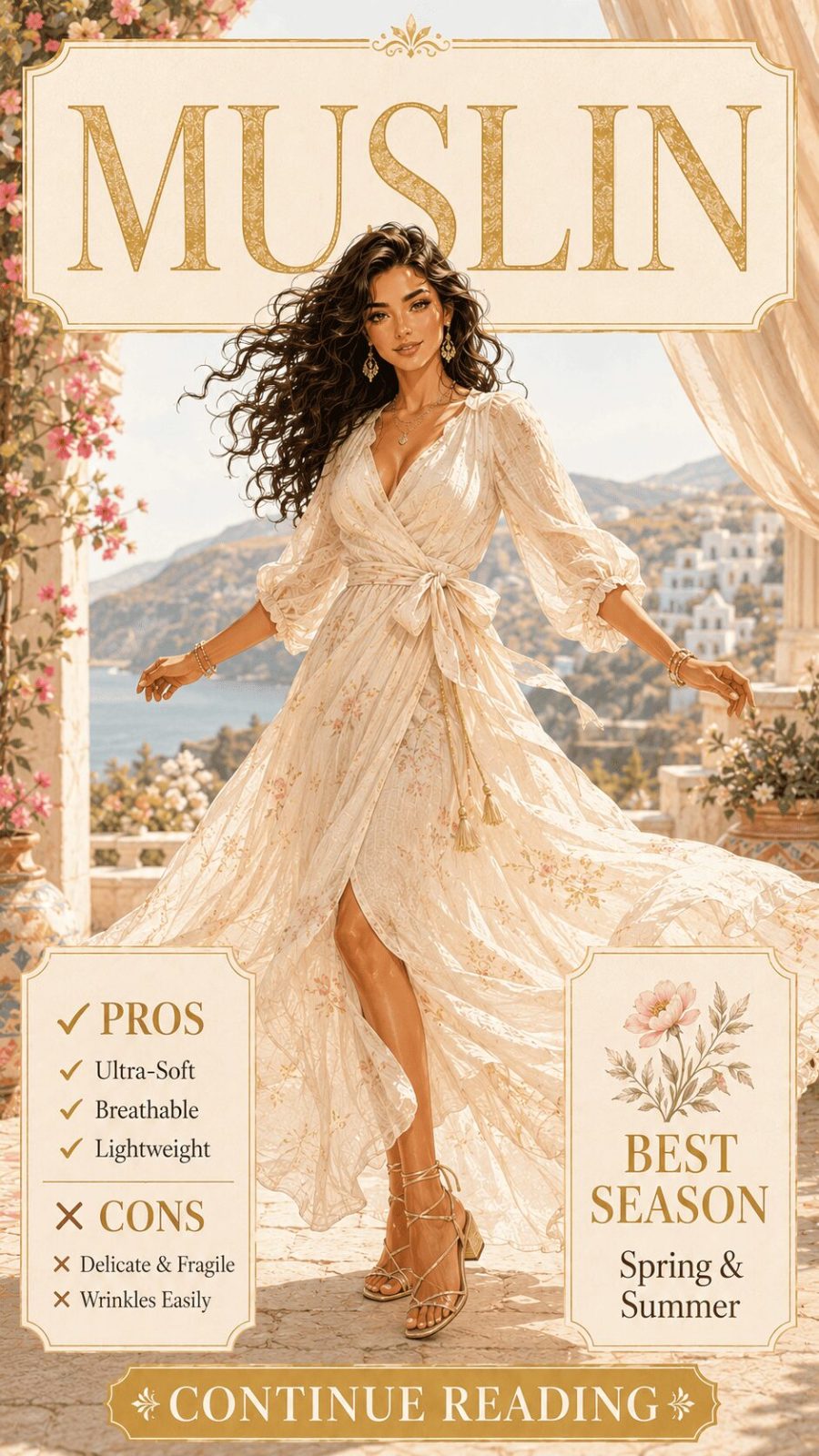
      Muslin

      Muslin Fabric for Women's Clothing

      An ancient plain-weave cotton with origins in Mosul, Iraq — and arguably the most important fabric in fashion history that most people can't identify by name. Regency-era fashion was built on muslin's gossamer-light drape. Today it ranges from coarse open-weave (used for pattern-making toiles) to superfine Swiss muslin and voile, which float beautifully in summer dresses and blouses.

      DesignPlain weave, lightweight, semi-sheer in fine grades, soft drape
      SeasonSpring / Summer
      Best ForSummer dresses, blouses, layering under structured pieces
    2. 08

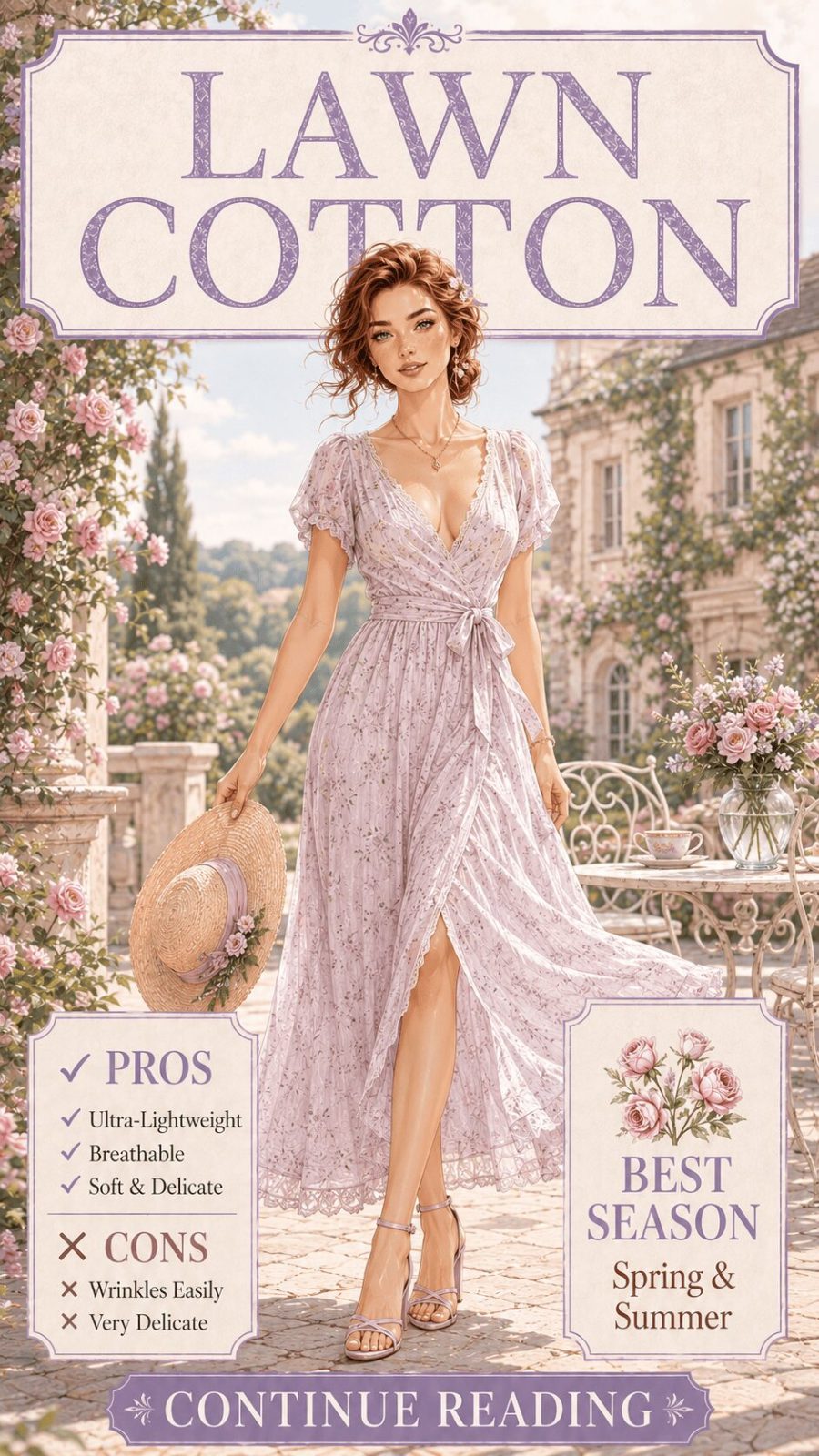
      Lawn Cotton

      Lawn Cotton Fabric for Women's Clothing

      A crisp, fine-weave cotton with a slightly sheer quality and a silky finish that sets it apart from standard quilting cotton. Originally produced in Laon, France, it holds prints with extraordinary clarity — which is why premium printed blouse fabric is often lawn. Pakistani lawn in particular is celebrated for its fine quality and vivid printed designs, dominating South Asian fashion markets.

      DesignFine, crisp weave, semi-sheer, excellent print clarity
      SeasonSpring / Summer
      Best ForPrinted blouses, kurtis, summer dresses, ethnic tops
    1. 09

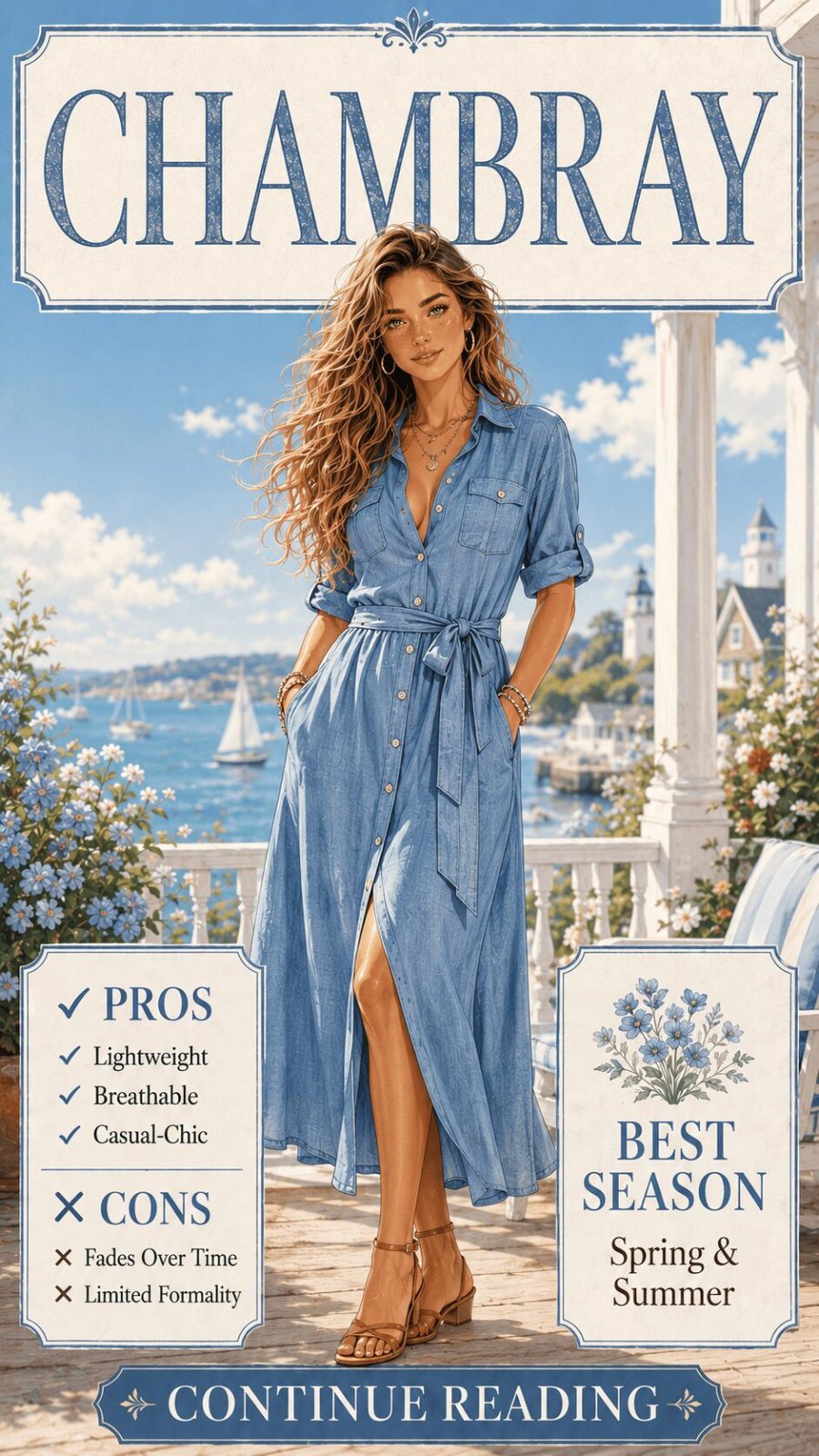
      Chambray

      Chambray Fabric for Women's Clothing

      Chambray is often confused with denim — and honestly, that confusion is understandable. Both use a coloured warp thread and white weft, but chambray uses a plain weave rather than denim's diagonal twill. The result is softer, lighter, and more breathable. A chambray shirt drapes rather than holds structure, which makes it one of the best warm-weather alternatives to a formal shirt.

      DesignPlain weave, soft drape, denim-adjacent colour, much lighter weight
      SeasonSpring / Summer / Light Autumn
      Best ForShirts, dresses, smart-casual tops, warm-weather office wear
    2. 10

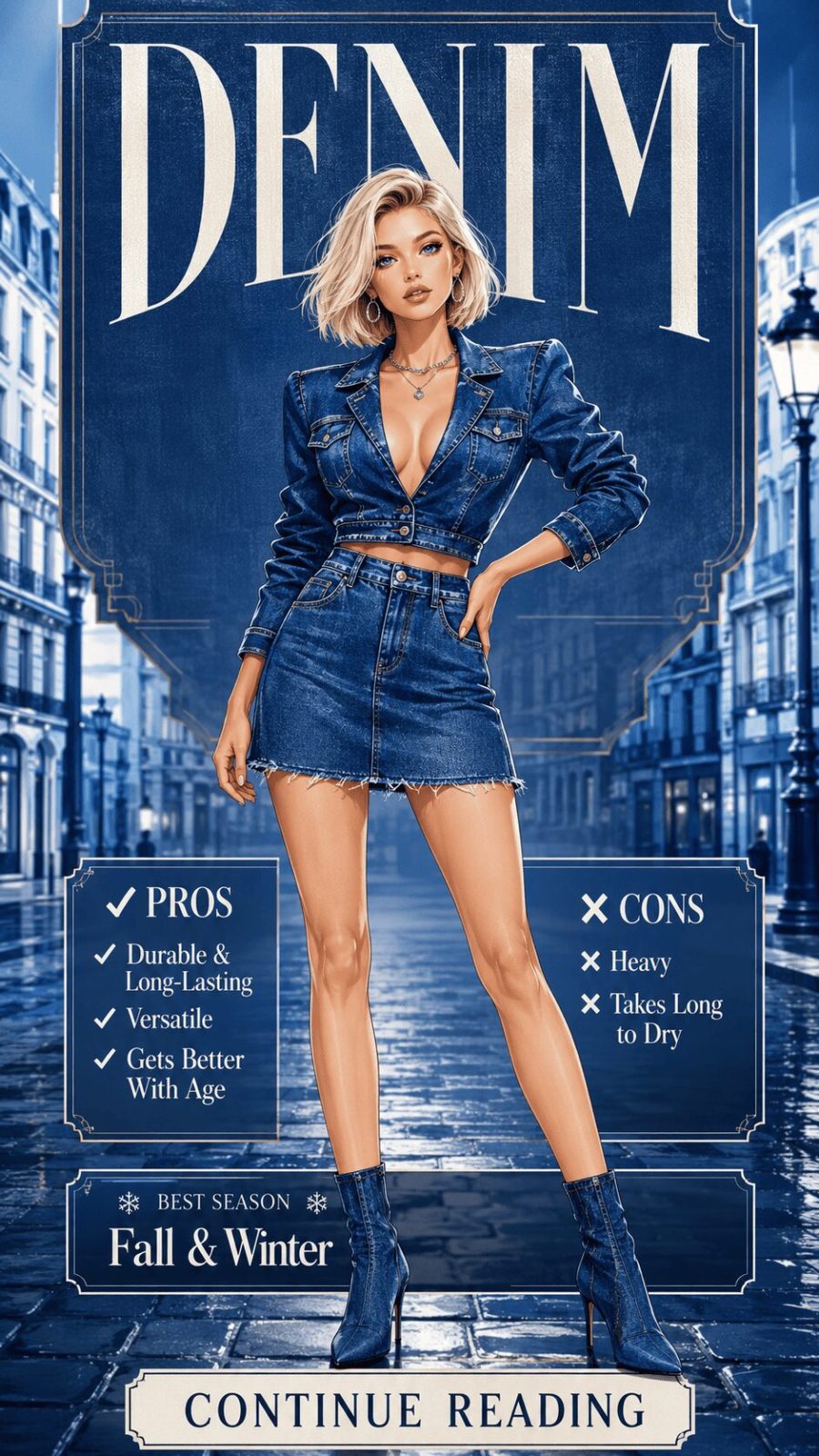
      Denim

      Denim Fabric for Women's Clothing

      A sturdy cotton twill weave — the defining fabric of the 20th century. Originally a workwear material (serge de Nîmes, France), it was adopted by cowboys, then teenagers, then high fashion. Its diagonal twill structure creates inherent strength and that characteristic diagonal ribbing visible on the fabric surface. Modern denim ranges from rigid raw selvedge to stretch-blend styles with 2-3% elastane. Our full guide to denim fits for women explores how the fabric works across different cuts.

      DesignDiagonal twill weave, structured hand, fades with wear
      SeasonSpring / Autumn / Winter (lighter washes in Summer)
      Best ForJeans, jackets, skirts, casual dresses, dungarees
    1. 11

      Corduroy

      Corduroy Fabric for Women's Clothing

      A ribbed velvet-like cotton textile with parallel vertical cords or "wales" — the ridge count per inch classifying the fabric from wide-wale (chunky, textural) to fine-wale (almost smooth). The name supposedly derives from "cord du roi," cloth of the king, though that etymology is disputed. Undisputed: its warmth, durability, and satisfying tactile quality make it one of autumn-winter fashion's most reliable textures.

      DesignRibbed pile surface, warm hand, directional nap that catches light
      SeasonAutumn / Winter
      Best ForTrousers, skirts, jackets, shirts, statement-texture pieces
    2. 12

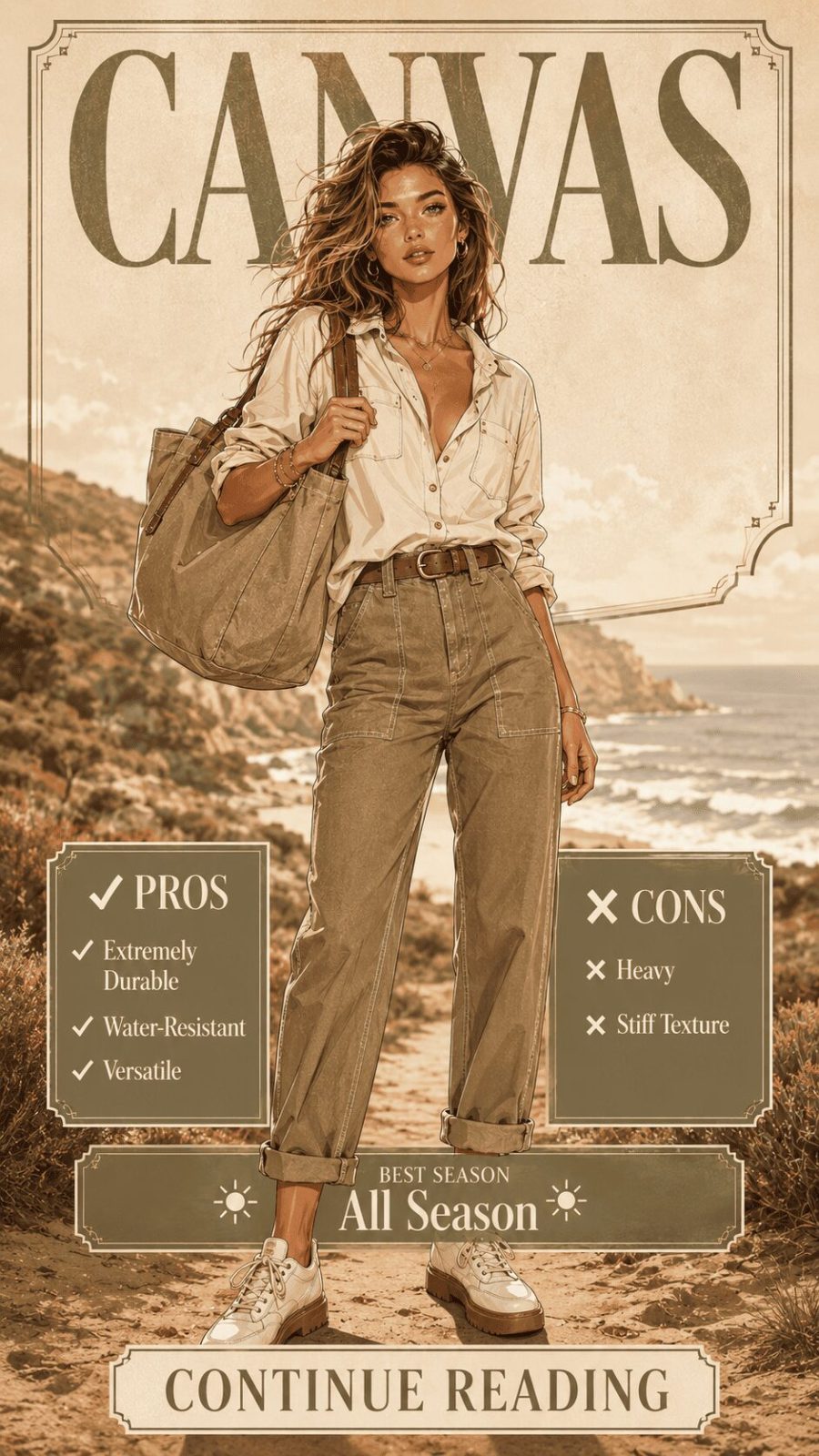
      Canvas

      Canvas Fabric for Women's Clothing

      Heavy, plain-weave cotton (or linen) with enough structure to hold its shape without interfacing. Originally a sailmaker's material — and you can feel that practicality in every stitch. In women's fashion it appears in structured totes, utilitarian jackets, and architectural statement pieces where the goal is deliberate, no-apology rigidity. Bleached or dyed, it takes colour well and resists abrasion.

      DesignHeavy, stiff, structured; holds architectural shape without support
      SeasonSpring / Summer / Autumn
      Best ForBags, structured jackets, utility wear, outerwear with defined shape
    1. 13

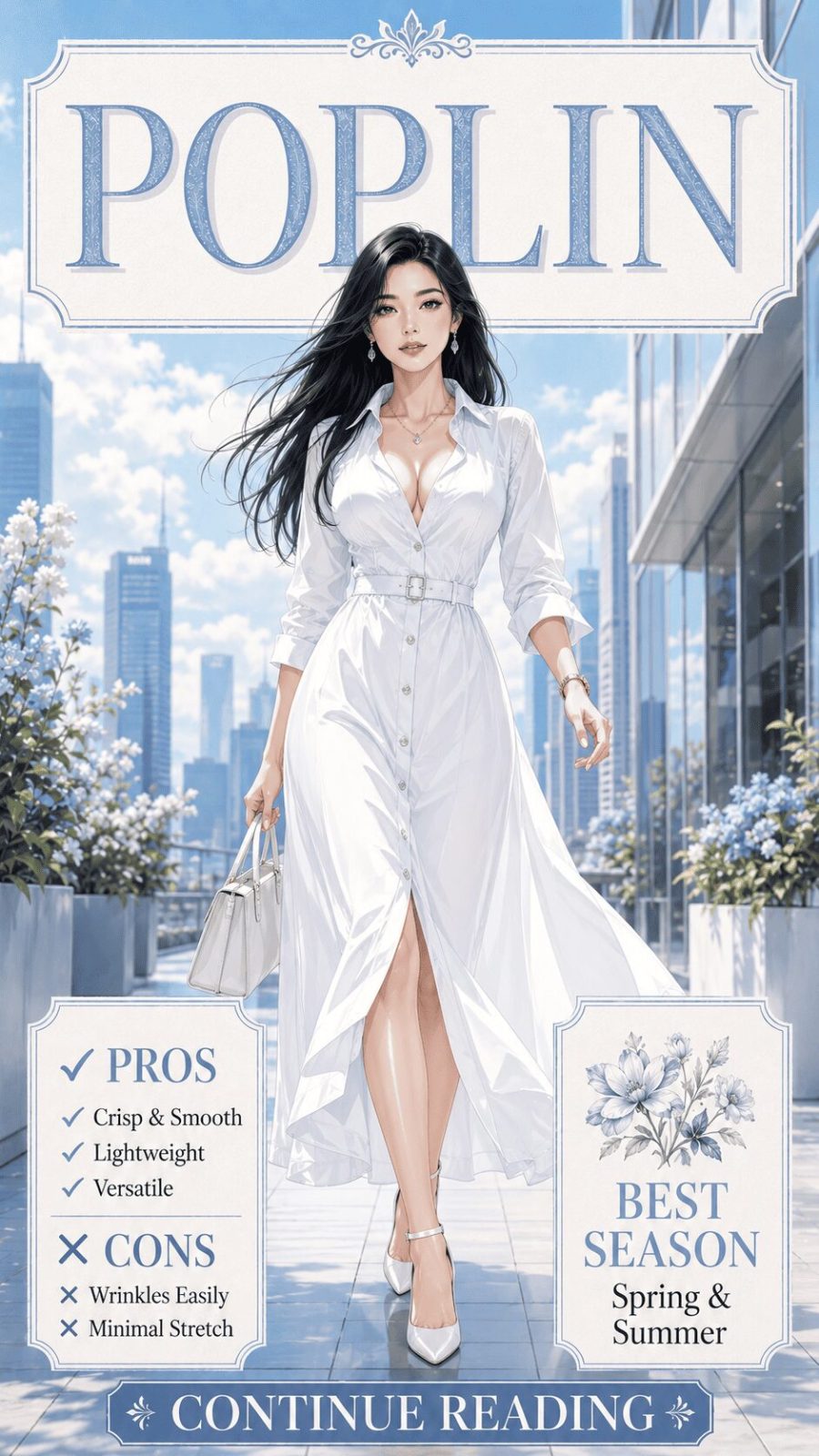
      Poplin

      Poplin Fabric for Women's Clothing

      A tight plain-weave fabric with a fine crosswise rib produced by using a heavier weft thread than warp. The result is a smooth, slightly lustrous surface that holds a crease cleanly — which is exactly why it became the fabric of choice for formal dress shirts and office blouses. Poplin presses beautifully, resists wrinkling better than muslin, and has just enough body to maintain collar and cuff structure.

      DesignSlight crosswise rib, smooth surface, crisp pressing ability
      SeasonAll seasons
      Best ForDress shirts, office blouses, structured dresses, tailored garments
    2. 14

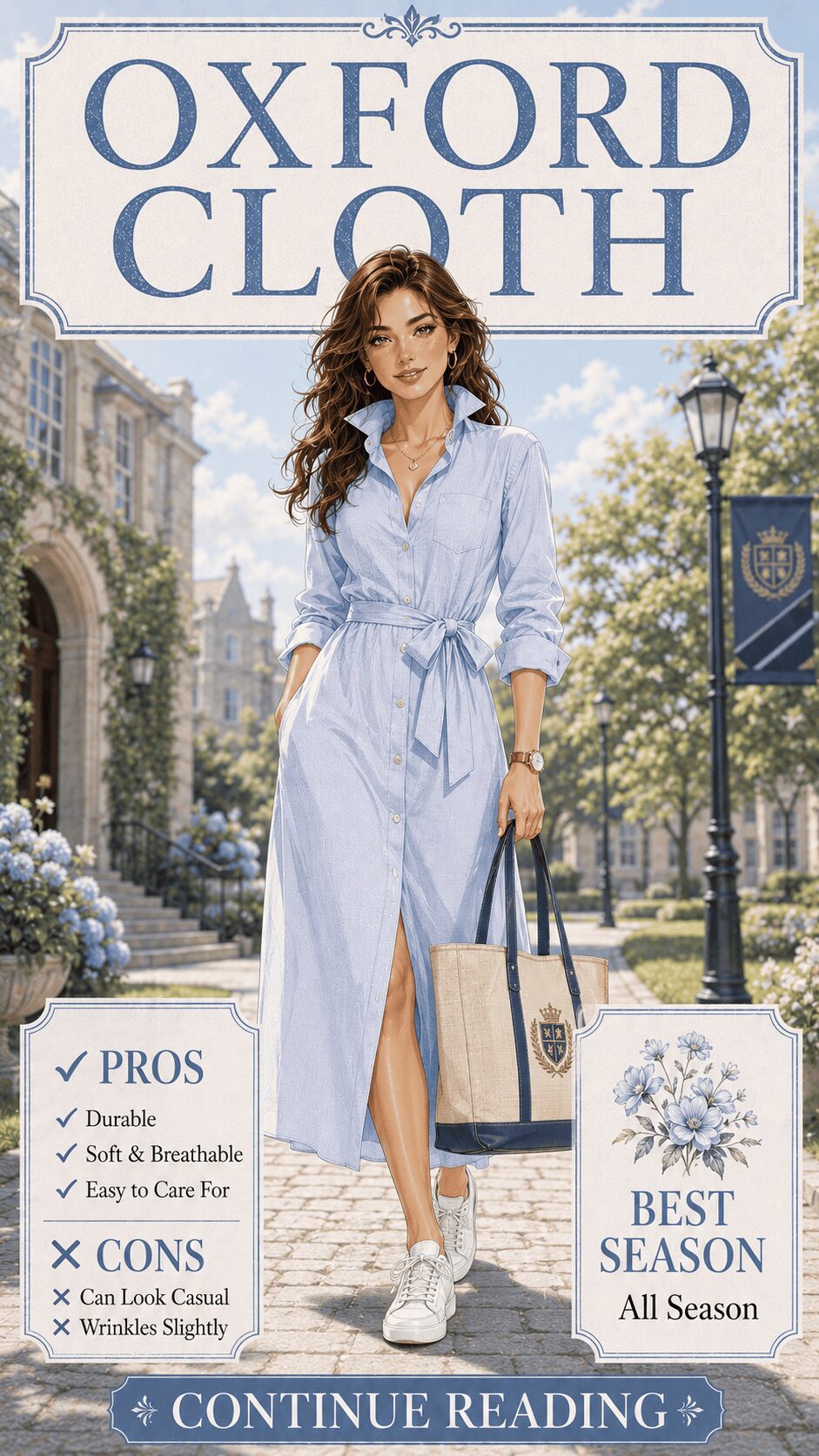
      Oxford Cloth

      Oxford Cloth Fabric for Women's Clothing

      A basket-weave cotton fabric with a heavier, more textural feel than poplin and a distinctly casual yet polished sensibility. Named for Oxford University (though the connection is largely marketing history), it became the foundation of the classic Oxford shirt — relaxed enough for weekends, structured enough for smart-casual. The subtle weave creates a matte, refined texture that photographs extremely well.

      DesignBasket weave, heavier hand, matte texture, slightly casual
      SeasonSpring / Autumn
      Best ForShirts, casual-smart blouses, weekend wear, travel

    Category 2: Natural Animal-Derived Fibres (#15–#24)

    Protein-based fibres from living creatures — inherently temperature-regulating and among fashion's most prized materials

    1. 15

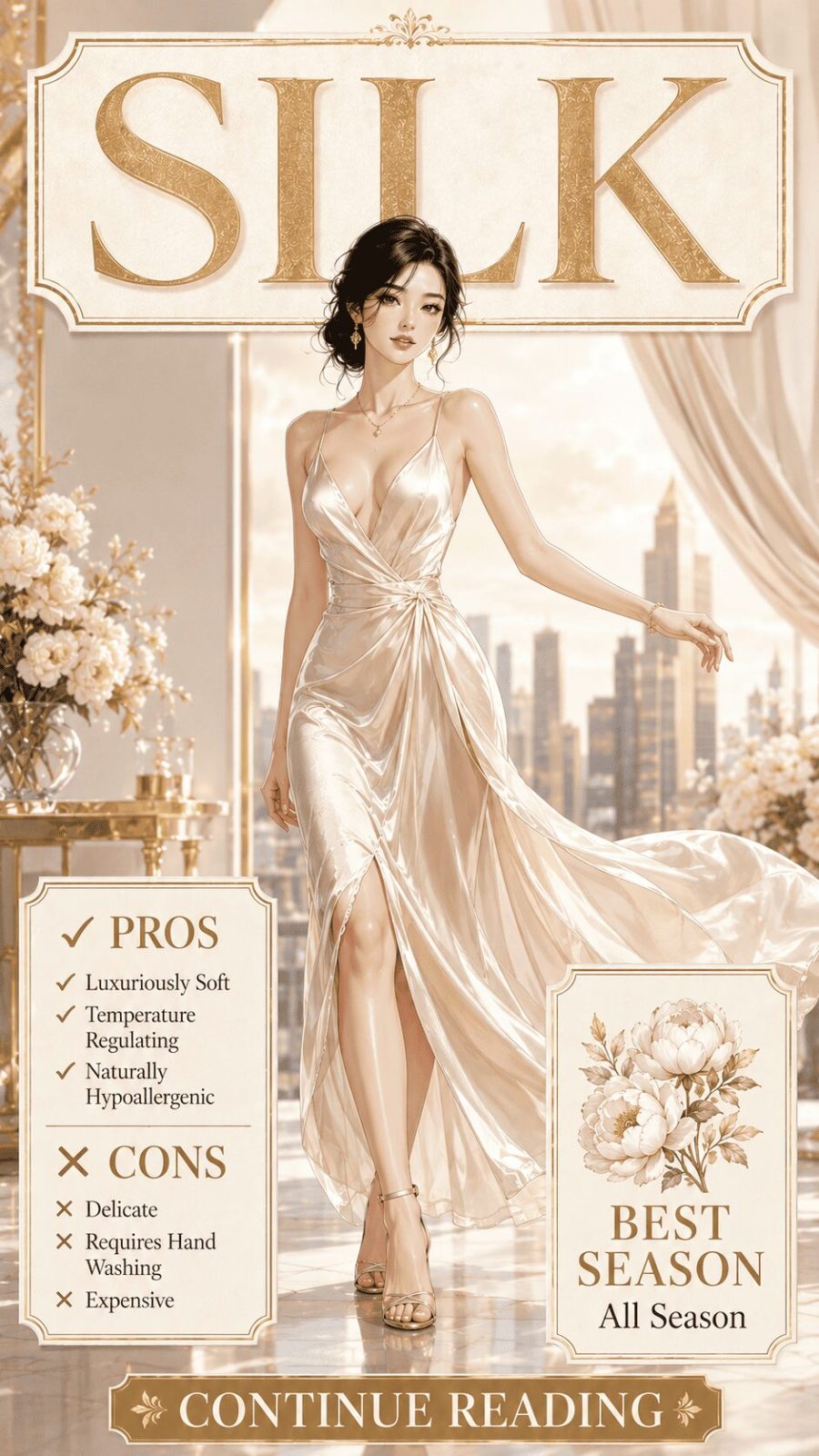
      Silk

      Silk Fabric for Women's Clothing

      Produced by silkworm larvae spinning their cocoons, silk is a continuous protein filament — sometimes over a kilometre long from a single cocoon. That unbroken length creates the signature smooth, lustrous surface that reflects light so differently from every other fabric. Naturally temperature-regulating (genuinely warm in winter, cool in summer), hypoallergenic, and with a drape that simply cannot be replicated synthetically. For a deeper look at how silk works across garment types, our guide to silk fabrics for women covers every silk variety in detail.

      DesignLuminous sheen, fluid drape, cool touch, subtle lustre that shifts with movement
      SeasonAll seasons; weight and weave determine context
      Best ForBlouses, evening wear, occasionwear, slip dresses, scarves
    2. 16

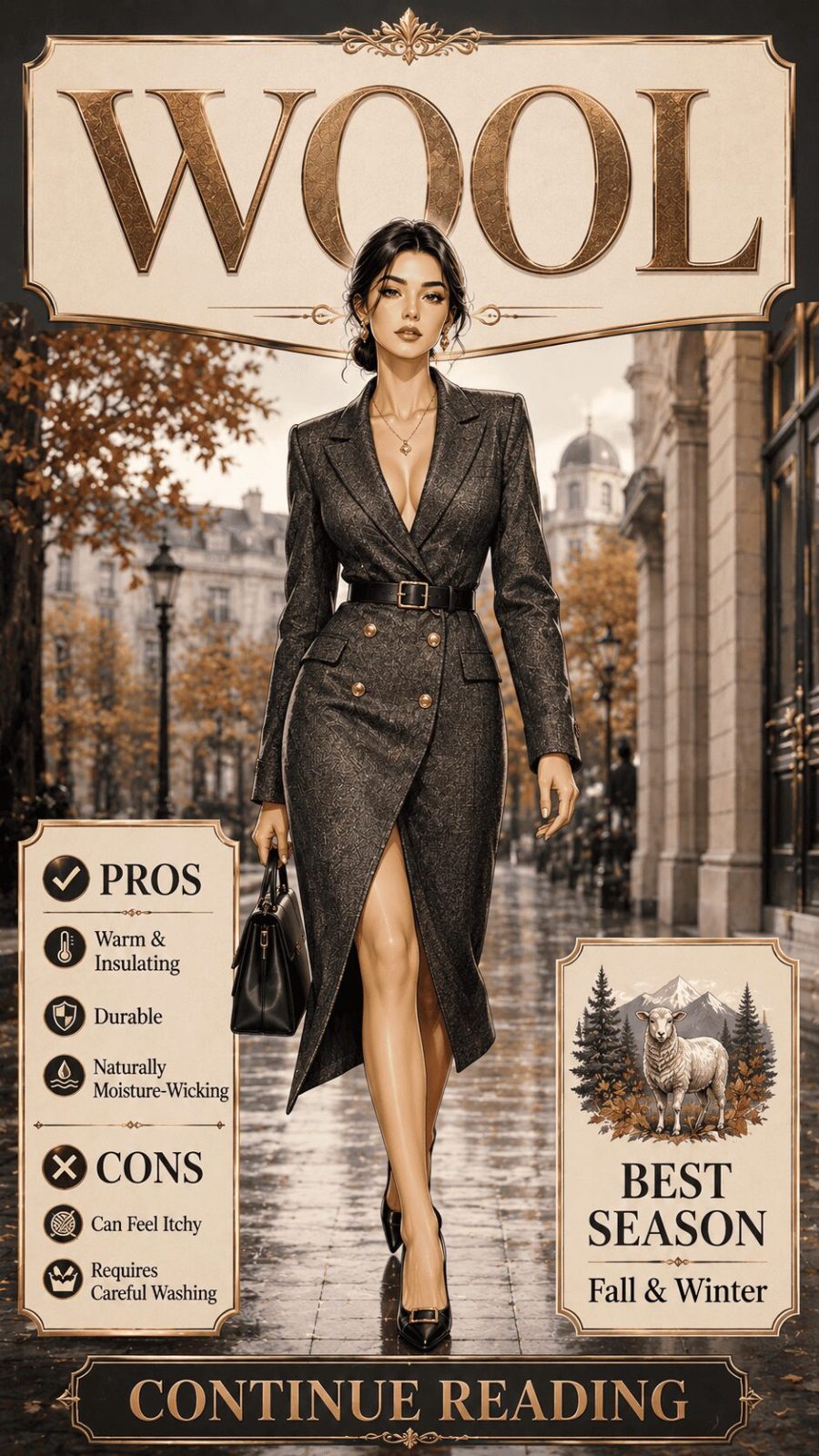
      Wool

      Wool Fabric for Women's Clothing

      The protein fibre shorn from sheep — and one of the most technically sophisticated natural materials in existence. Wool's crimped structure traps air, creating insulation. Its natural scales manage moisture (absorbing up to 35% of its weight without feeling wet). It's naturally fire-resistant and odour-resistant. Ranging from fine super 100s suiting wool to chunky Aran knit, it spans every formality level. See our complete breakdown of wool fabrics for women for the full classification.

      DesignCrimped, warm hand, ranges from smooth fine suiting to chunky knit
      SeasonAutumn / Winter; fine merino year-round
      Best ForSweaters, coats, suits, skirts, trousers, winter dresses
    1. 17

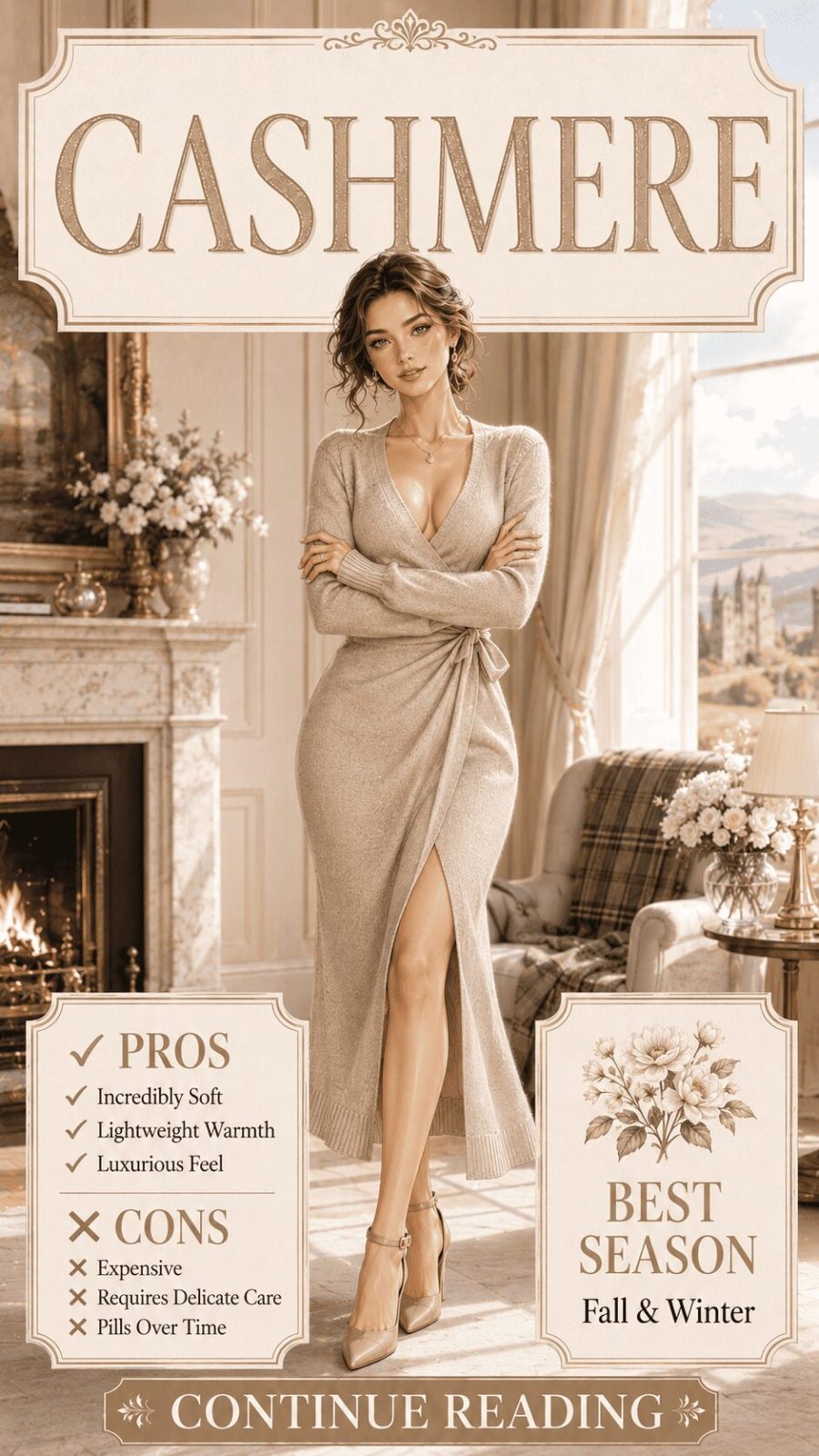
      Cashmere

      Cashmere Fabric for Women's Clothing

      Combed from the soft undercoat of Kashmir goats, primarily in Mongolia and China. The fibres must measure under 19 microns in diameter — for reference, a human hair is 70 microns. That fineness is the source of cashmere's extraordinary softness. It's also why a single high-quality cashmere sweater requires the seasonal output of three to five goats. Worth the investment? In most stylist opinion: consistently, yes.

      DesignExceptionally soft hand, slight halo, warm without weight
      SeasonAutumn / Winter; fine-gauge works in Spring transitions
      Best ForSweaters, turtlenecks, cardigans, investment wardrobe pieces
    2. 18

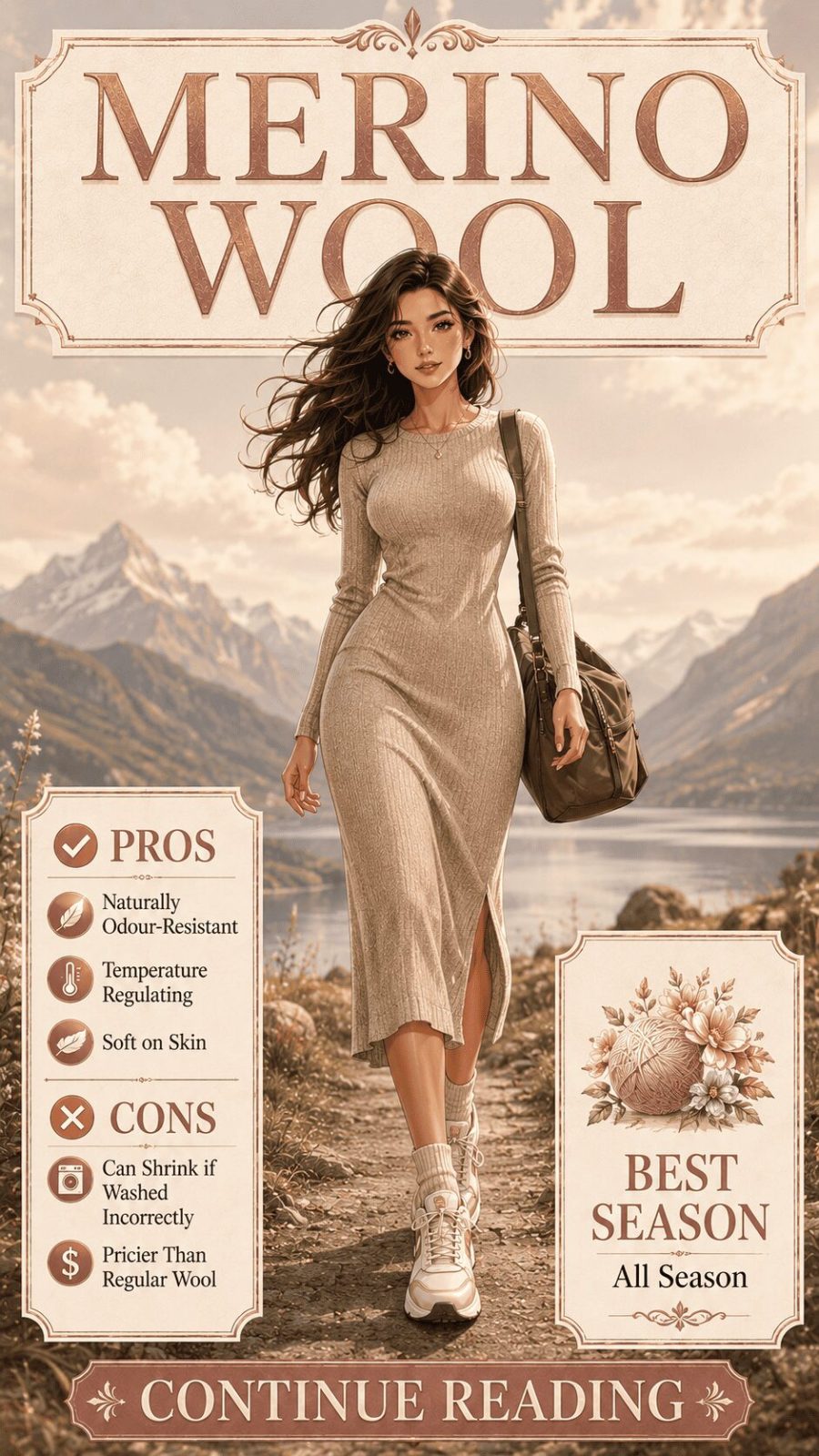
      Merino Wool

      Merino Wool Fabric for Women's Clothing

      The finest category of conventional sheep's wool — fibres under 24 microns, soft enough to wear directly against skin without the itch that coarser wools produce. Merino's exceptional properties include natural odour resistance (allowing multi-wear between washes), temperature regulation across a surprisingly broad range, and a moisture management system that wicks sweat away while retaining warmth. The travel wardrobe's best friend.

      DesignFine, smooth, next-to-skin soft, minimal itch
      SeasonYear-round by weight (ultra-fine in spring/summer)
      Best ForBase layers, travel tops, lightweight sweaters, activewear layers
    1. 19

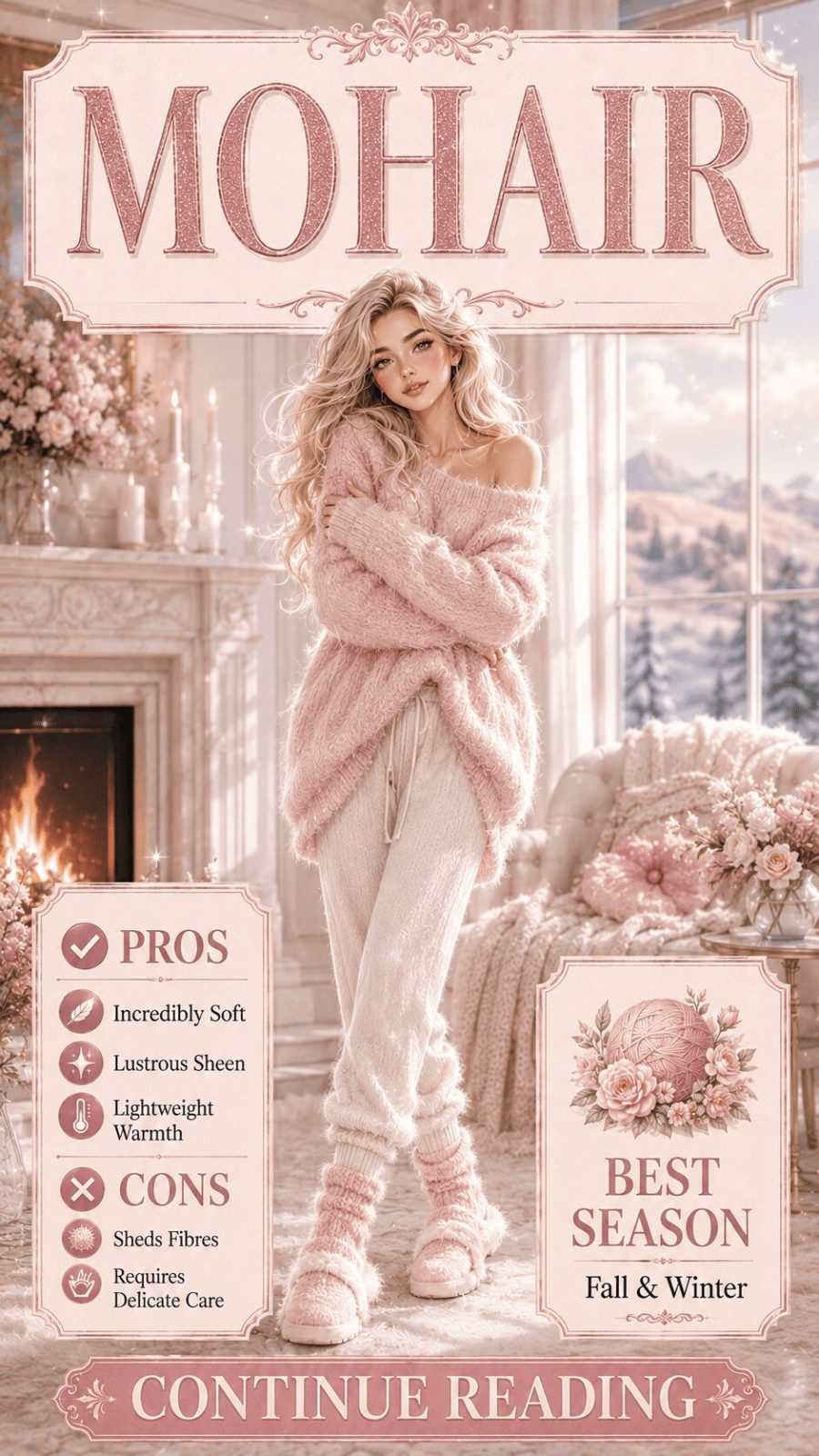
      Mohair

      Mohair Fabric for Women's Clothing

      Shorn from Angora goats (not to be confused with Angora rabbits), mohair is one of the most glamorous fibres in knitwear. Its long, smooth filaments don't felt like wool — they maintain a brilliant sheen and create that distinctive fluffy halo that catches light dramatically. Lightweight for its warmth level, durable, and increasingly central to high-fashion knitwear collections from Acne Studios to Bottega Veneta.

      DesignLuminous sheen, prominent fluffy halo, lightweight warmth
      SeasonAutumn / Winter
      Best ForStatement sweaters, cardigans, textural coats, evening knitwear
    2. 20

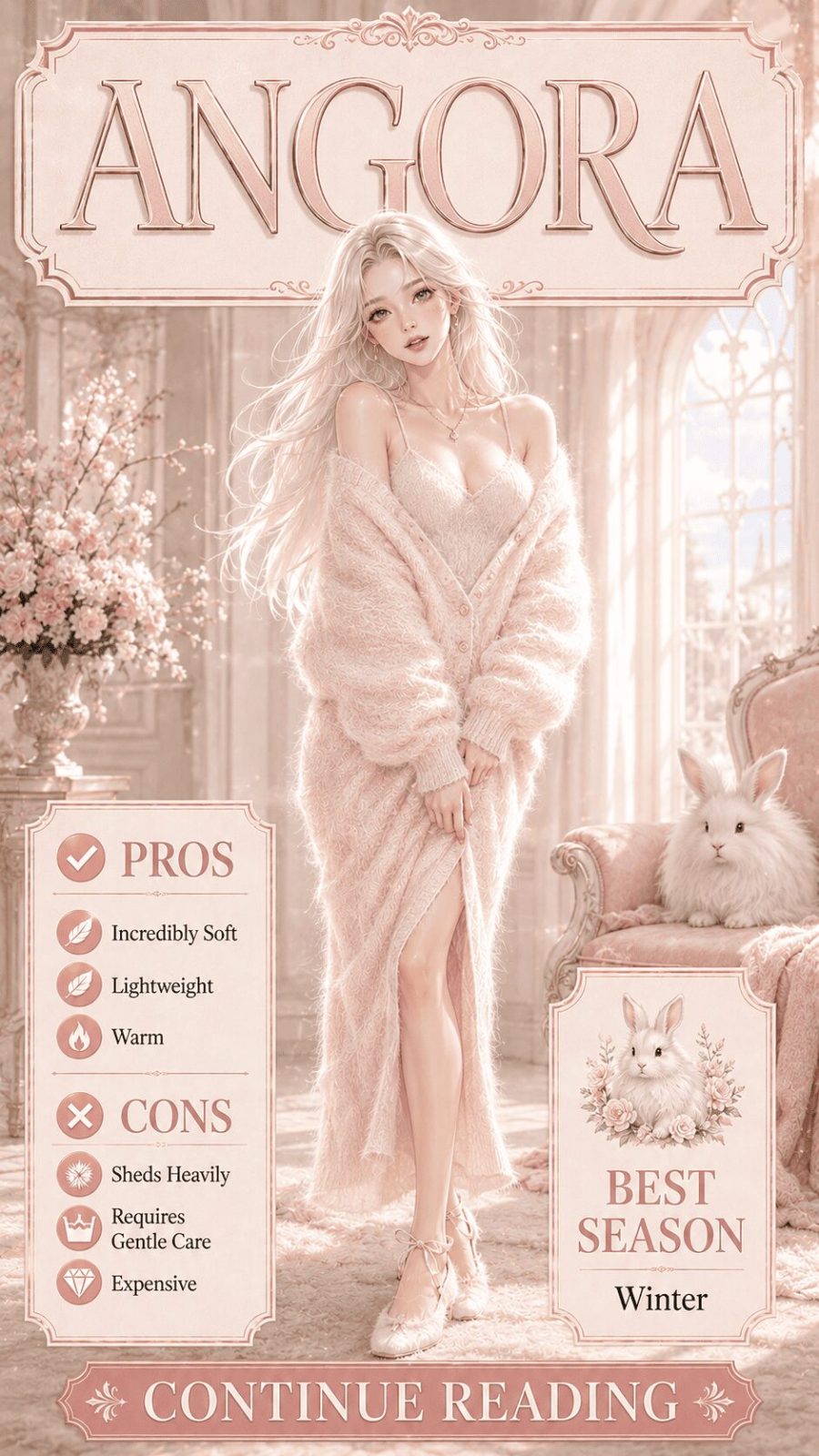
      Angora

      Angora Fabric for Women's Clothing

      Harvested from Angora rabbits, angora fibre is extraordinarily fine and soft — finer even than cashmere at its finest grades. The hollow core structure provides remarkable insulation with minimal weight. Pure angora sheds, which is why most commercial angora is blended with wool or nylon at 20-40% to improve durability and reduce fibre loss. Primarily used as an accent or blend fibre in luxury knitwear.

      DesignUltra-fine, extremely soft, pronounced fluffy halo, sheds without blend
      SeasonWinter
      Best ForLuxury knitwear accents, winter tops, tactile statement pieces
    1. 21

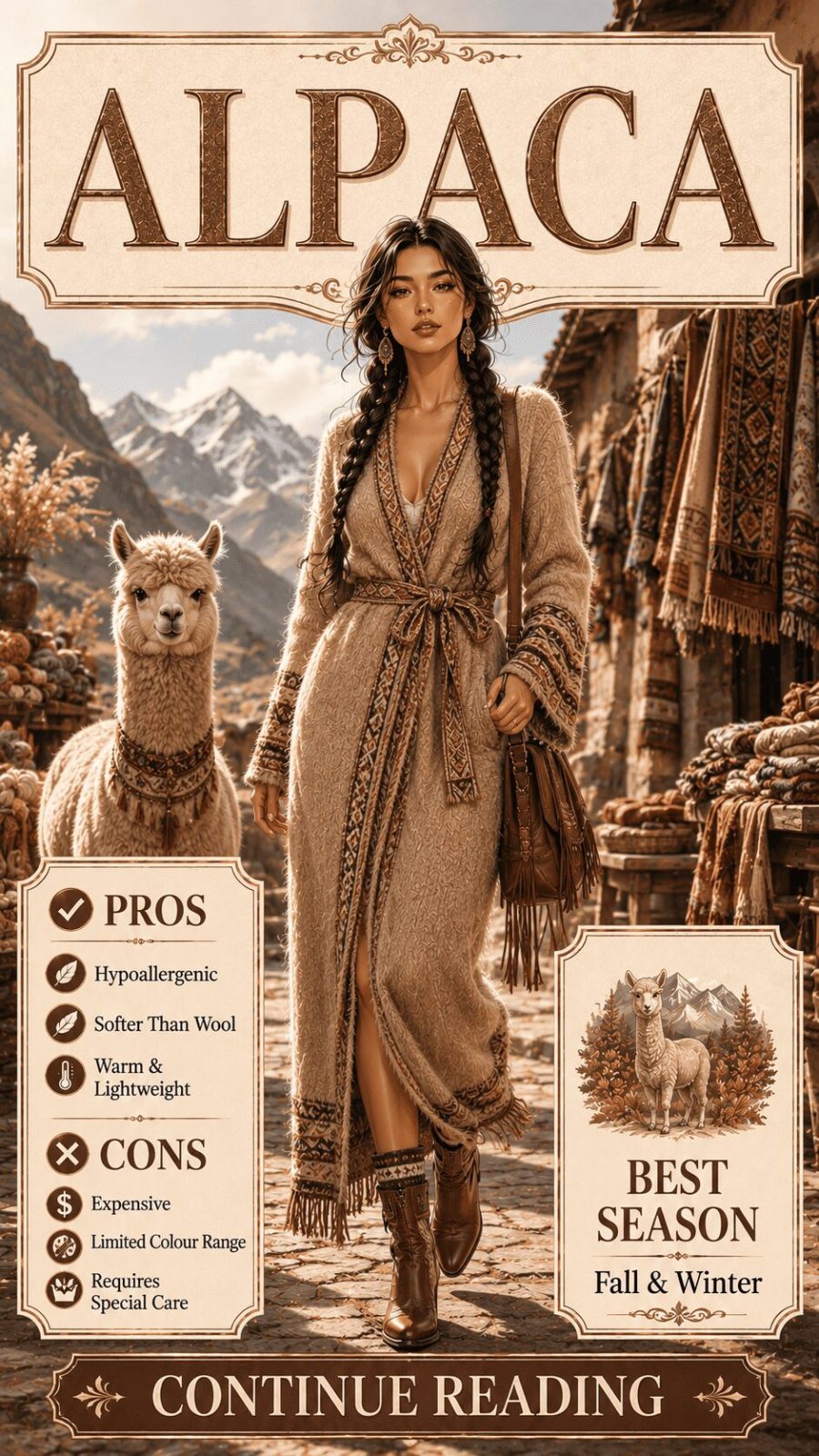
      Alpaca

      Alpaca Fabric for Women's Clothing

      A protein fibre from the South American alpaca — lighter than sheep's wool, warmer by comparison, and naturally free of lanolin (which is what makes standard wool itch for some wearers). The fibre contains microscopic air pockets that create insulation without weight. Baby alpaca — from the first shearing — is the finest and softest grade, producing a luxurious hand comparable to cashmere at a more approachable price point.

      DesignSoft, slight sheen, lightweight warmth, lanolin-free
      SeasonAutumn / Winter
      Best ForSweaters, scarves, coats; ideal for wool-sensitive wearers
    2. 22

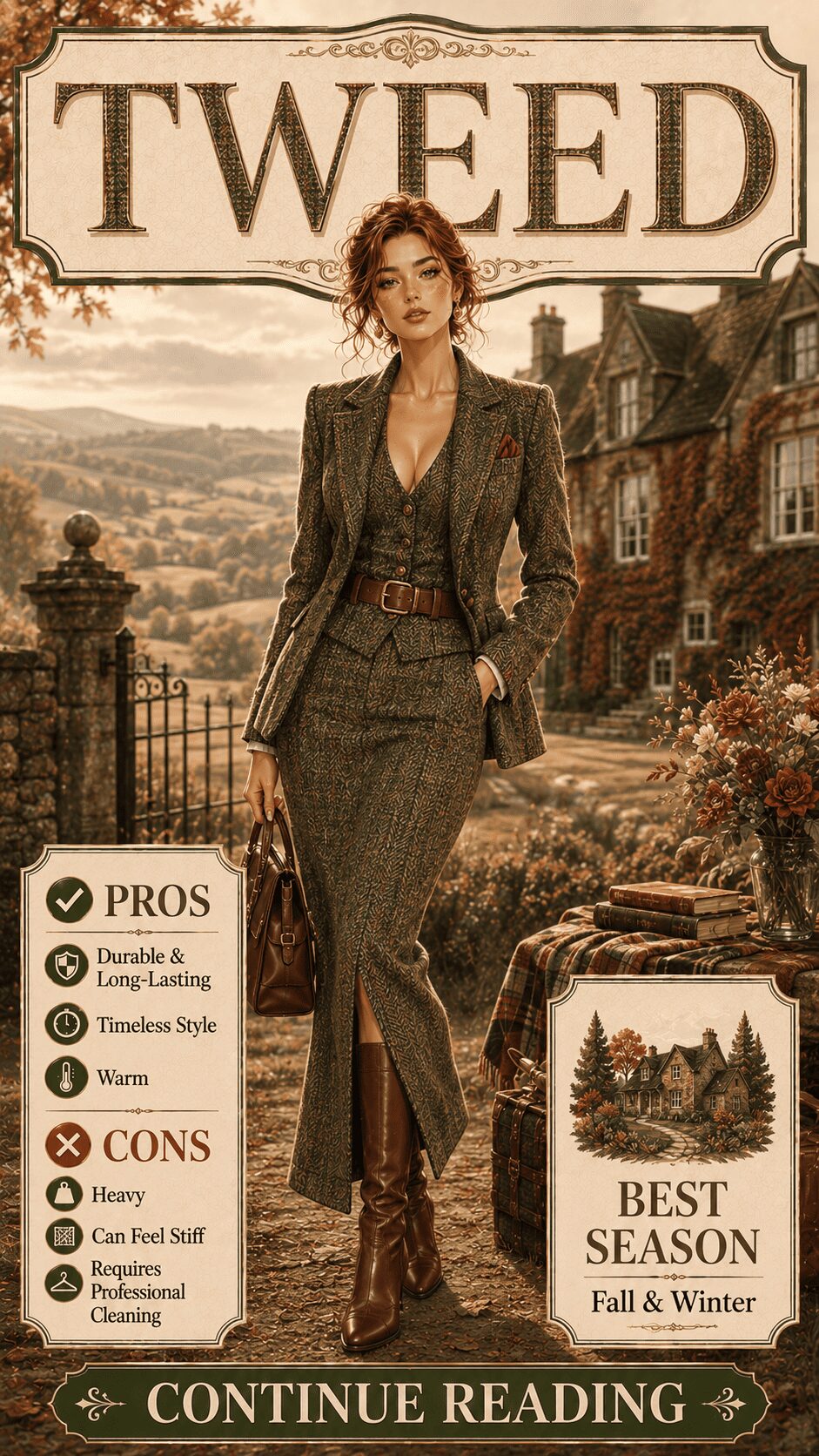
      Tweed

      Tweed Fabric for Women's Clothing

      A rough-surfaced woollen cloth, traditionally hand-woven in Scotland and Ireland, with a distinctive nubby texture from irregular yarns. Herringbone, houndstooth, and plain colour-speckled tweeds are the most recognizable patterns. Chanel's appropriation of tweed in the 1920s transformed it from workwear to luxury fashion — a status it has held for a century. Heavy and insulating, with a structured drape that tailors beautifully.

      DesignNubby texture, multi-colour speckled yarns, structured hand
      SeasonAutumn / Winter
      Best ForJackets, skirts, blazers, structured coats
    1. 23

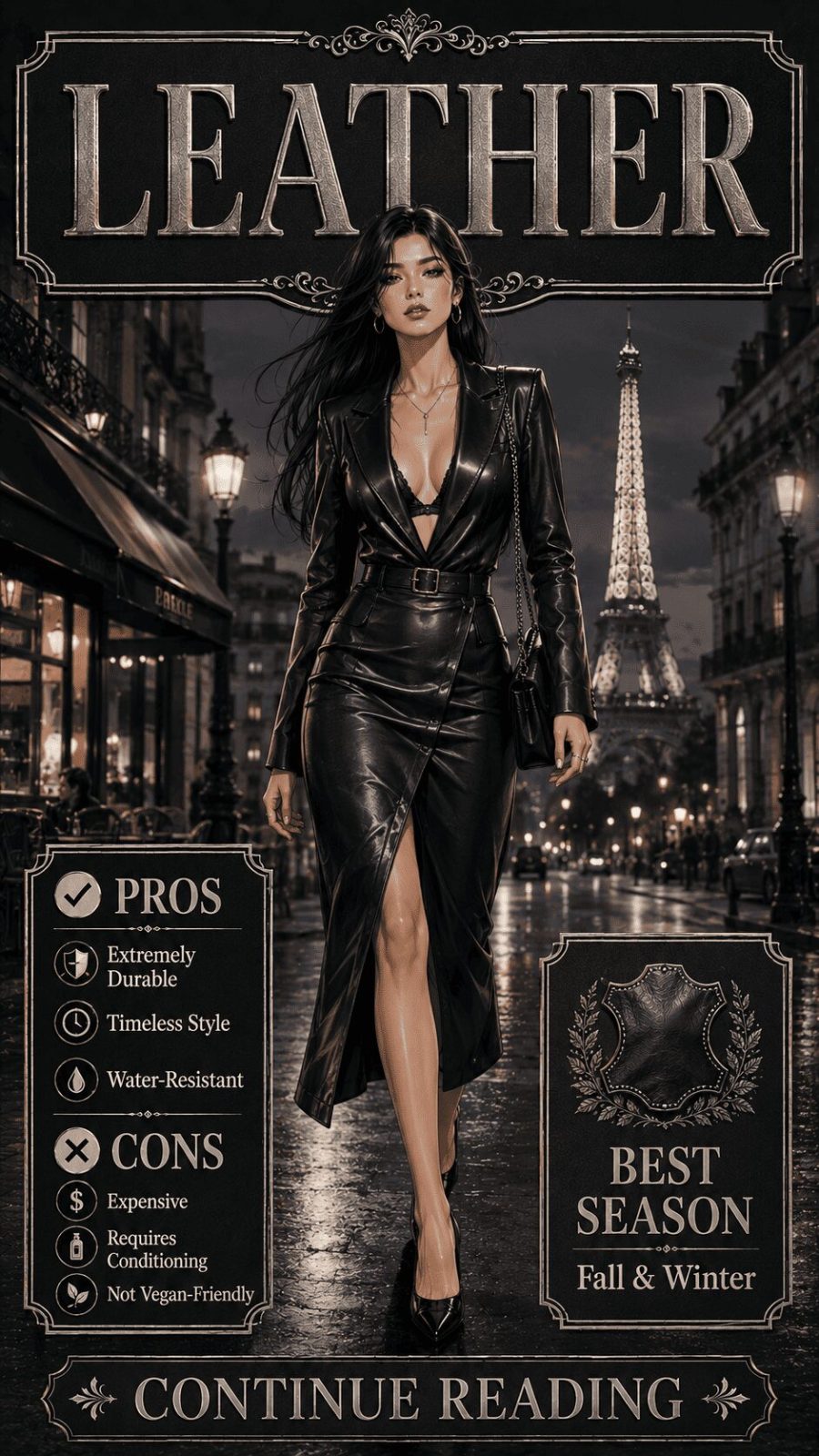
      Leather

      Leather Fabric for Women's Clothing

      Animal hide — most commonly cattle, though lamb, deer, and goat are also used — preserved through tanning. Full-grain leather retains the original hide surface and develops a rich patina over time. Top-grain has the surface buffed for uniformity. Suede is the underside of the hide, with a soft nap. Leather's zero-stretch structure, durability, and tactile authority make it genuinely irreplaceable in fashion — and very much worth learning the grades of before purchasing.

      DesignSmooth or napped surface, zero stretch, develops patina with age
      SeasonAutumn / Winter (lambskin in mild Spring)
      Best ForJackets, skirts, trousers, bags, boots, statement pieces
    2. 24

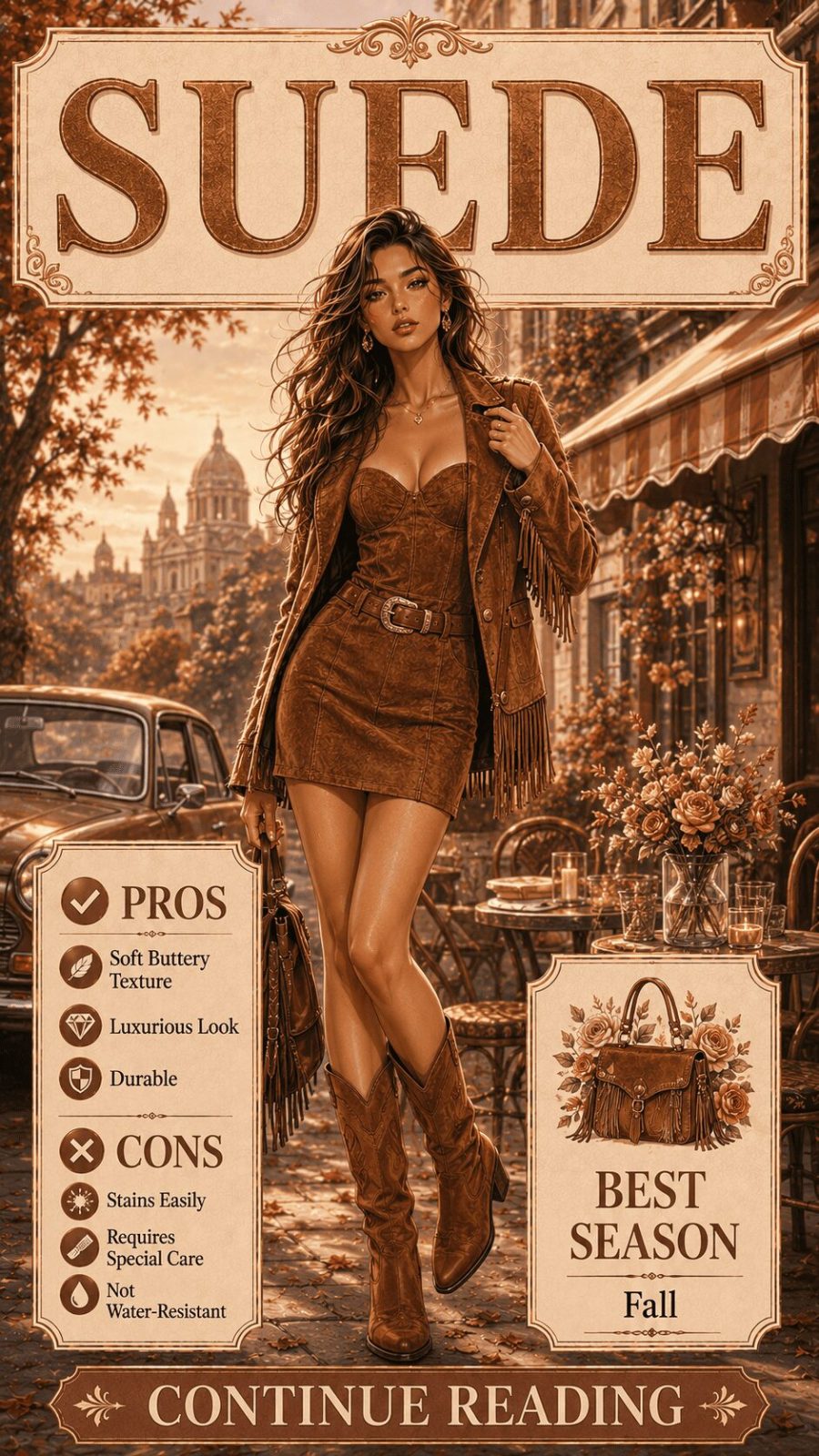
      Suede

      Suede Fabric for Women's Clothing

      The inner split of leather — buffed to raise a soft, velvety nap. Suede is softer and more pliable than full-grain leather but significantly less water-resistant. Its matte finish and tactile surface create a quieter, more refined aesthetic than polished leather. Particularly associated with 1970s bohemian fashion and luxury accessories. Requires specific care: suede protector spray applied before first wear is essential, not optional.

      DesignSoft nap, matte finish, supple and pliable hand
      SeasonAutumn (dry days) / Winter (with care)
      Best ForJackets, skirts, ankle boots, bags, bohemian-luxe pieces

    Category 3: Semi-Synthetic / Regenerated Fibres (#25–#34)

    Natural cellulose transformed through chemistry — the middle ground between plant fibres and full synthetics

    1. 25

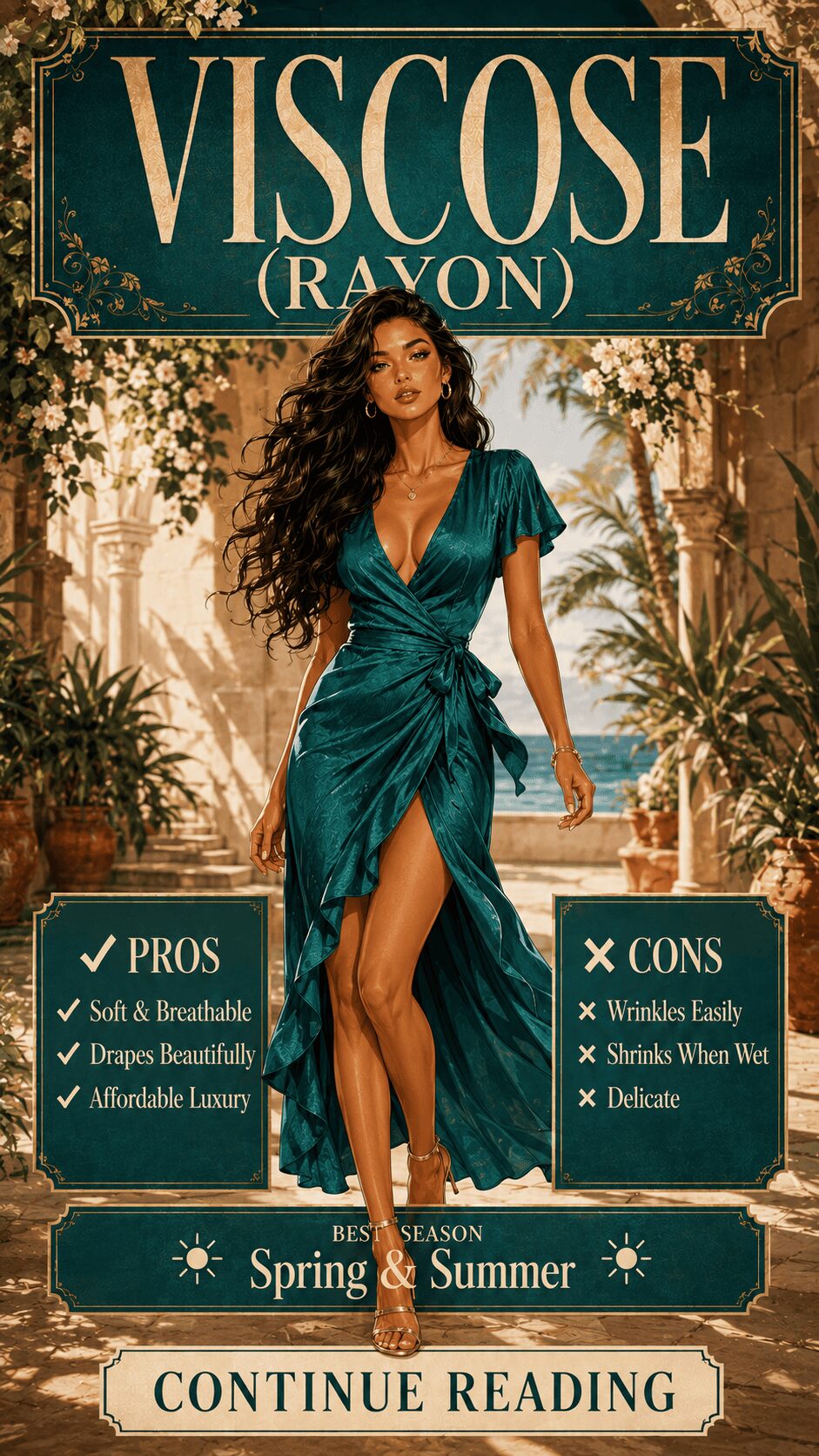
      Viscose (Rayon)

      Viscose Rayon Fabric for Women's Clothing

      Produced from dissolved wood cellulose, regenerated into smooth continuous fibres. The result is fabric with a silk-like drape, lovely breathability, and an excellent ability to absorb dye in vivid, saturated colours — at a fraction of silk's cost. The trade-off? It weakens significantly when wet, can stretch out of shape, and wrinkles readily. Understanding this helps enormously when shopping: look for ECOVERO or FSC-certified viscose if sustainability matters to you.

      DesignSilky drape, vibrant colour absorption, soft hand, fluid fall
      SeasonSpring / Summer
      Best ForBlouses, summer dresses, maxi skirts, printed casual wear
    2. 26

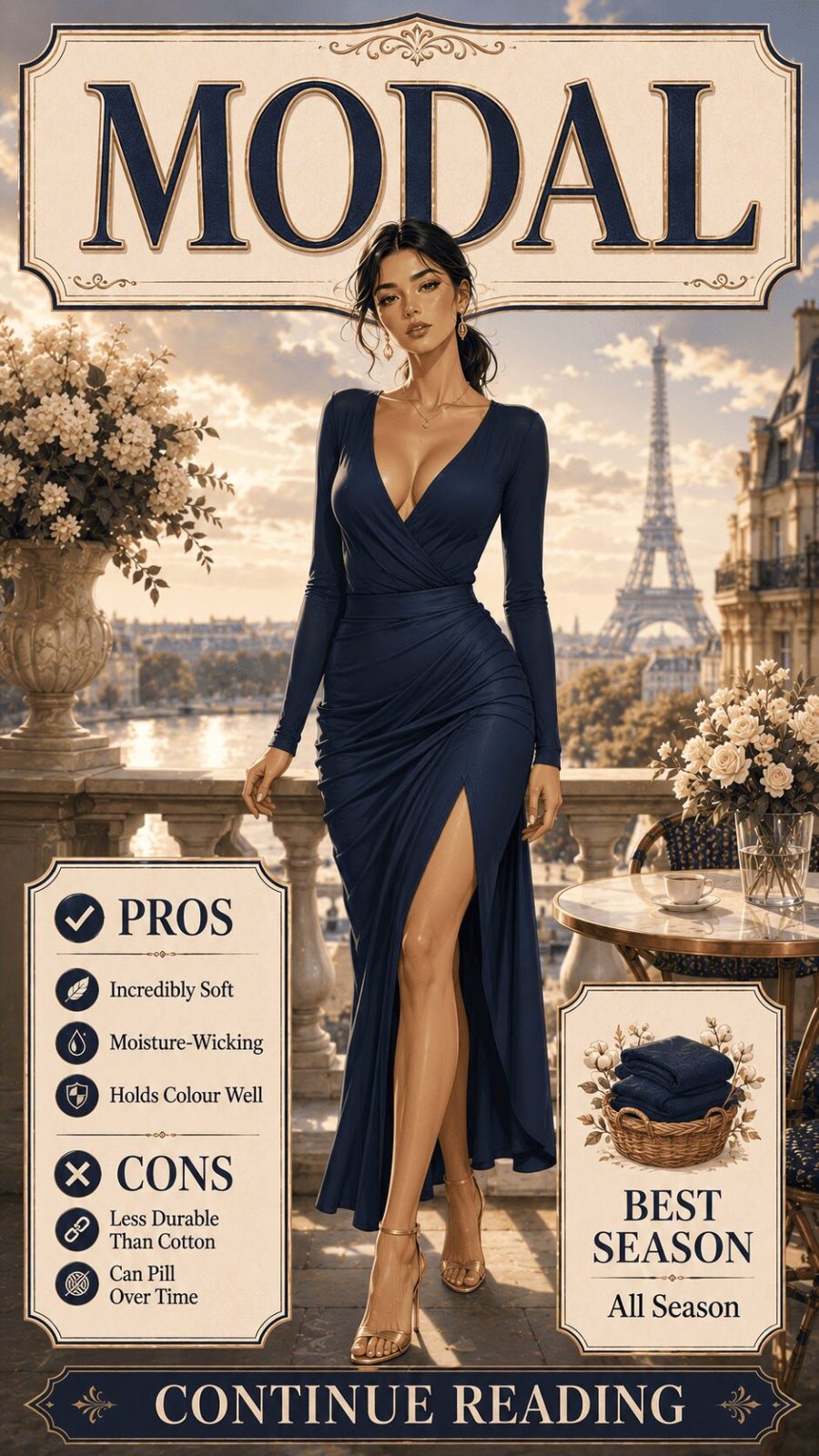
      Modal

      Modal Fabric for Women's Clothing

      A second-generation viscose derived from beechwood pulp, processed to produce finer, stronger fibres than standard rayon. Modal has a cool, slightly silky surface that feels genuinely luxurious against skin — better wet-strength than viscose, better resistance to shrinkage, and significantly softer hand. Lenzing Modal (Austrian beechwood) is the benchmark quality grade. Commonly blended with cotton or spandex in everyday basics and underwear.

      DesignCool, silky touch, excellent drape, softer than cotton
      SeasonYear-round
      Best ForT-shirts, loungewear, fitted tops, underwear, everyday basics
    1. 27

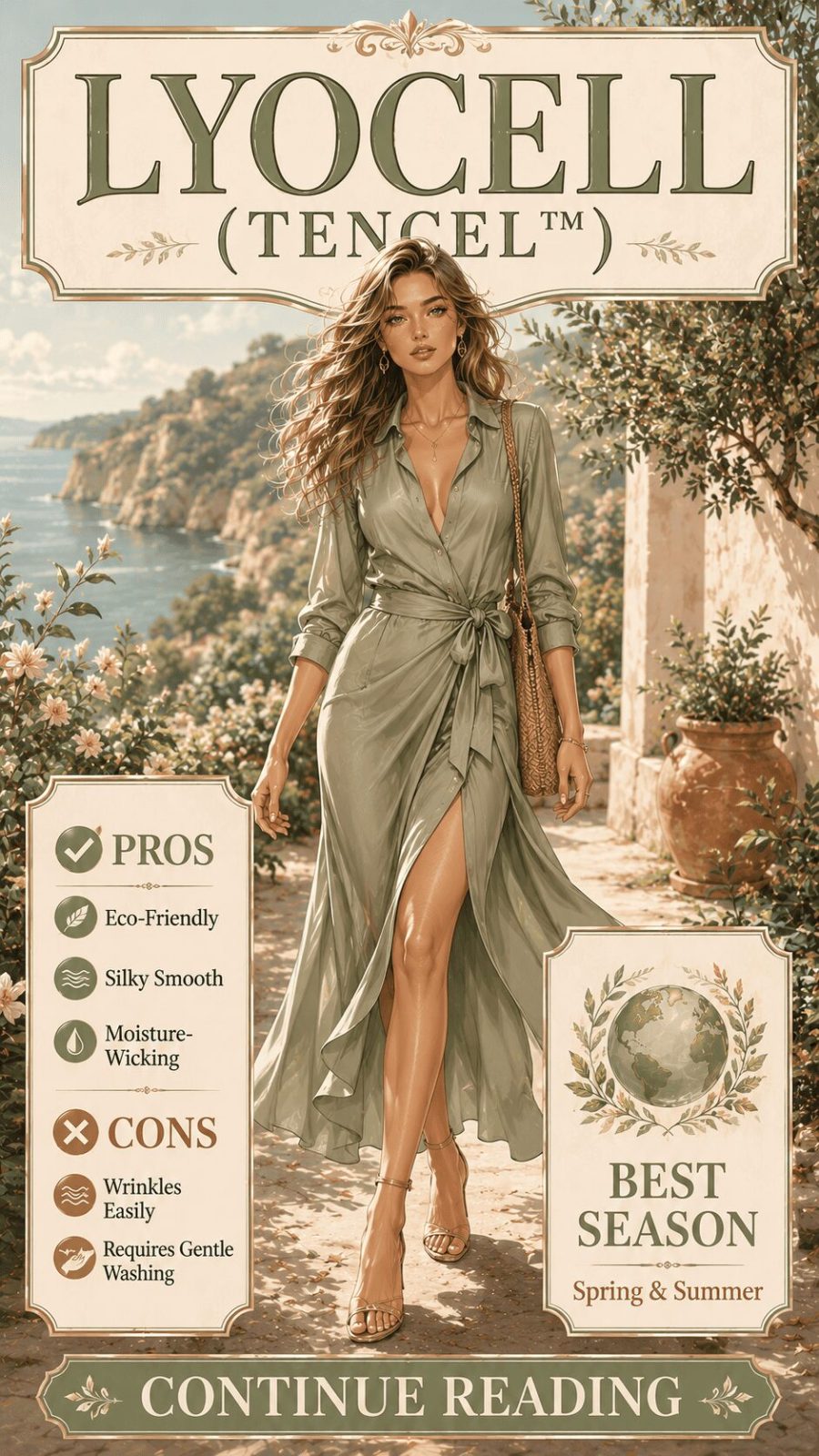
      Lyocell (Tencelâ„¢)

      Lyocell Tencel Fabric for Women's Clothing

      Produced in a closed-loop solvent process where 99% of the spinning liquid is recycled — making it substantially more environmentally responsible than standard viscose. Tencel is Lenzing's brand name for their lyocell. The resulting fabric is smooth, breathable, incredibly soft, and has strong wet-strength. It drapes beautifully with a natural, subtle sheen. Its moisture-wicking properties make it genuinely practical for all-day wear in warm conditions.

      DesignSmooth, subtle sheen, soft drape, strong wet-strength
      SeasonAll seasons
      Best ForSustainable basics, blouses, dresses, trousers, activewear blends
    2. 28

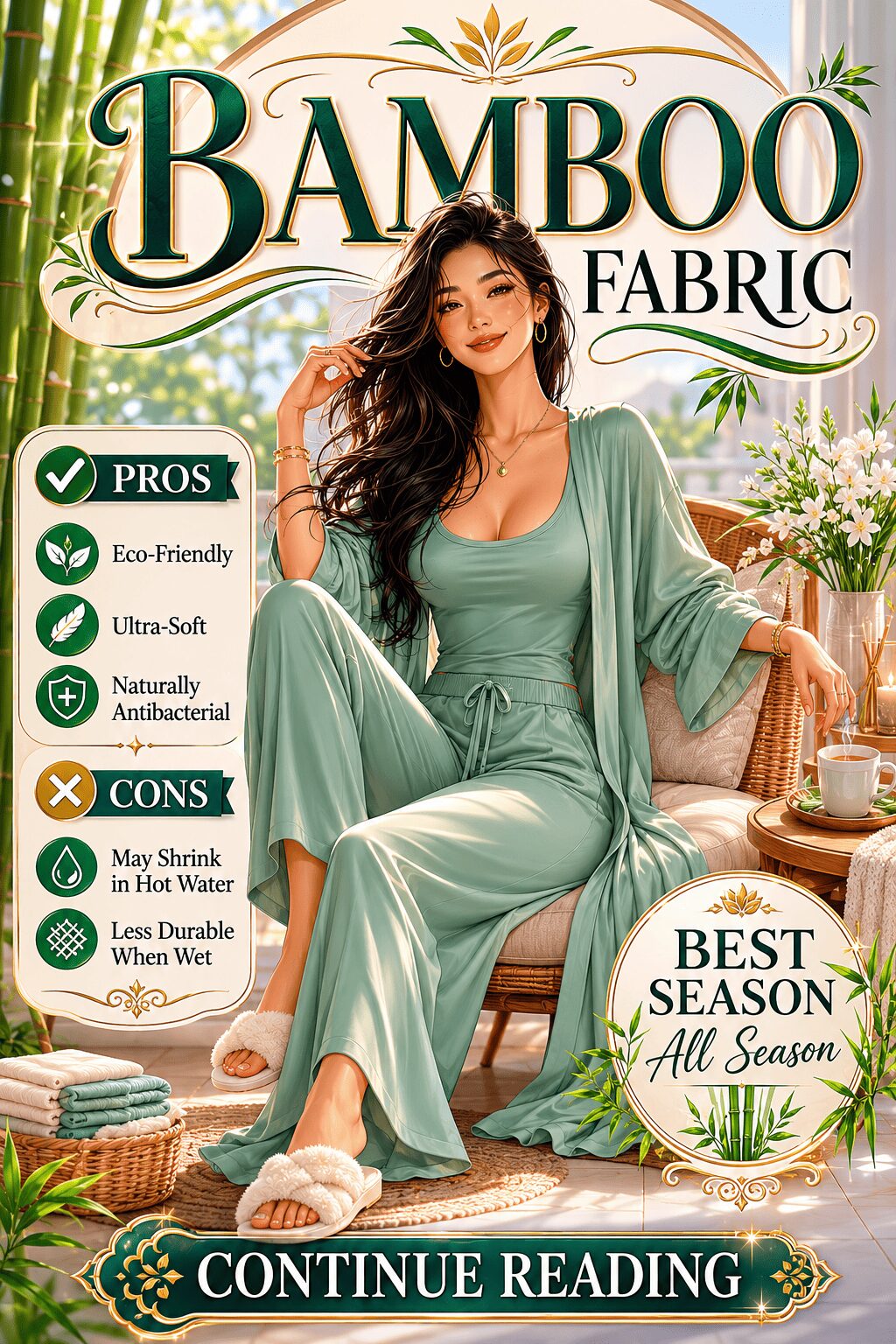
      Bamboo Fabric

      Bamboo Fabric for Women's Clothing

      Most commercial bamboo fabric is a bamboo-derived viscose — cellulose extracted from bamboo and processed using the same chemical method as rayon. True mechanically processed bamboo (bamboo linen) is rare and expensive. Bamboo viscose is genuinely soft and breathable but the "eco" credentials depend heavily on processing method. The plant itself is remarkably sustainable (fast-growing, no pesticides); the chemical processing is where the environmental variable sits.

      DesignSilky soft, cool touch, breathable, slight natural sheen
      SeasonYear-round; especially summer
      Best ForLoungewear, basics, activewear, sensitive skin garments
    1. 29

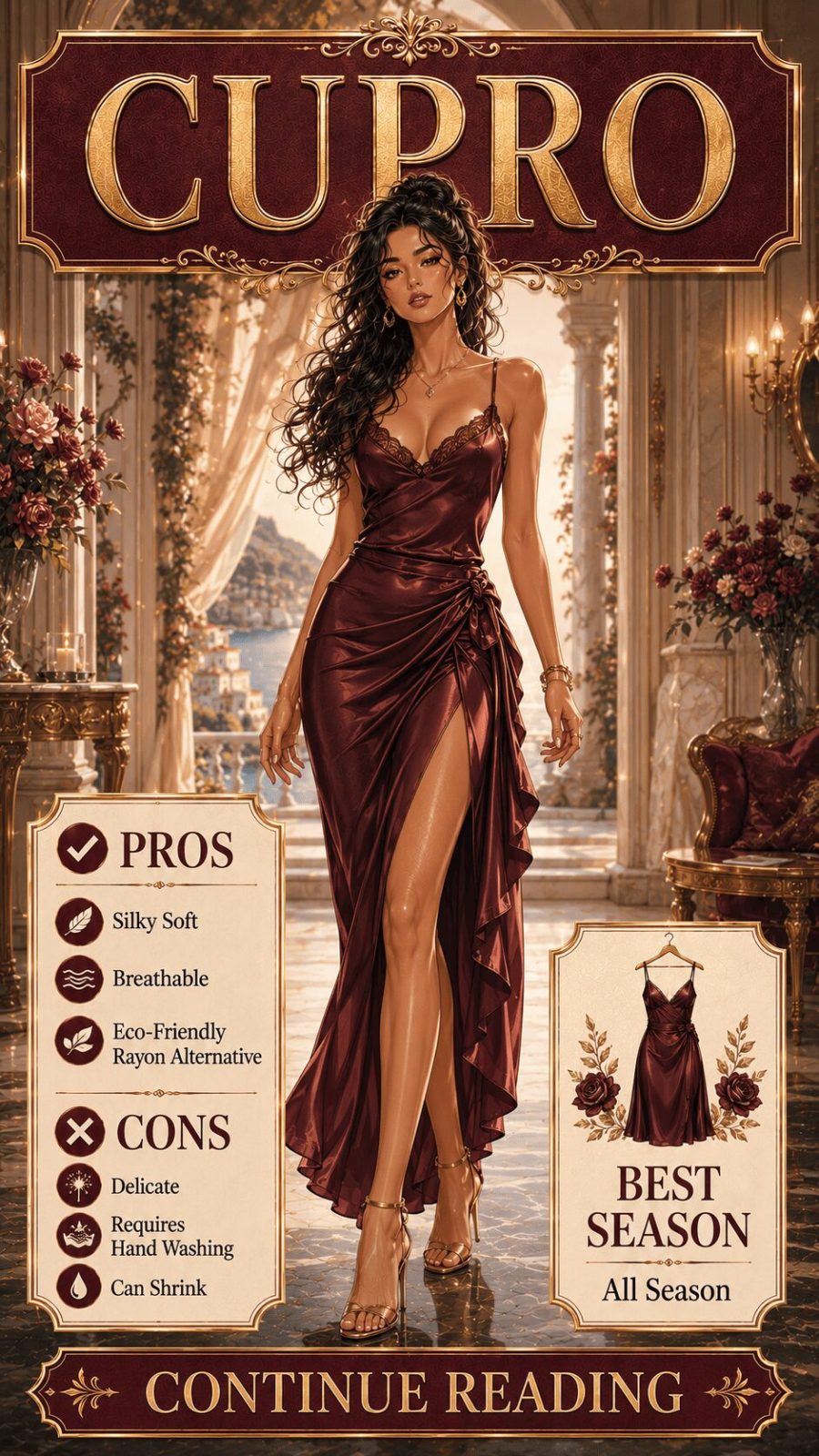
      Cupro

      Cupro Fabric for Women's Clothing

      Regenerated from cotton linter — the short fibres too fine to spin conventionally, dissolved in a copper-ammonia solution and regenerated into smooth filaments. The result is often used as a lining fabric (it's breathable where polyester lining is stifling) and in lightweight, fluid outer garments. Cupro falls, drapes, and feels remarkably similar to silk. An underappreciated fabric that often appears in better-quality ready-to-wear without being called out by name.

      DesignSilk-like drape and hand, lightweight, breathable, cool touch
      SeasonSpring / Summer; lining year-round
      Best ForLinings, blouses, dresses, lightweight evening pieces
    2. 30

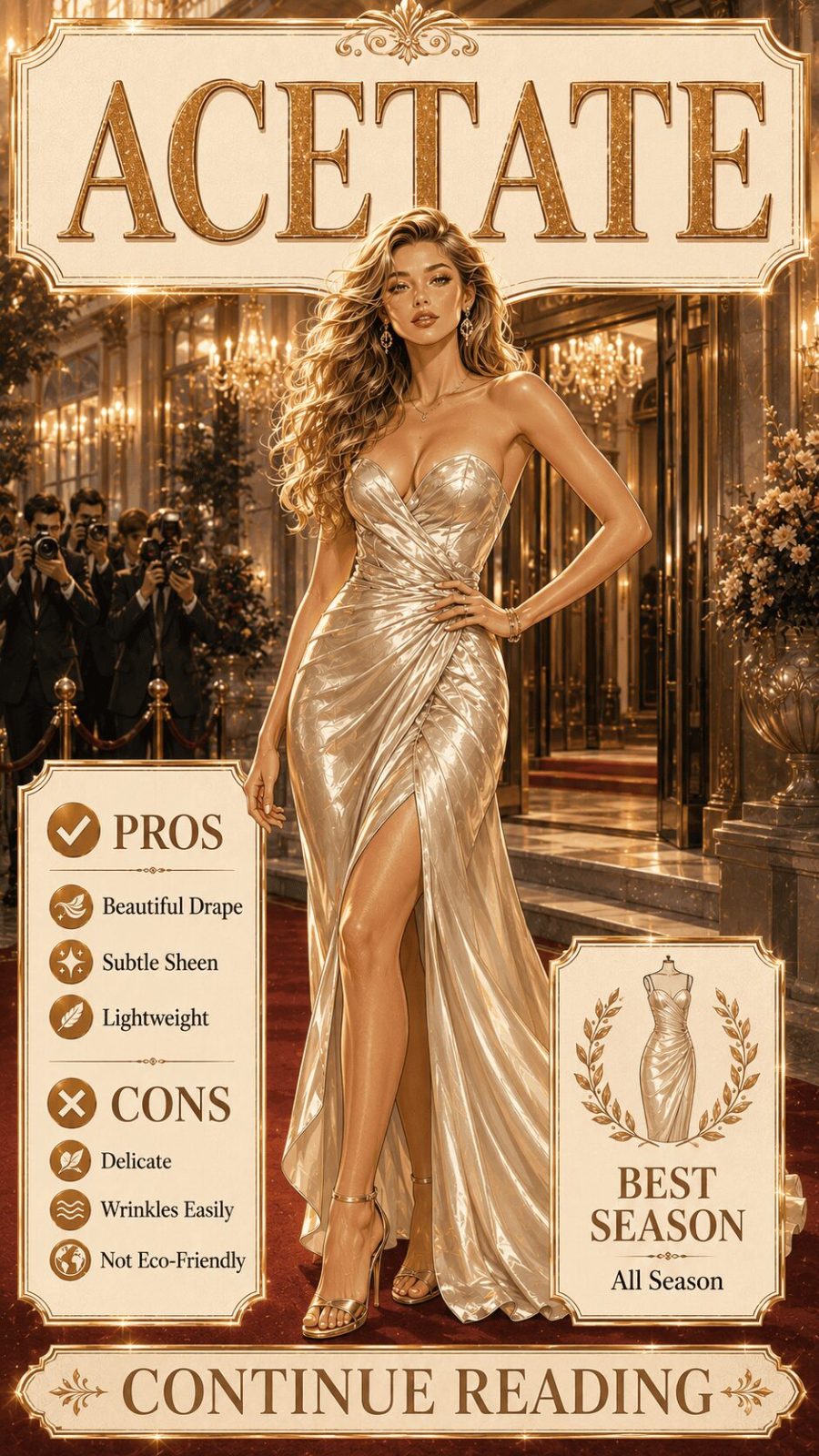
      Acetate

      Acetate Fabric for Women's Clothing

      Produced from wood pulp cellulose chemically modified with acetic acid. The resulting fibre has a high-lustre, silk-like appearance and drapes smoothly — which is why it became the go-to lining fabric for tailored garments from the 1930s onwards. Its key weakness: heat sensitivity. Acetate shrinks with hot water and will dissolve with acetone (nail polish remover). Always check care labels carefully with acetate garments.

      DesignHigh lustre, silky appearance, smooth drape, lightweight
      SeasonAll seasons as lining
      Best ForLinings, eveningwear, structured dresses, satin-look pieces
    1. 31

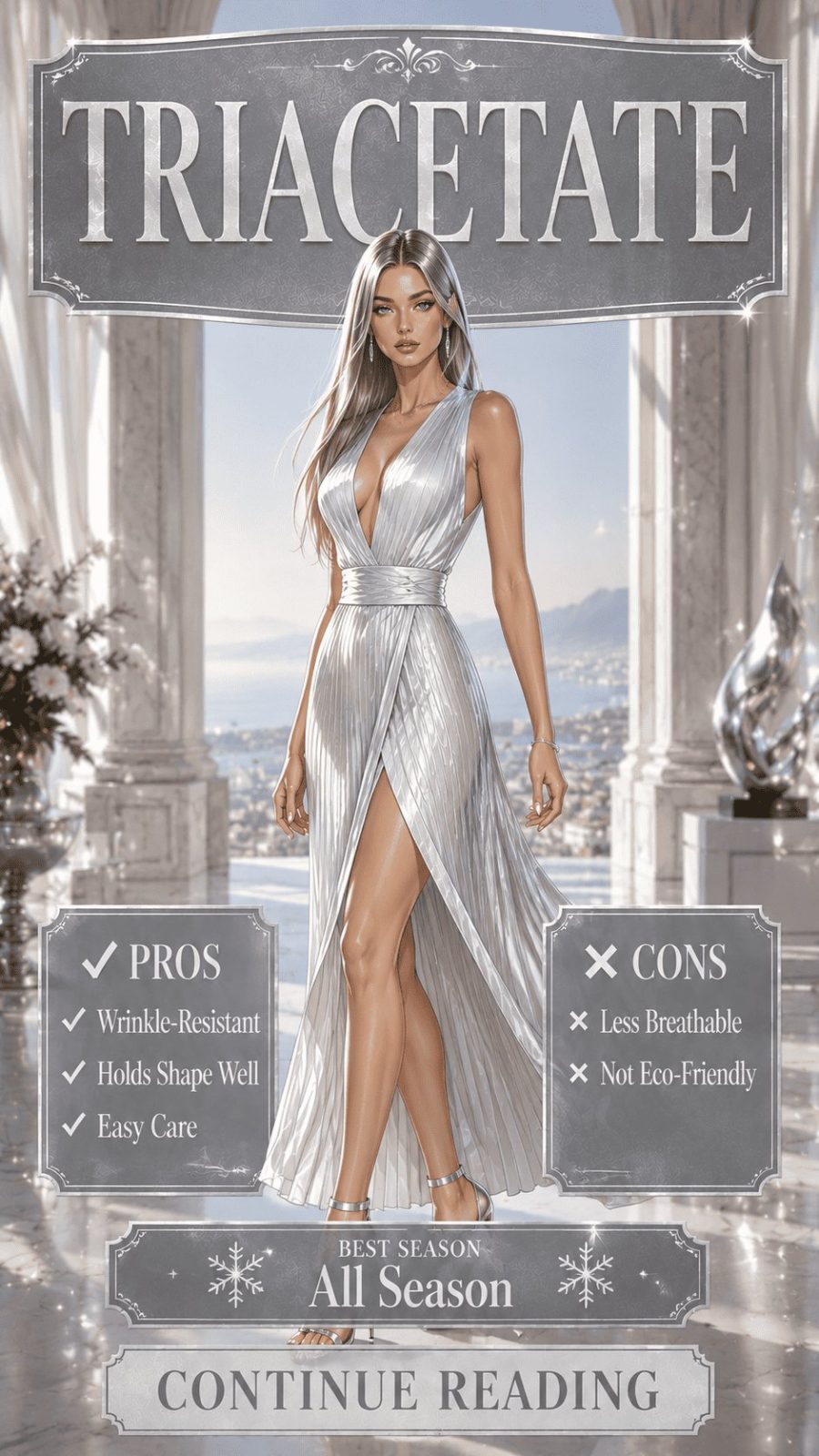
      Triacetate

      Triacetate Fabric for Women's Clothing

      An improved version of acetate with higher heat resistance — meaning it can actually be machine-washed and tumble-dried at low temperature without catastrophic shrinkage. This greater chemical modification creates a fabric that resists wrinkling, holds pleats exceptionally well, and maintains its crisp surface through repeated wearing. Often used in pleated skirts and structured evening pieces where pleat retention is critical.

      DesignCrisp, pleat-retaining, wrinkle-resistant, slightly stiffer than acetate
      SeasonAll seasons
      Best ForPleated skirts, structured eveningwear, easy-care formal garments
    2. 32

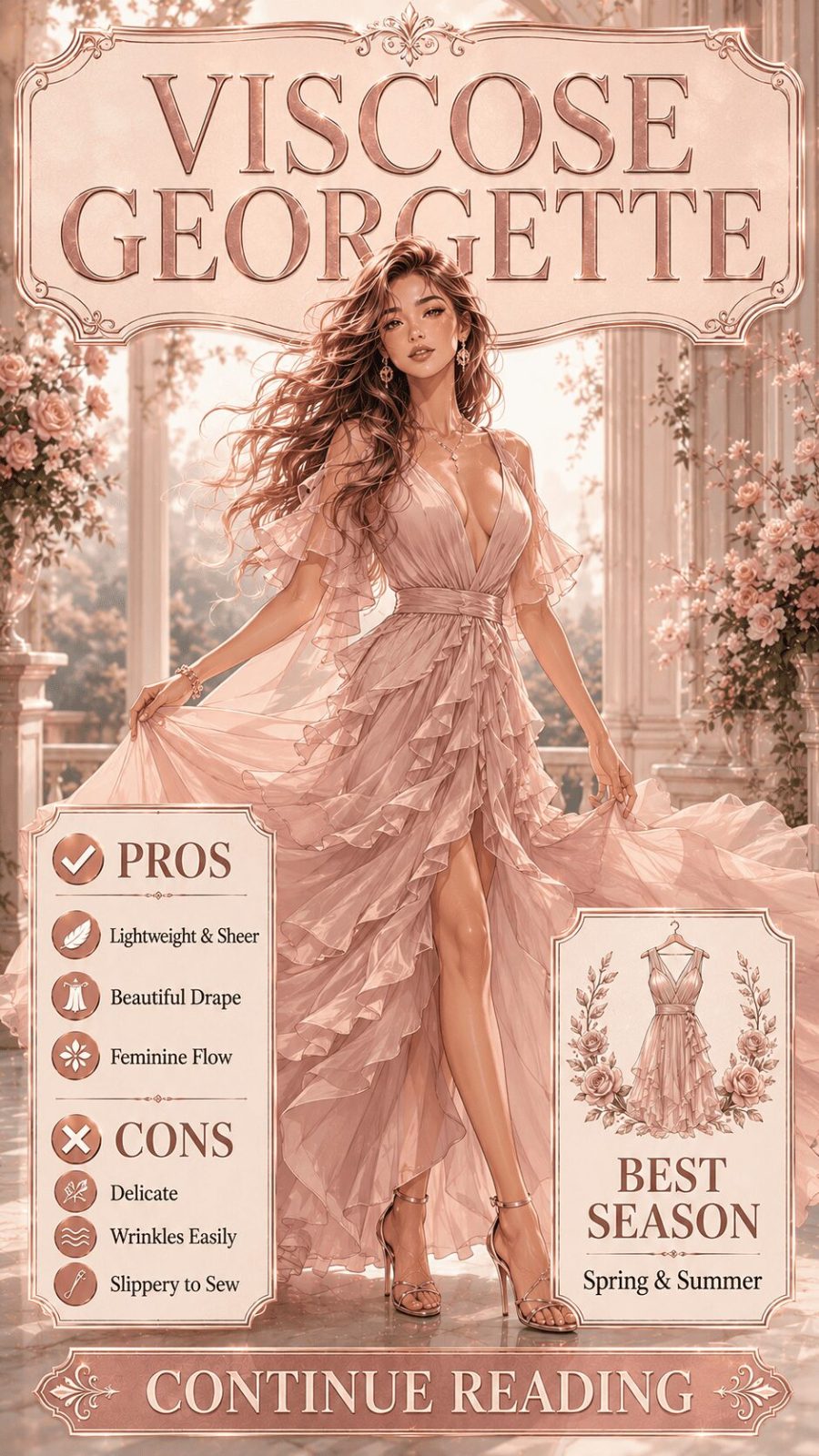
      Viscose Georgette

      Viscose Georgette Fabric for Women's Clothing

      A lightweight, slightly crepe-like fabric created by weaving highly twisted viscose yarns. The crinkled surface creates a matte finish quite different from silk georgette — less sheer, less refined, but more accessible and still beautifully fluid. Viscose georgette appears extensively in Indian blouses, summer dresses, and occasion tops where movement and drape are more important than structure.

      DesignCrepe texture, matte finish, fluid drape, slightly crinkled surface
      SeasonSpring / Summer
      Best ForTops, dresses, kurtis, occasion blouses, ethnic garments
    1. 33

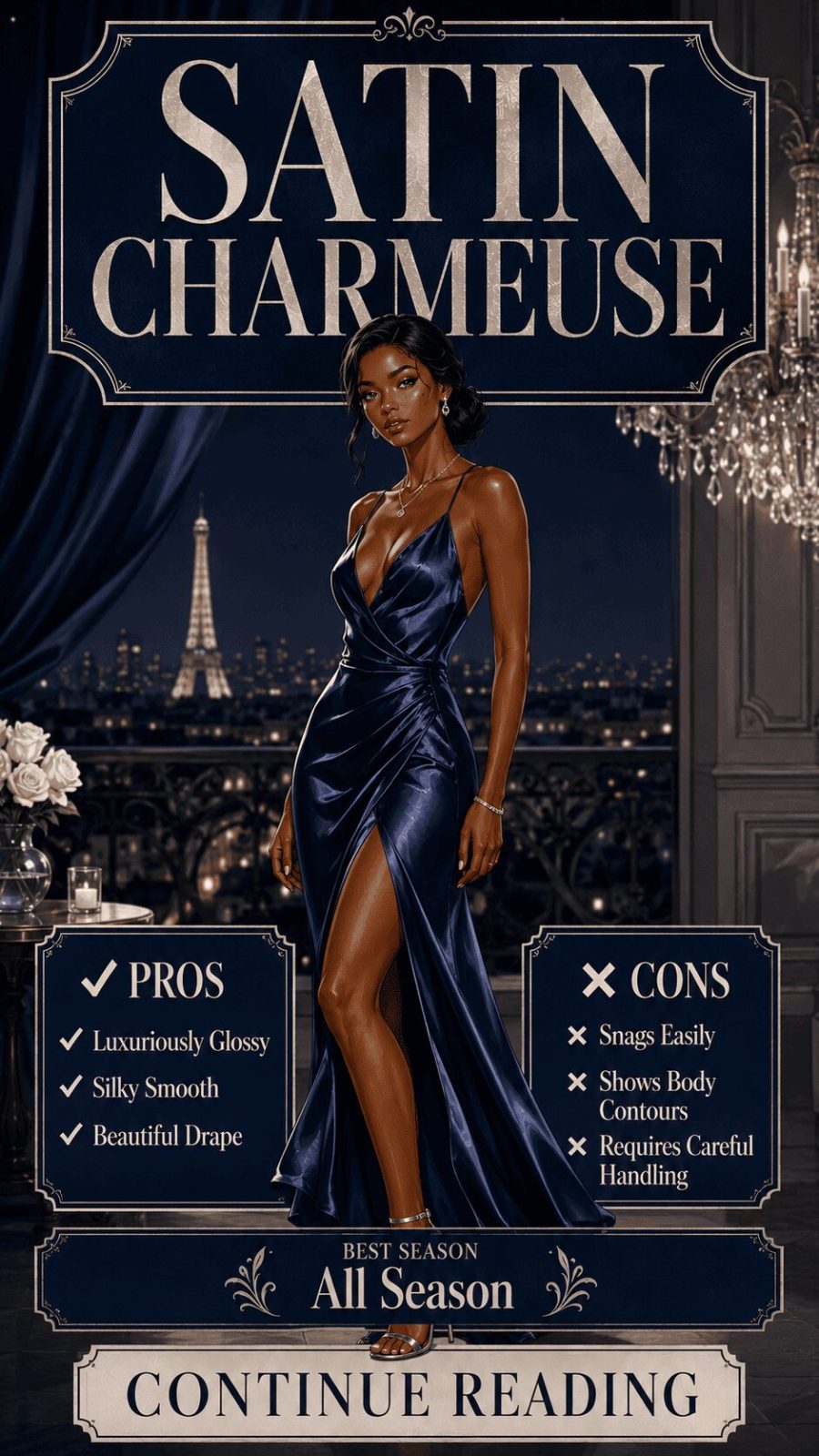
      Satin Charmeuse

      Satin Charmeuse Fabric for Women's Clothing

      A lightweight satin-weave fabric — often produced in silk but increasingly in polyester or viscose — with a lustrous face and matte reverse. Charmeuse is softer and more fluid than standard satin; it clings rather than standing away from the body. The tactile combination of cool smoothness and fluid movement makes it a default for slip dresses, bias-cut garments, and anything designed to play with body contour rather than conceal it.

      DesignHigh-lustre face, matte reverse, fluid and clinging drape
      SeasonSpring / Summer / Evening year-round
      Best ForSlip dresses, bias-cut garments, evening blouses, lingerie-inspired tops
    2. 34

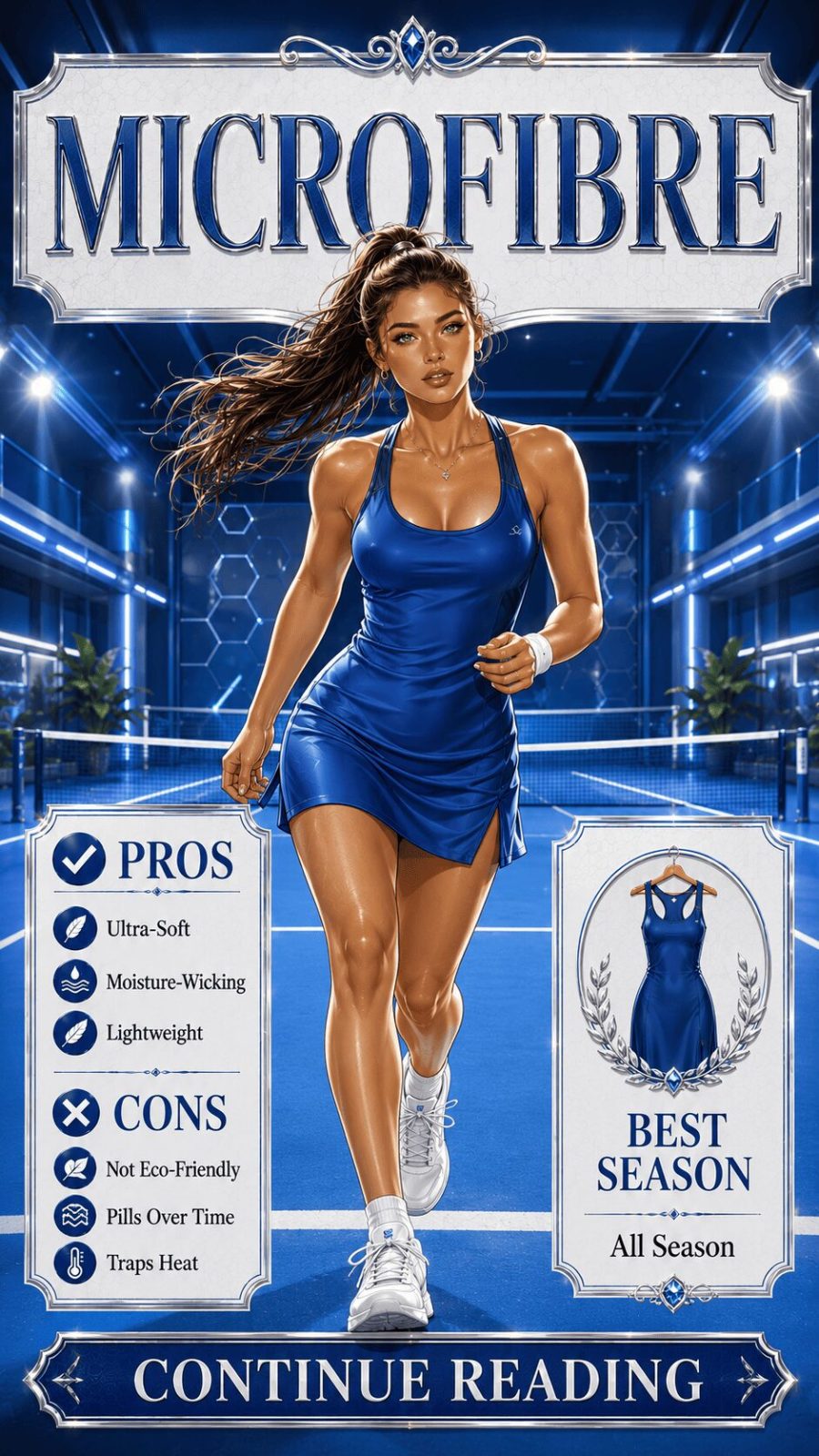
      Microfibre

      Microfibre Fabric for Women's Clothing

      Technically a fibre category rather than a single material — microfibres are any synthetic fibres measuring less than one denier (finer than silk). Most commonly polyester or nylon, microfibre fabrics achieve extraordinary softness, compressibility, and moisture management through fibre fineness rather than fibre type. The trade-off: every wash releases microplastic particles into waterways — an environmental issue increasingly tracked by researchers.

      DesignUltra-soft hand, lightweight, often peach-skin or suede-like finish
      SeasonAll seasons
      Best ForActivewear, lingerie, sportswear, lightweight outer layers

    Category 4: Fully Synthetic Fibres (#35–#46)

    Engineered from petrochemicals — performance-driven, wrinkle-resistant, and ubiquitous in modern fashion

    Synthetics have a complicated reputation — and not entirely unfairly. But dismissing them entirely ignores the genuine performance advantages they offer. Polyester's wrinkle resistance is real. Nylon's durability is real. Elastane's stretch recovery is irreplaceable. The issue is their environmental cost and their tendency to feel uncomfortable in warm conditions. Understanding where synthetics genuinely outperform natural fibres makes you a better-informed consumer, not a compromised one. For garments focused on activewear and performance, synthetics often make genuine functional sense.

    1. 35

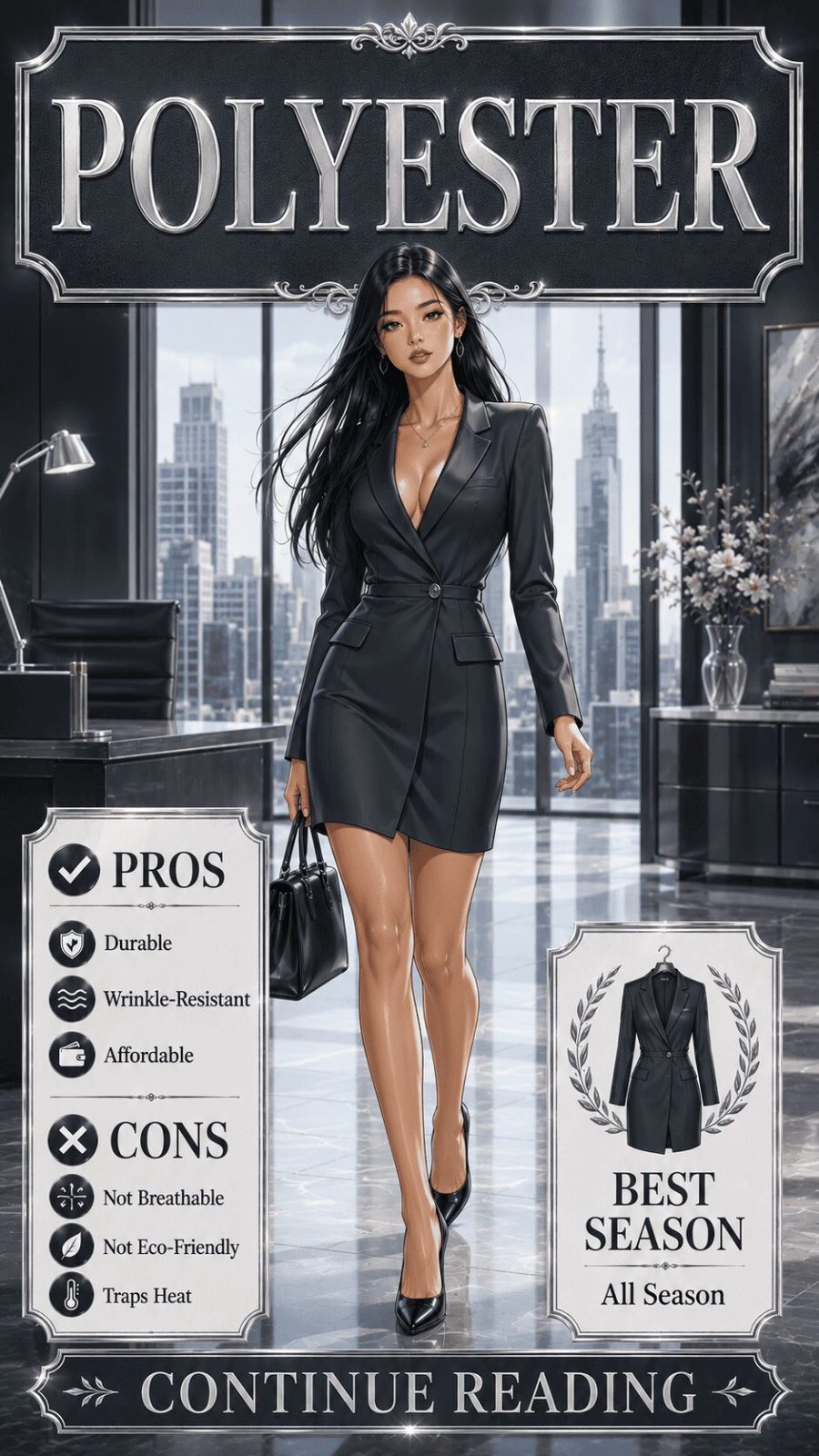
      Polyester

      Polyester Fabric for Women's Clothing

      The world's most widely produced synthetic fibre — derived from petroleum-based polyethylene terephthalate. Resistant to wrinkles, shrinkage, and most stains. Dries extremely quickly. Holds its shape indefinitely. These are real advantages. The disadvantages are equally real: limited breathability in heat, tendency to hold odour over time, and a significant environmental footprint both in production and (as microplastic shedding) in use. Recycled polyester (rPET) addresses some of these concerns partially.

      DesignWrinkle-resistant, holds colour well, range from sheer chiffon to thick ponte
      SeasonAll seasons; avoid in high summer heat
      Best ForTravel wear, activewear, blended fabrics, low-maintenance garments
    2. 36

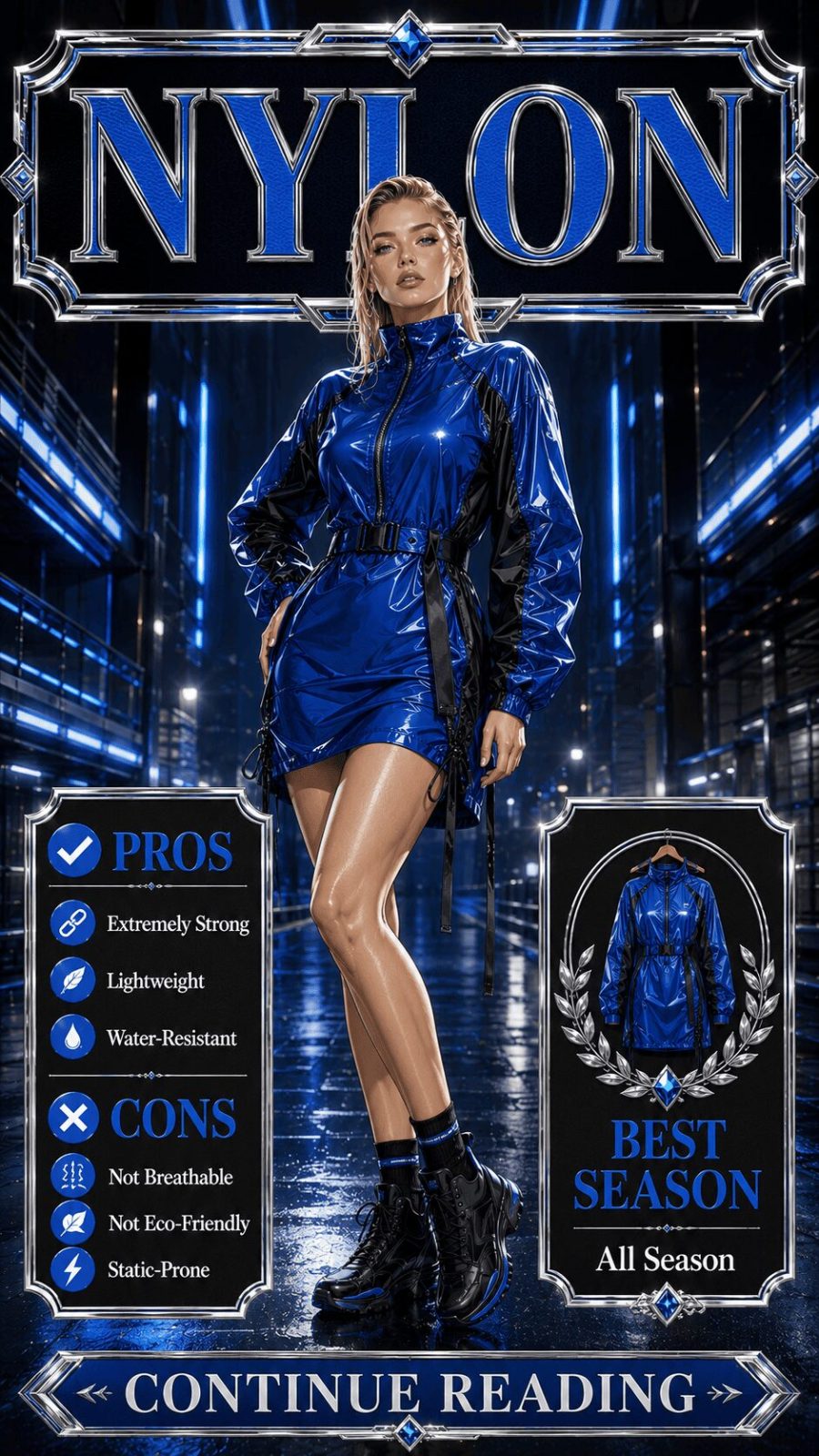
      Nylon

      Nylon Fabric for Women's Clothing

      The first true fully synthetic fibre — introduced by DuPont in 1938, initially for stockings. Nylon is exceptionally strong for its weight, resistant to abrasion and chemicals, and has a natural silky lustre. It replaced silk in hosiery and parachutes during the Second World War for practical reasons. In contemporary fashion it appears in hosiery, swimwear, activewear, and outer layers requiring durability without bulk. Often blended with elastane for stretch-recovery performance.

      DesignStrong, smooth, slight sheen, excellent abrasion resistance
      SeasonAll seasons; dominant in transitional outerwear
      Best ForHosiery, swimwear, activewear, windbreakers, lightweight outerwear
    1. 37

      Elastane (Spandex / Lycraâ„¢)

      Elastane Spandex Lycra Fabric for Women's Clothing

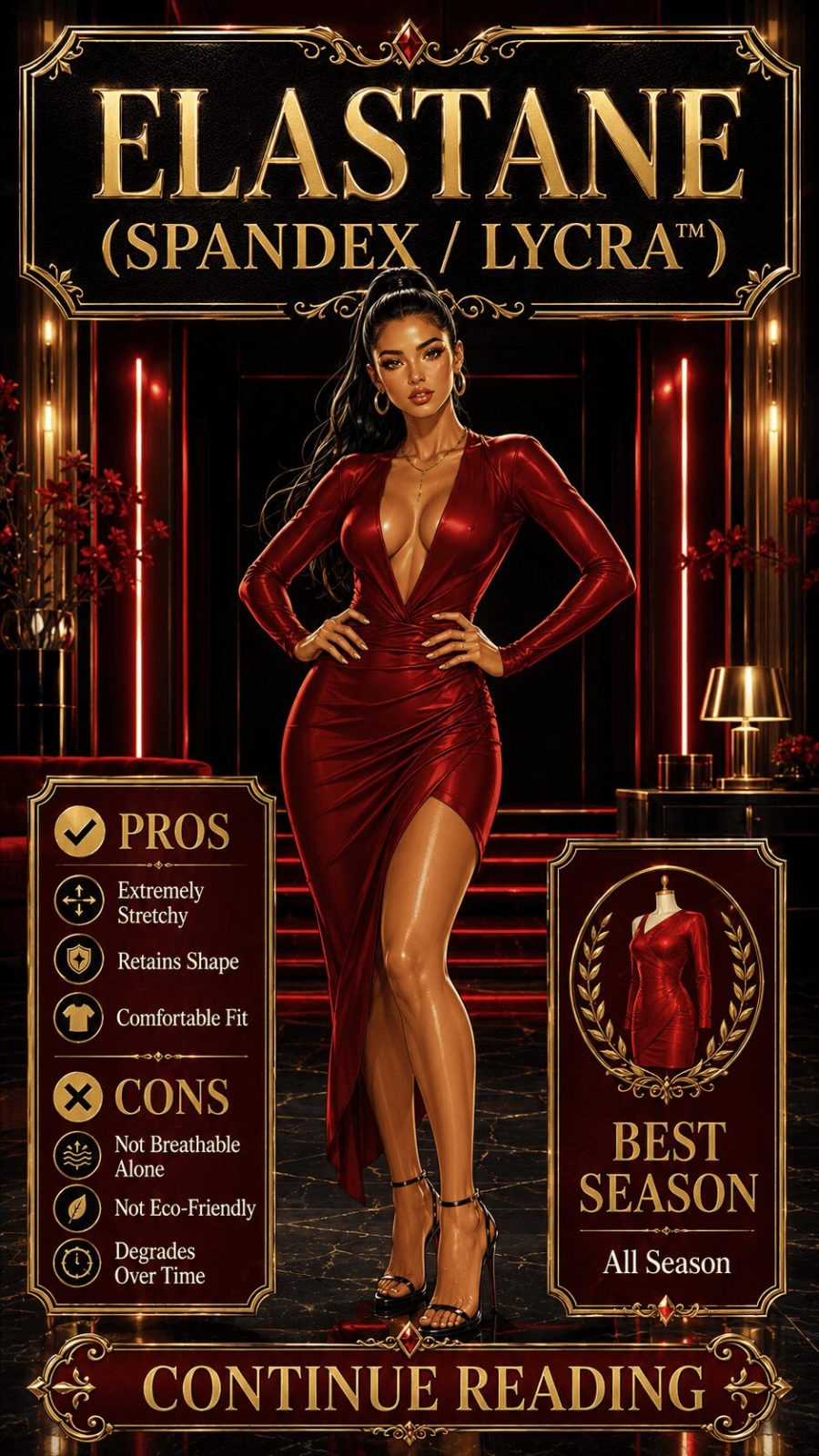
      Pure polyurethane — the stretch ingredient in almost every fitted garment made today. Elastane is essentially never used alone; it appears in blends at 2-5% in casual cotton tops, 15-20% in performance activewear, and up to 40% in swimwear. The critical property is stretch recovery: elastane returns to its original shape after stretching up to 600% of its length. Lycra is DuPont's brand name, now owned by Invista. Without elastane, fitted jeans, yoga pants, and shaped blouses as we know them simply wouldn't exist.

      DesignUsed in blends only; invisible stretch ingredient
      SeasonAll seasons in blended fabrics
      Best ForActivewear, swimwear, jeans, fitted tops, leggings — always in blend
    2. 38

      Acrylic

      Acrylic Fabric for Women's Clothing

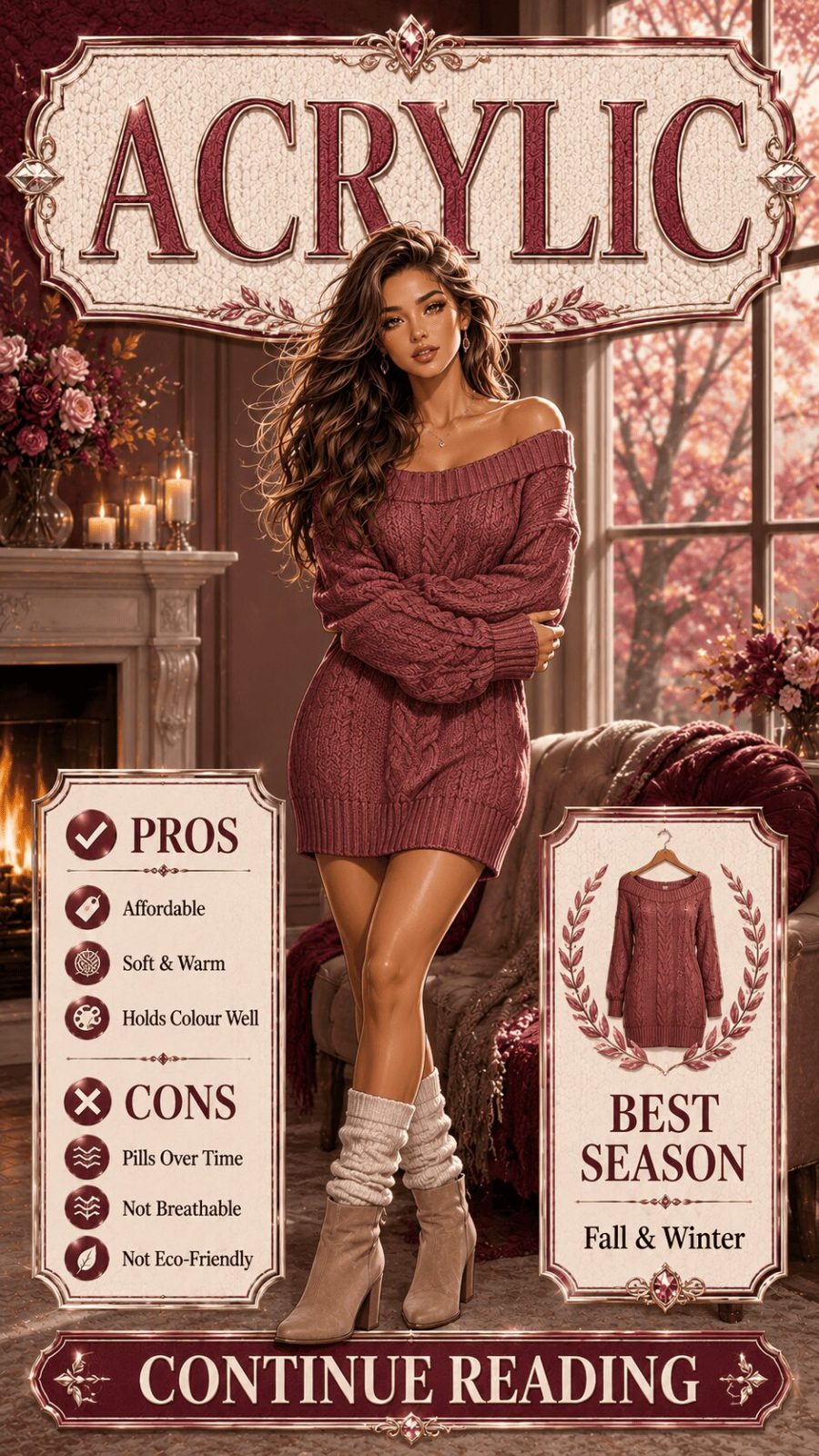
      A synthetic fibre produced from acrylonitrile — engineered specifically to mimic wool's appearance and warmth at significantly lower cost. Acrylic pills readily, holds static in dry conditions, and breathes poorly relative to natural fibres. Its primary advantage is price point and ease of care; it's machine-washable where wool often isn't. In cheaper knitwear, acrylic is the dominant fibre — often marketed as "soft knitwear" without specifying the fibre content.

      DesignWool-like appearance, pills with wear, bright colour retention
      SeasonAutumn / Winter
      Best ForBudget knitwear, sweaters, beanies, scarves, affordable casual layers
    1. 39

      Faux Leather (PU / PVC)

      Faux Leather PU Fabric for Women's Clothing

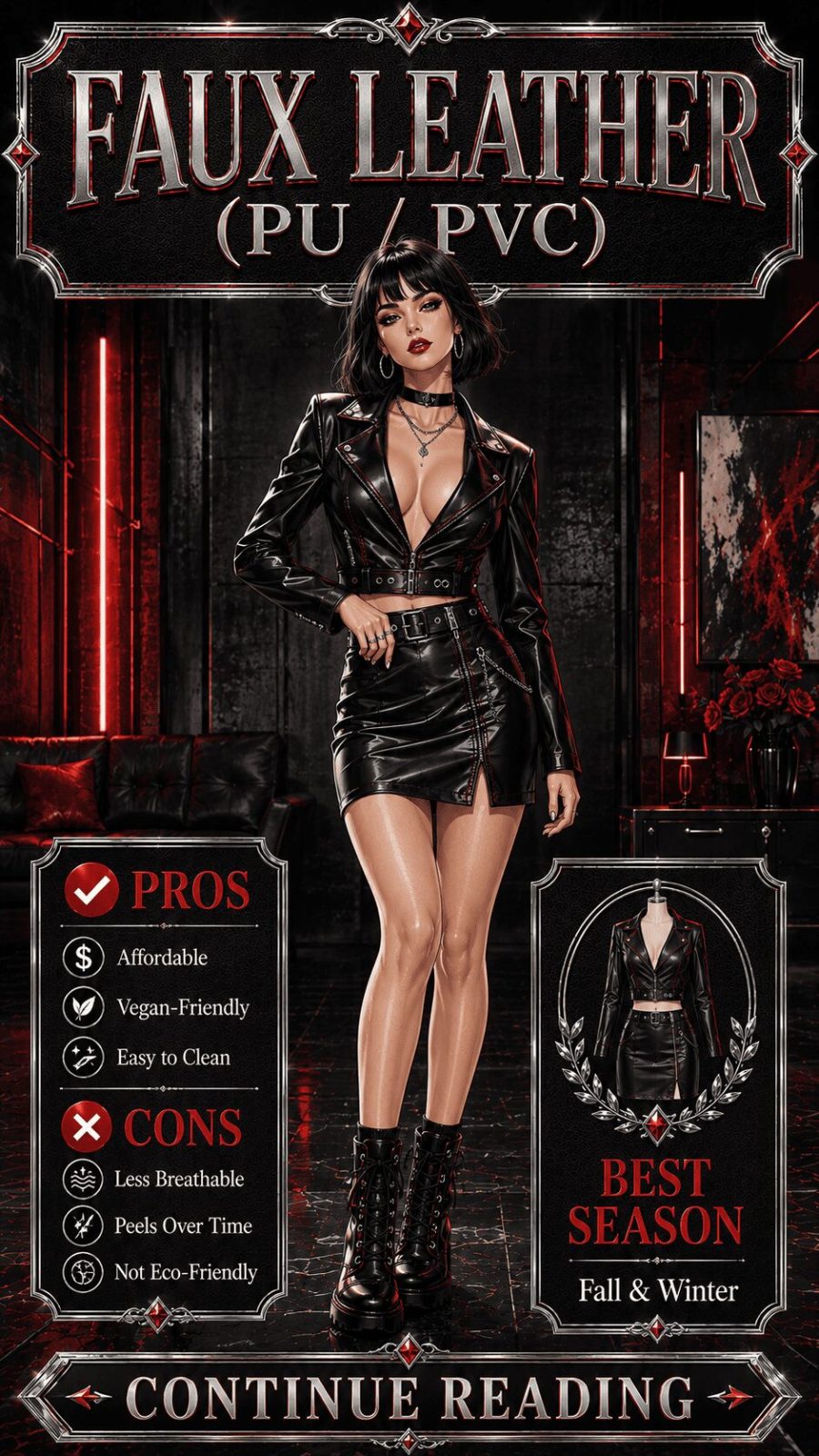
      Polyurethane (PU) coated fabric — a fabric base (often polyester) with a polyurethane surface coating designed to replicate leather's appearance. PU leather is more breathable and softer than PVC (vinyl) and is the standard for better-quality faux leather in fashion garments. It cannot develop a genuine patina and will eventually crack and peel — typically within 3-7 years of regular wear — rather than aging as real leather does. Significant in veganism-aligned fashion for its animal-free credentials.

      DesignLeather-like surface, uniform appearance, eventual cracking with age
      SeasonAutumn / Winter
      Best ForJackets, skirts, trousers, bags; vegan/animal-free fashion choices
    2. 40

      Technical Fleece

      Technical Fleece Fabric for Women's Clothing

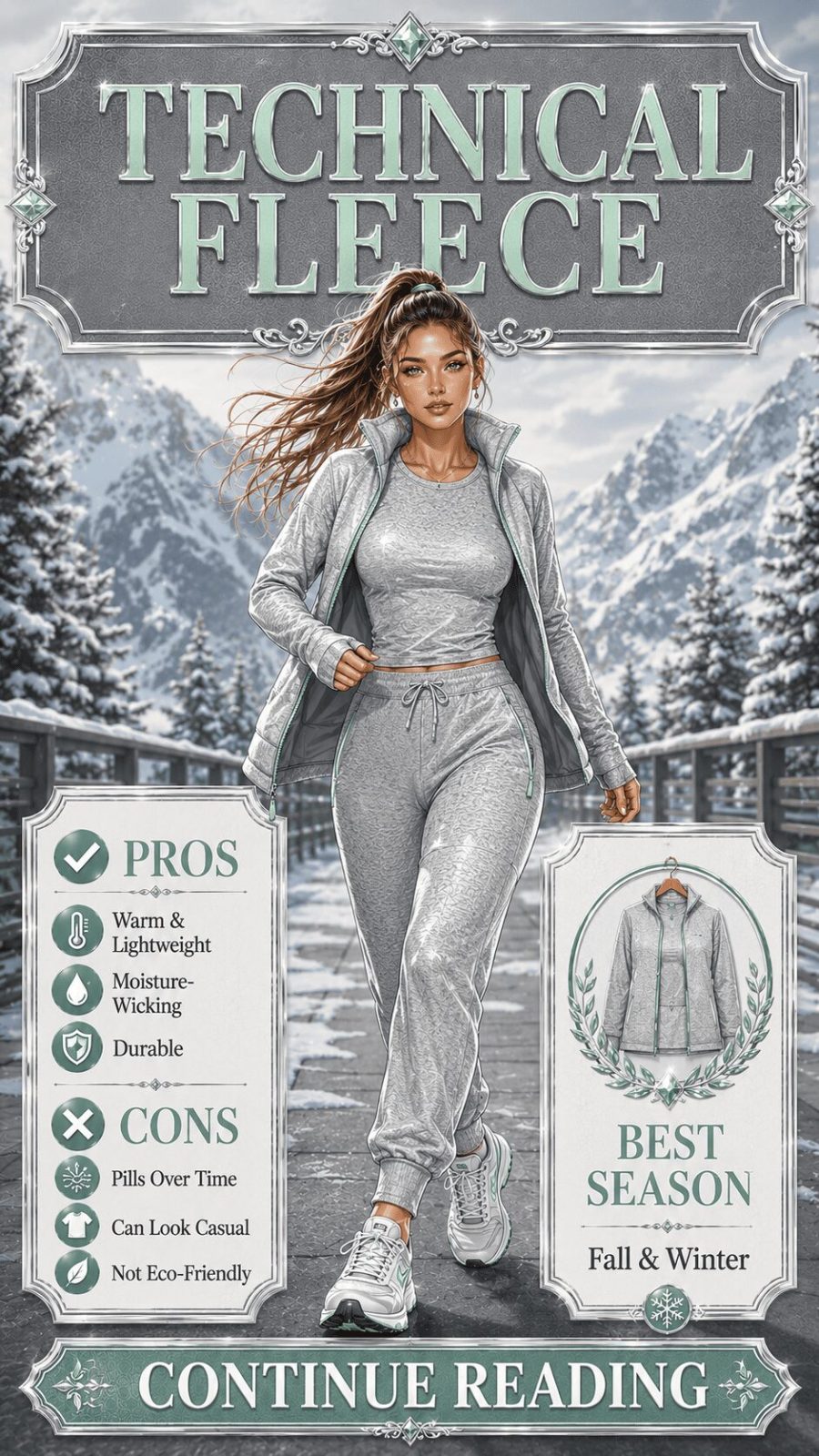
      A knitted polyester fabric with a raised, brushed pile on one or both sides. Unlike woven fabrics, fleece does not fray when cut — making it efficient to manufacture. Its insulation-to-weight ratio is exceptional; it's also moisture-wicking and dries quickly. Malden Mills (Polartec) pioneered high-performance fleece in the 1970s. The primary trade-off is microplastic shedding — fleece releases more plastic fibres per wash than almost any other synthetic textile.

      DesignBrushed pile, soft hand, lightweight insulation, casual aesthetic
      SeasonAutumn / Winter
      Best ForCasual outerwear, athleisure, hiking layers, winter loungewear
    1. 41

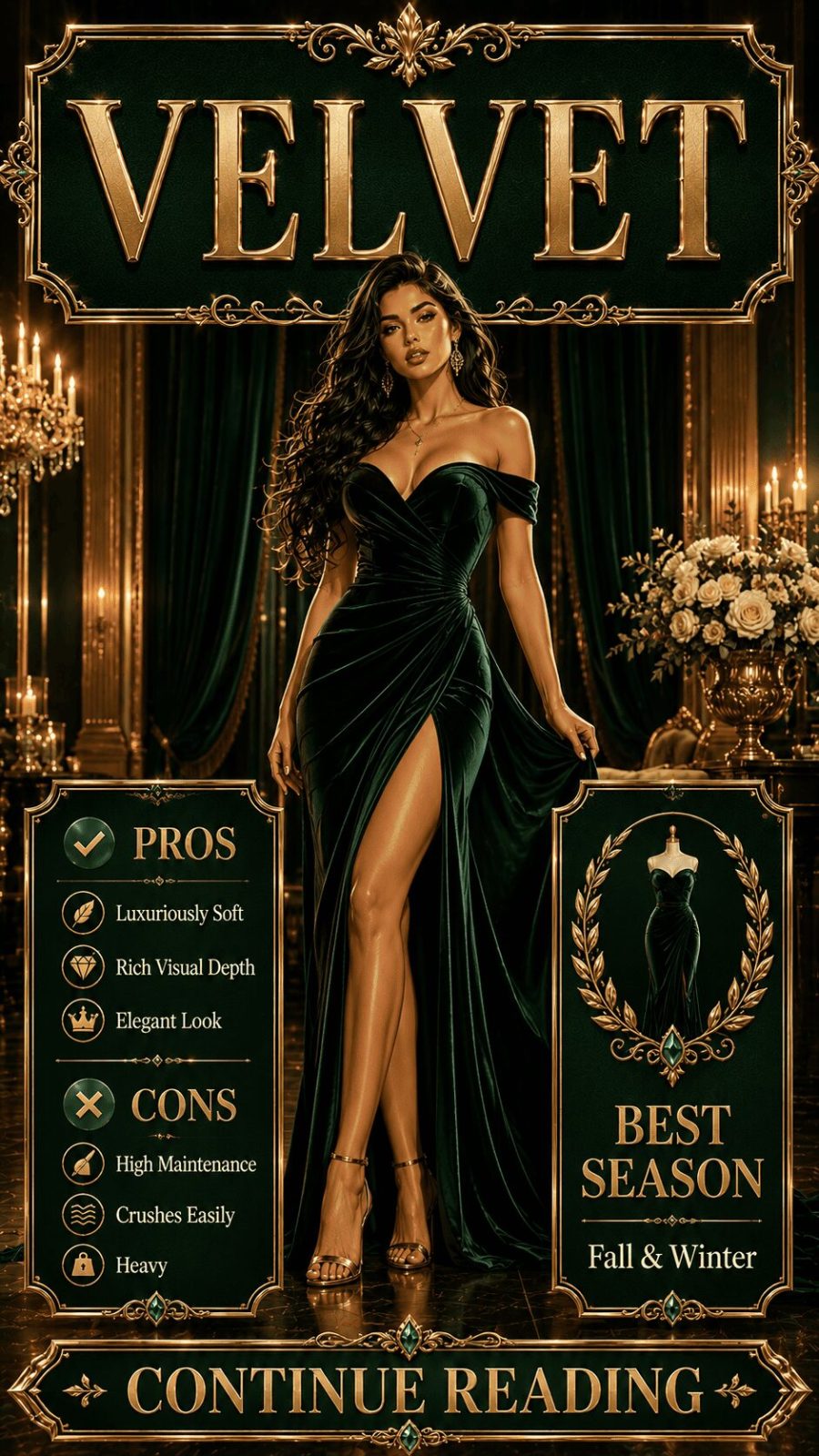
      Velvet

      Velvet Fabric for Women's Clothing

      A cut-pile woven fabric — a supplementary pile yarn is woven into a base fabric and then cut to create the characteristic short, dense pile surface. Most commercial velvet is now polyester or polyester-cotton blend; traditional silk velvet is rare and very expensive. The pile creates a directional nap that reads different colours at different angles, producing velvet's distinctive depth and richness. Crushes with handling but steams back — don't iron directly. For eveningwear and fashion-forward occasion dressing, few fabrics compete.

      DesignShort cut pile, directional nap, deep colour, tactile richness
      SeasonAutumn / Winter / Evening year-round
      Best ForEvening tops, party dresses, blazers, festive occasionwear
    2. 42

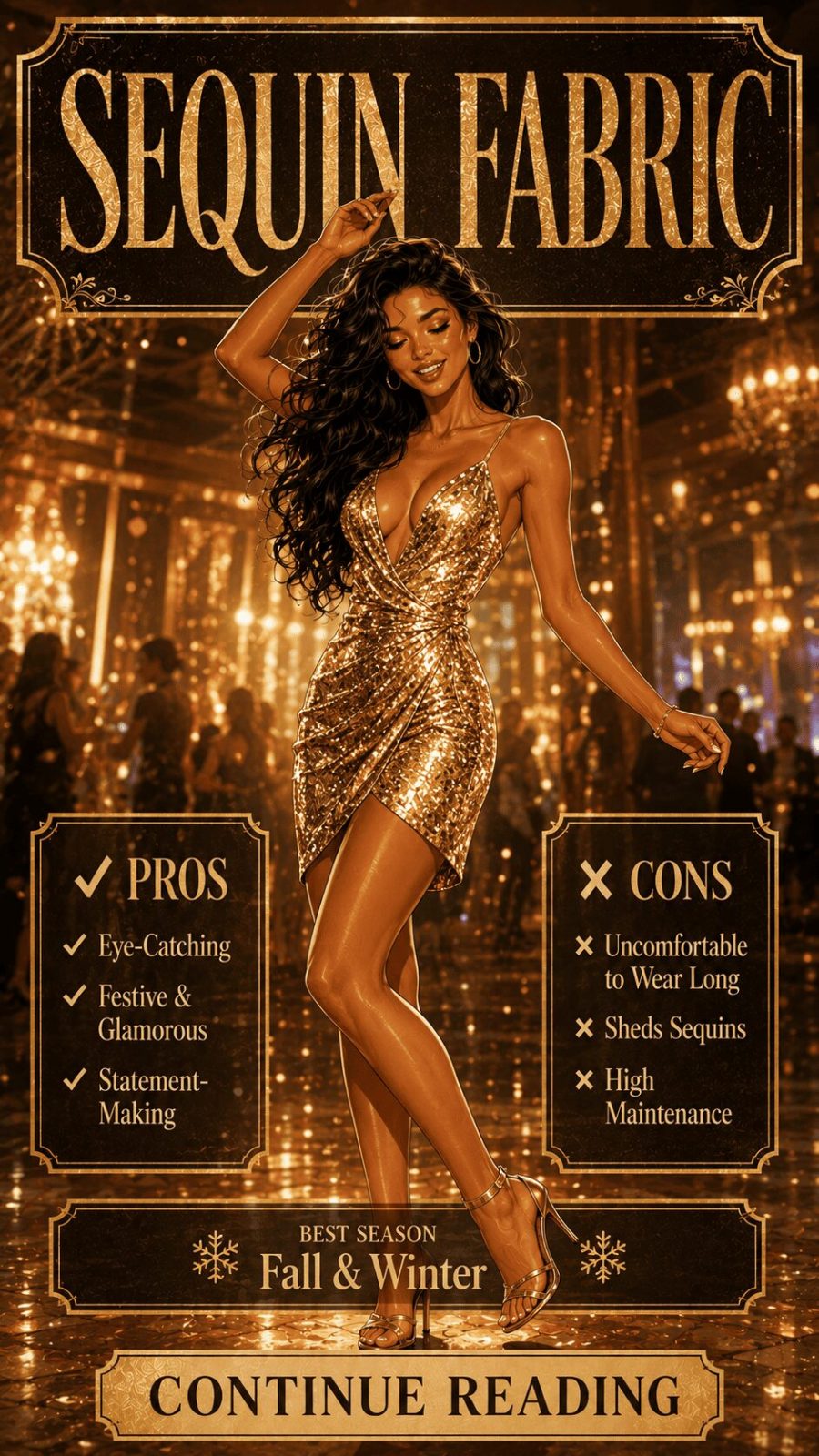
      Sequin Fabric

      Sequin Fabric for Women's Clothing

      Small disc-shaped embellishments — typically polyester or plastic — sewn or mechanically attached to a base fabric in overlapping rows. The result is a surface that reflects light at every angle, creating the characteristic visual shimmer. Quality varies enormously: cheaper sequin fabrics use hollow plastic discs that break and shed after washing; better constructions use flatter, more securely attached sequins that withstand careful cold washing. Hand washing inside-out in a laundry bag extends lifespan considerably.

      DesignAll-over light reflection, textured surface, high visual impact
      SeasonEvening / Party wear year-round
      Best ForEvening dresses, party tops, festive skirts, New Year outfits
    1. 43

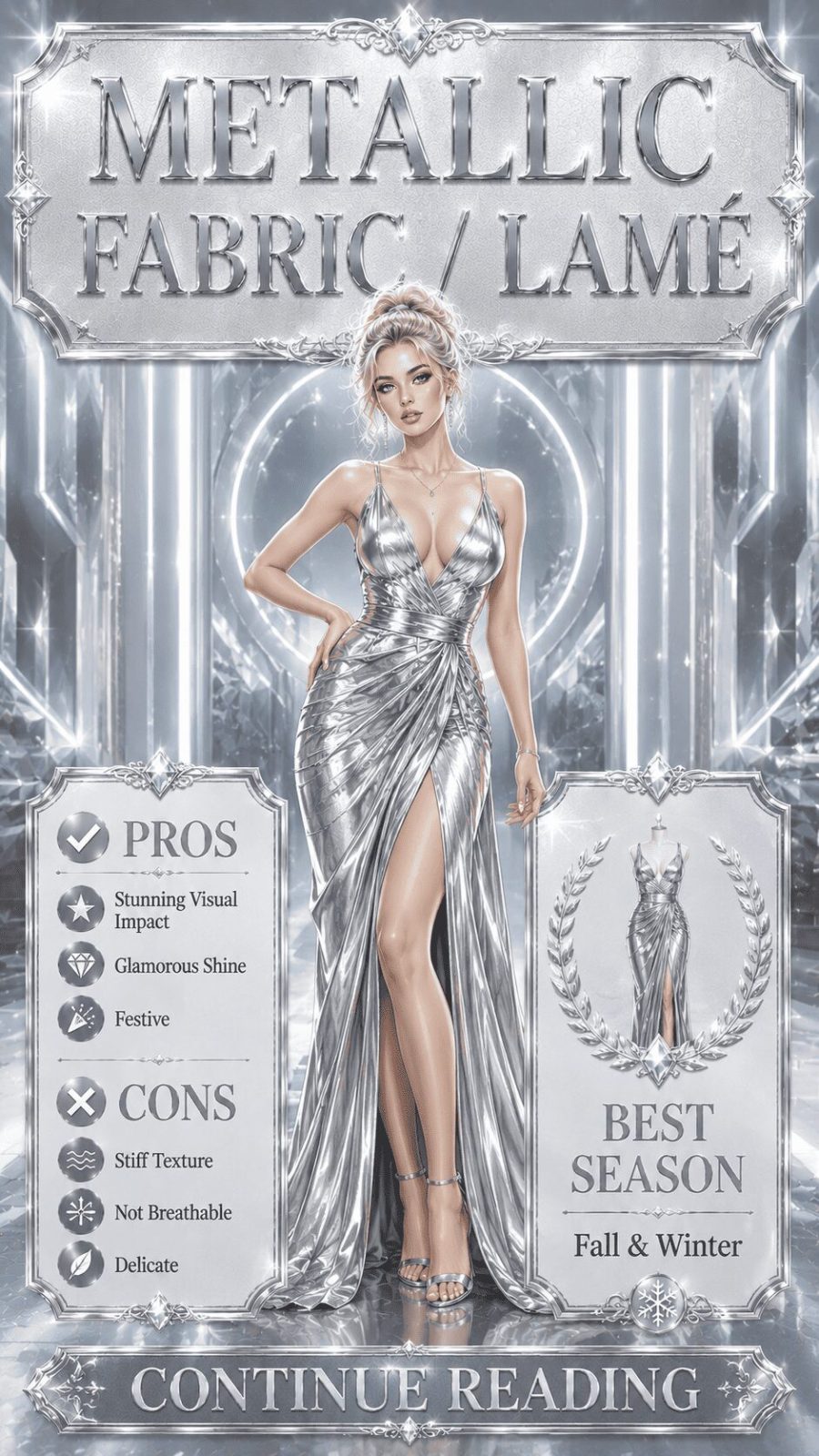
      Metallic Fabric / Lamé

      Metallic Lame Fabric for Women's Clothing

      Fabric woven or knitted with metallic yarns — typically polyester threads coated in metallic film. Lamé specifically refers to fabric woven entirely with metallic thread, producing a flat, highly reflective surface used extensively in eveningwear. More contemporary metallic fabrics blend metallic threads with softer base fibres for improved comfort and drape. Metallic fabrics are heat-sensitive; never iron directly and dry clean or cold-hand-wash only.

      DesignHigh-reflective metallic surface, rigid to fluid depending on construction
      SeasonEvening / occasion wear; festive seasons
      Best ForEvening tops, party dresses, festive occasionwear, statement pieces
    2. 44

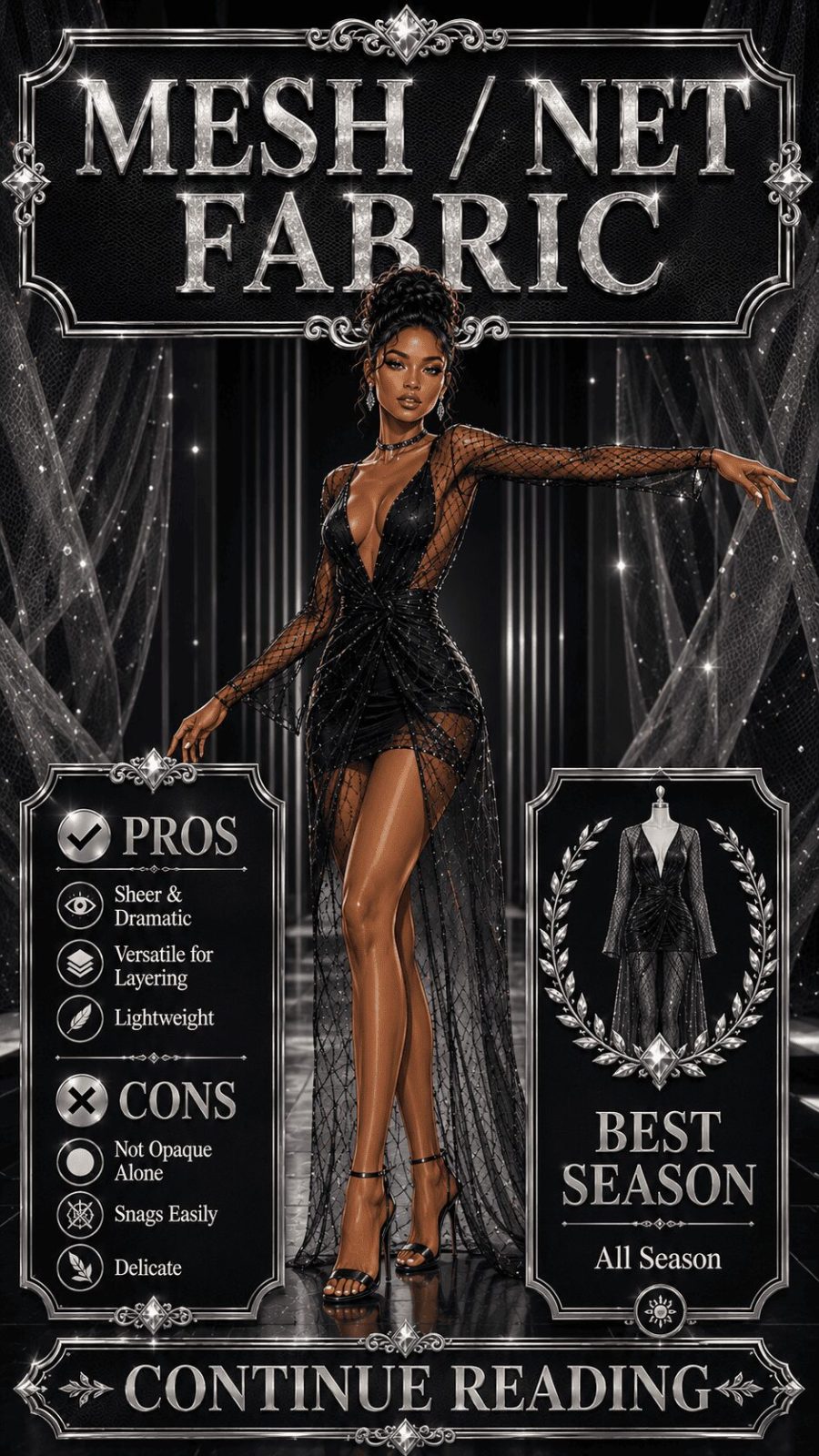
      Mesh / Net Fabric

      Mesh Net Fabric for Women's Clothing

      An open-weave or knit textile with a visible hole structure — ranging from fine tulle (used in evening skirts and veils) to coarse industrial-style mesh used in sportswear and streetwear. Most fashion mesh is polyester or nylon. The open structure creates inherent breathability regardless of fibre content. Powermesh — a firm, four-way stretch mesh — is a foundational material in shapewear, corsetry, and structured activewear.

      DesignOpen-hole structure, translucent, breathable regardless of fibre
      SeasonSummer / activewear year-round
      Best ForActivewear panels, festival tops, sheer layering, shapewear, tutus
    1. 45

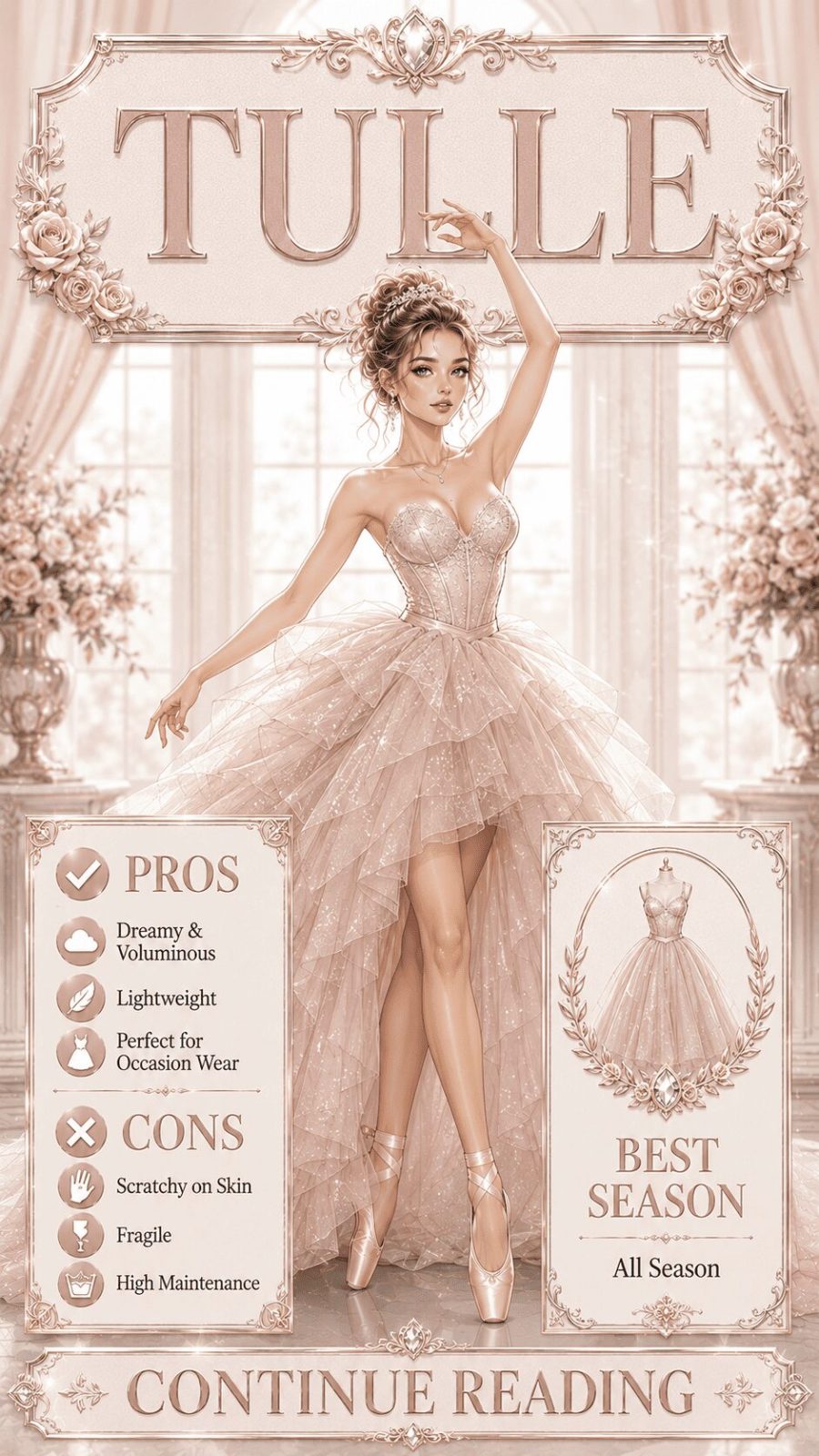
      Tulle

      Tulle Fabric for Women's Clothing

      An ultra-fine, lightweight, hexagonal net fabric — named after Tulle, France, where it was first manufactured in the early 19th century. Most modern tulle is nylon or polyester; silk tulle exists but is rare. It's the fabric behind ballet tutus, bridal veils, ball gown underskirts, and whimsical fashion skirts. Multiple layers create volume without weight; a single layer is nearly invisible over other fabrics.

      DesignFine hexagonal net, creates volume without weight, nearly sheer
      SeasonOccasion wear year-round
      Best ForBridal, ball gowns, tutus, underskirts, fashion-forward skirts
    2. 46

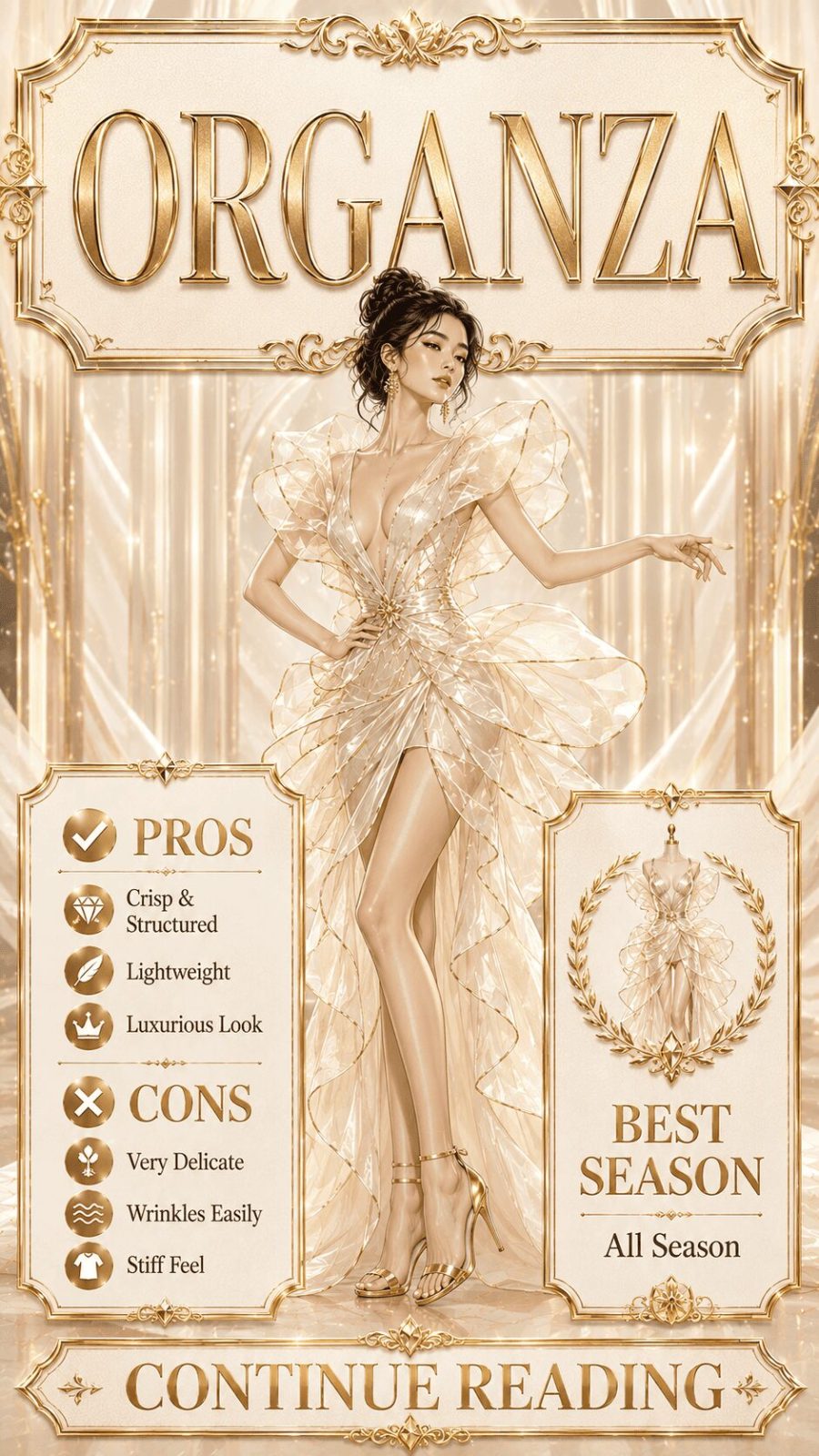
      Organza

      Organza Fabric for Women's Clothing

      A thin, plain-weave sheer fabric — traditionally silk, increasingly polyester — made with twisted filament yarns that create a crisp, structured sheer rather than a soft one. Unlike chiffon (which floats and clings), organza holds its shape; it can be cut to stand away from the body and hold sculptural silhouettes. It photographs with beautiful lightness and is a staple of eveningwear, bridal fashion, and statement sleeves designed to catch movement.

      DesignCrisp sheer, holds sculptural shape, slight stiffness with lightness
      SeasonSpring / Summer; eveningwear year-round
      Best ForStatement sleeves, bridal overlays, eveningwear, structured overskirts


    Category 5: Woven Fabric Constructions (#47–#58)

    The structure of the weave determines drape, strength, and surface — regardless of fibre origin

    The same fibre — cotton, silk, polyester — can produce wildly different fabrics depending entirely on how the threads are interlaced. Weave structure determines whether a fabric drapes or holds shape, shines or absorbs light, breathes or insulates. Understanding weave types is the deeper layer of fabric literacy that most shopping guides never explain. It's also the level at which professional buyers and fashion designers think about cloth. For anyone wanting to understand fashion textures at a deeper level, this is where it starts.

    1. 47

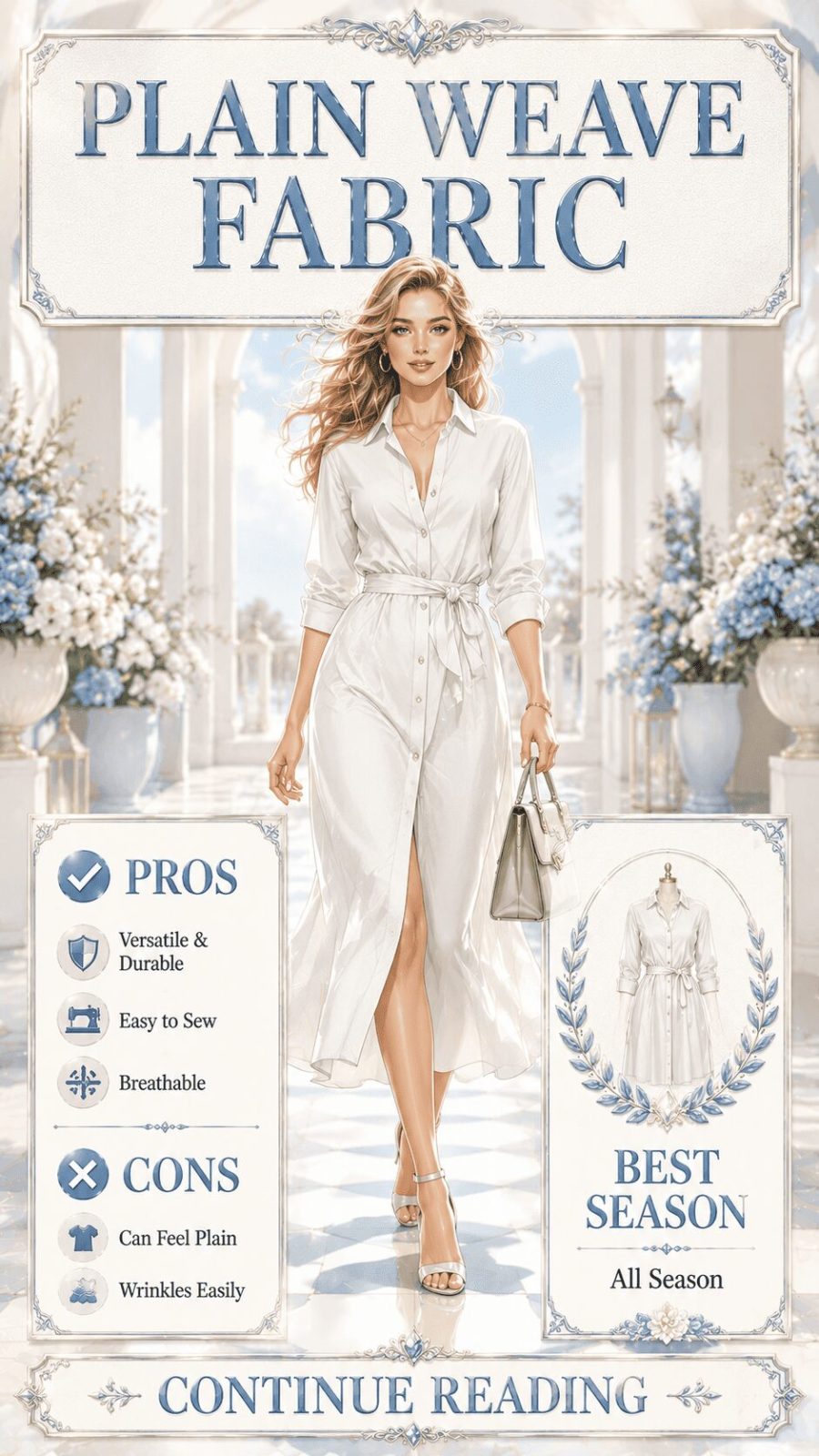
      Plain Weave Fabric

      Plain Weave Fabric for Women's Clothing

      The simplest weave structure — each weft thread passes alternately over and under each warp thread, like a basket. The result is a stable, balanced fabric that is the foundation of muslin, poplin, chiffon, voile, and dozens of other textiles. Tighter plain weaves produce firmer fabrics; looser weaves produce sheers. The interlocking pattern creates equal strength in both directions, and the flat surface takes print extremely well.

      DesignFlat, stable surface; matte to semi-lustrous depending on fibre
      SeasonAll seasons by fibre and weight
      Best ForShirts, blouses, printed fabrics, dresses — the foundation of most everyday garments
    2. 48

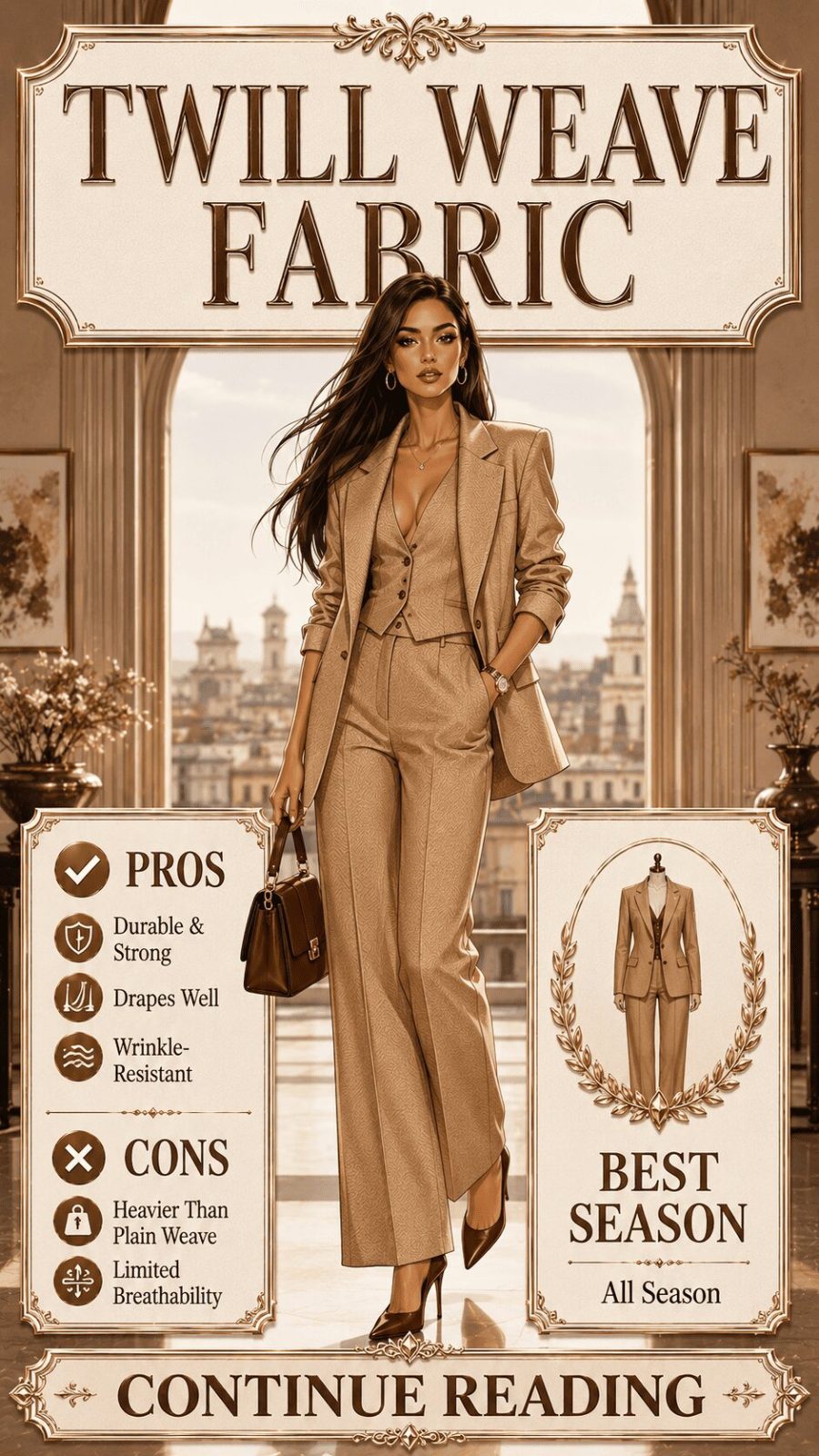
      Twill Weave Fabric

      Twill Weave Fabric for Women's Clothing

      Characterised by diagonal rib lines — the weft threads pass over two or more warp threads before going under, creating that distinctive angled pattern visible on the fabric surface. Twill produces stronger, denser fabric than plain weave. Denim, gabardine, chinos, and herringbone are all twill constructions. The diagonal line direction can vary: right-hand twills are most common in wool suiting; left-hand twills characterise most denim. — and that directional rib is exactly why twills resist wrinkles so effectively.

      DesignDiagonal rib surface, durable, drapes well, slight sheen on smooth twills
      SeasonAll seasons; heavier twills in Autumn/Winter
      Best ForJeans, trousers, jackets, suiting, workwear
    1. 49

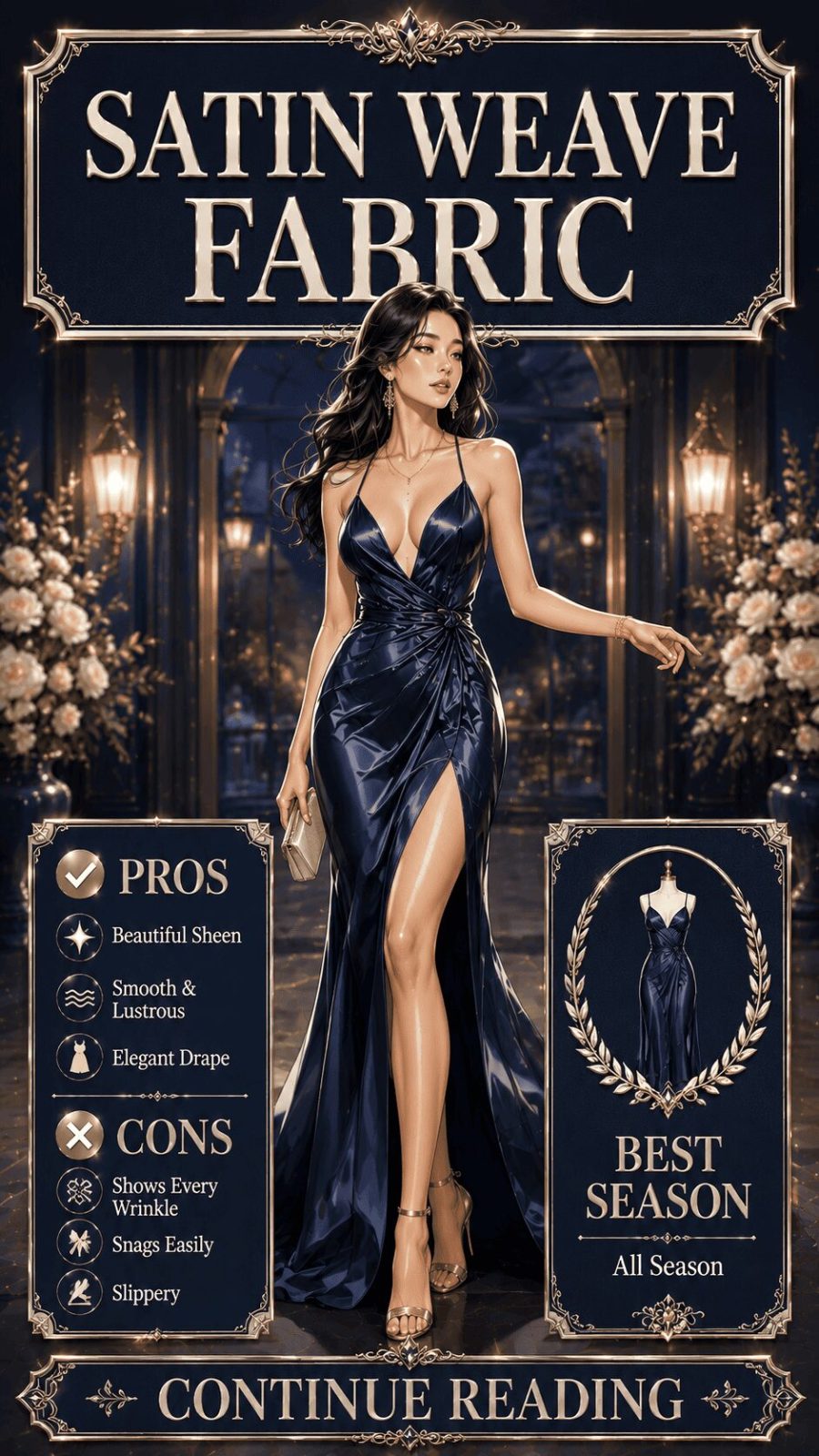
      Satin Weave Fabric

      Satin Weave Fabric for Women's Clothing

      In satin weave, warp threads float over multiple weft threads before interlacing — creating a smooth surface where the long floats catch and reflect light uniformly. The result is the characteristic high-lustre finish we call "satin." The weave structure, not the fibre, creates the shine. Polyester satin, silk satin, and cotton sateen all use this weave — the differences in lustre and hand come from the fibre, not the structure. Satin weave fabrics are more prone to snags than twill or plain weave because of those long floating threads.

      DesignHigh-lustre surface, smooth hand, snag-prone, fluid drape
      SeasonAll seasons; eveningwear year-round
      Best ForEvening dresses, bridal, blouses, luxury tops, slip dresses
    2. 50

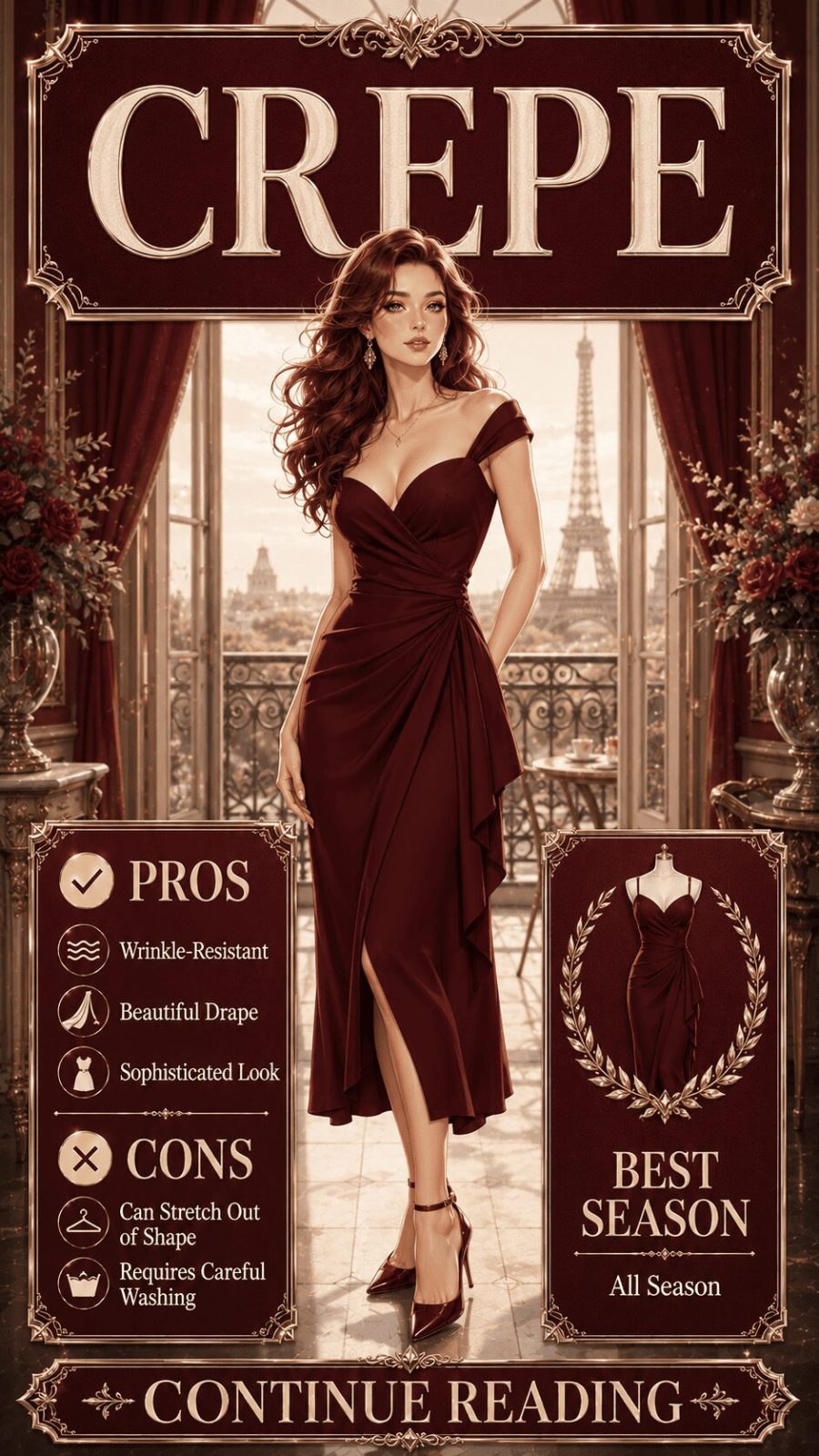
      Crepe

      Crepe Fabric for Women's Clothing

      Produced using highly twisted yarns that, when woven, create a puckered, crinkled surface with a matte, non-reflective quality. Crepe can be made from silk, wool, polyester, or viscose — the word describes the surface texture, not the fibre. It's notoriously forgiving on the body, draping smoothly over figure variations that other fabrics would highlight. Professional stylists — honestly, myself included — reach for crepe constantly for client workwear precisely because it photographs well, resists wrinkle, and suits nearly every body proportion.

      DesignPebbly or crinkled surface, matte finish, smooth drape, wrinkle-resistant
      SeasonAll seasons; wool crepe in Autumn/Winter
      Best ForOffice wear, dresses, blouses, trousers, occasionwear
    1. 51

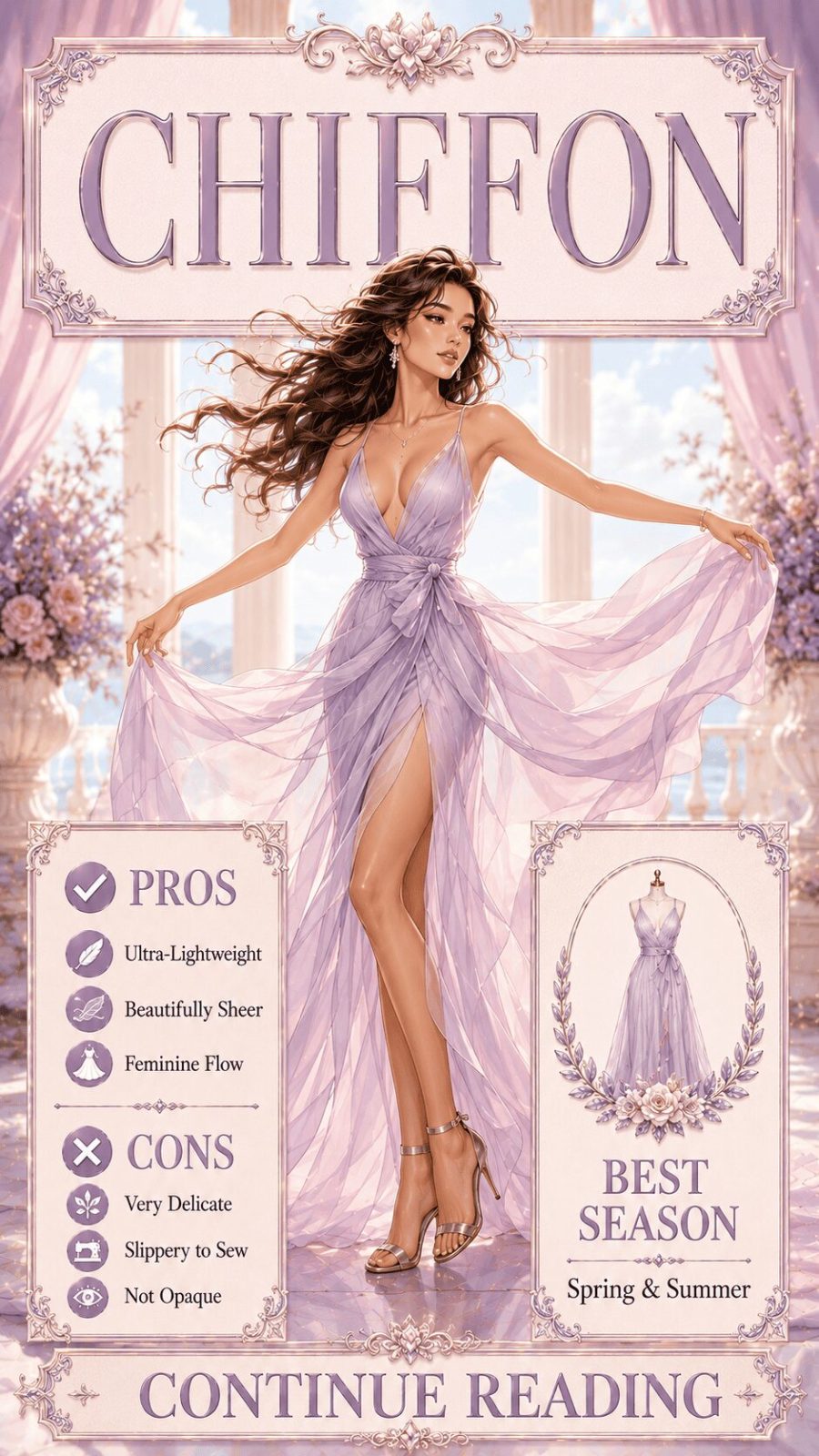
      Chiffon

      Chiffon Fabric for Women's Clothing

      A nearly weightless, sheer plain-weave fabric with a slightly rough texture from the use of alternating S- and Z-twist yarns. Silk chiffon is the most refined; polyester chiffon is more accessible and more durable, though with less of the floaty, almost-invisible quality of the genuine article. Chiffon layers beautifully, barely registers as weight on the body, and catches movement in a way that most other fabrics simply can't replicate — which is exactly why it dominates evening and bridal overlays.

      DesignNear-weightless, sheer, slightly grainy texture, floats with movement
      SeasonSpring / Summer / Evening year-round
      Best ForBlouses, evening tops, bridal overlays, layered dresses
    2. 52

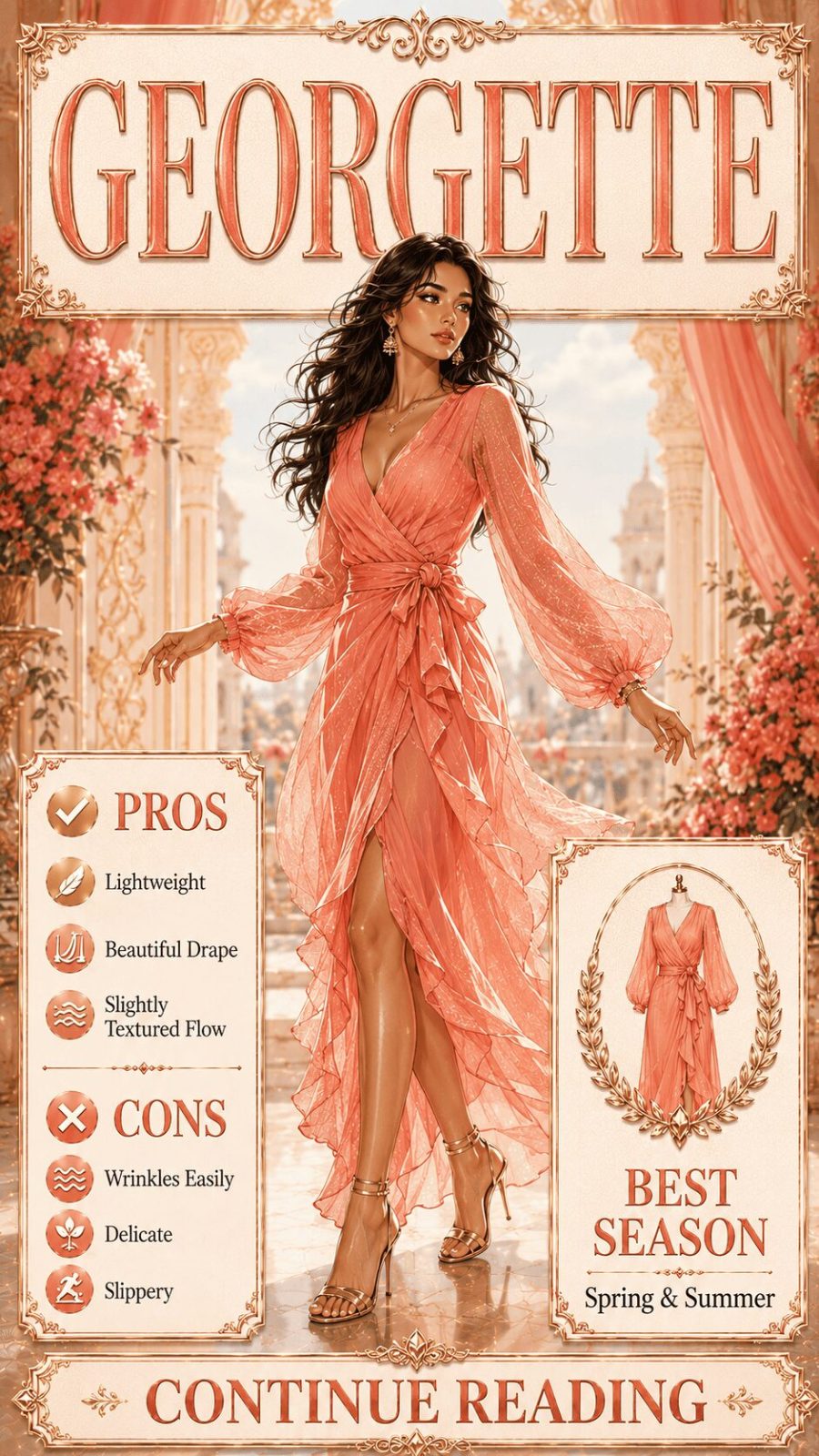
      Georgette

      Georgette Fabric for Women's Clothing

      Heavier and more opaque than chiffon, georgette uses highly twisted S- and Z-twist yarns in both warp and weft, producing a pebble-like surface and a matte, crêpe-like character. Where chiffon floats and is barely-there, georgette flows and has more visual substance. It holds pleats and gathers well, drapes beautifully from the shoulder, and is one of fashion's most reliable fabrics for blouses, dresses, and kaftans in warm seasons. Named after French dressmaker Georgette de la Plante.

      DesignMatte, pebbly surface, opaque drape, holds gathers and pleats
      SeasonSpring / Summer
      Best ForBlouses, dresses, kaftans, occasion tops, ethnic garments
    1. 53

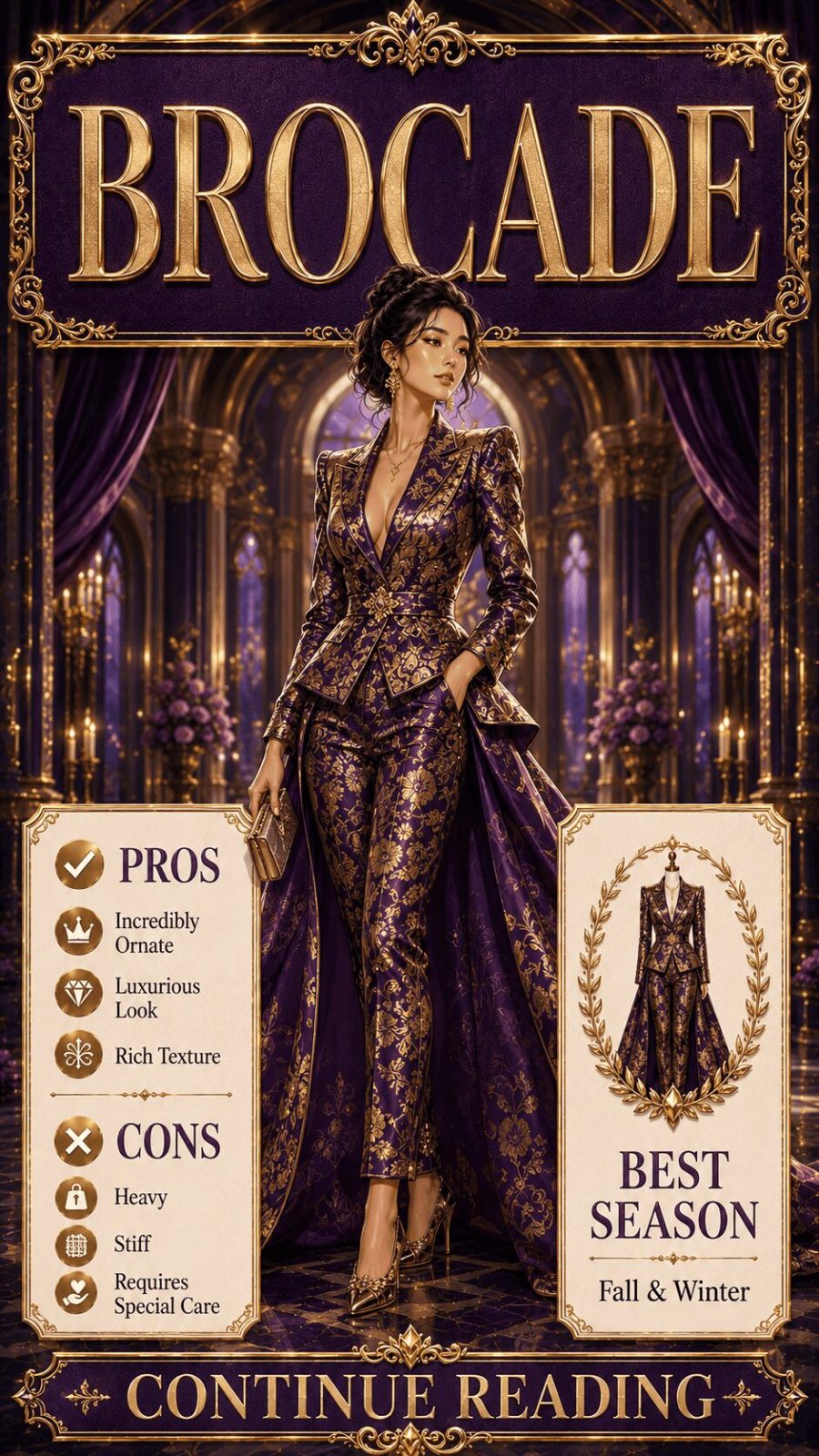
      Brocade

      Brocade Fabric for Women's Clothing

      A Jacquard-woven fabric with a raised, embossed pattern woven directly into the structure using supplementary weft threads — typically in silk, metallic, or a combination. The pattern is not printed or embroidered; it emerges from the weave itself, creating depth and relief on the fabric surface. Historically the fabric of royal courts, brocade today appears in occasionwear, structured jackets, and cultural garments including Indian lehengas, Chinese qipao, and formal Vietnamese áo dài.

      DesignRaised woven pattern, often metallic threads, heavy and structured
      SeasonAutumn / Winter / Festive / Occasion
      Best ForFormal jackets, ethnic occasionwear, structured tops, festive dressing
    2. 54

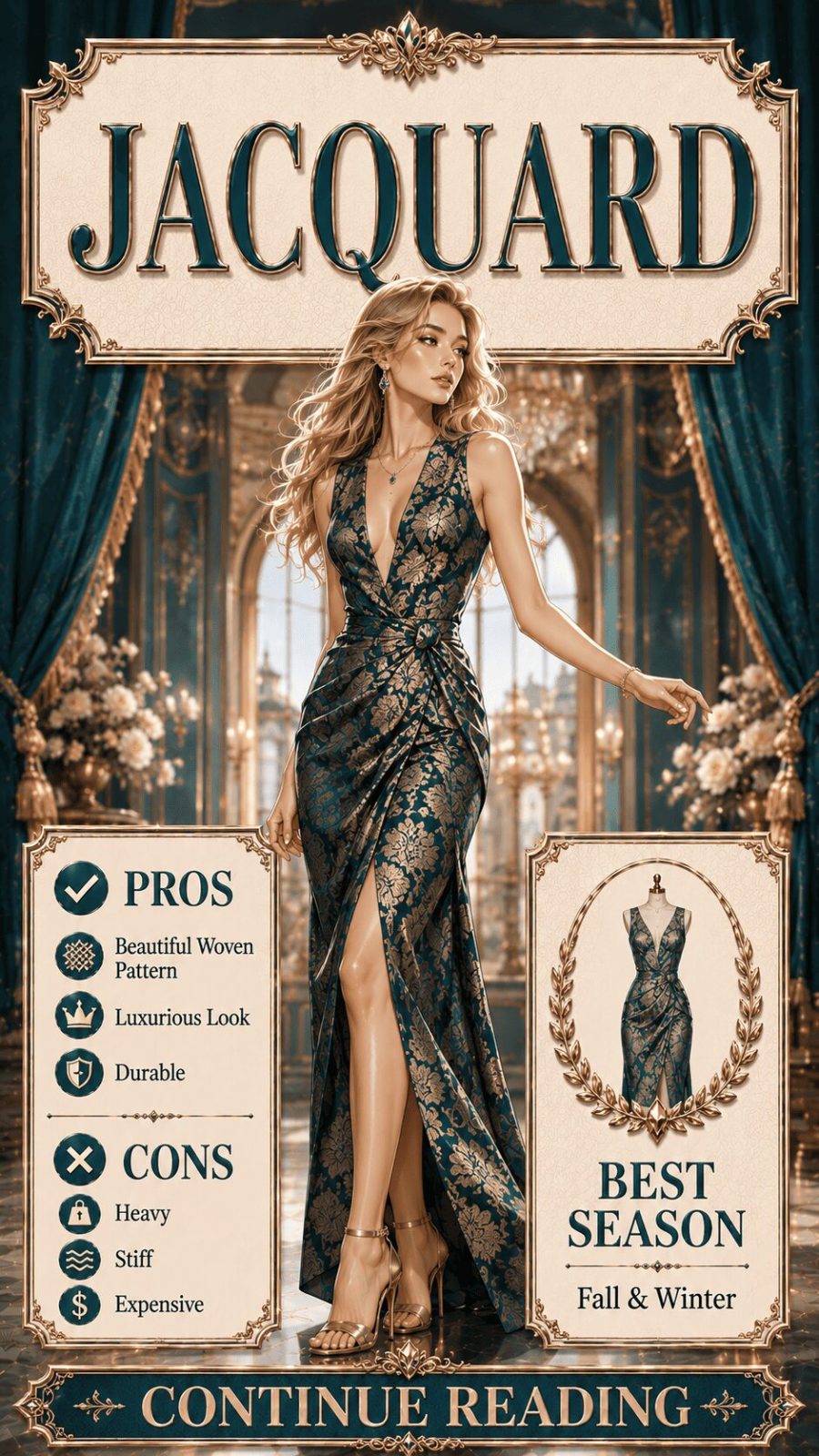
      Jacquard

      Jacquard Fabric for Women's Clothing

      Not a fabric type but a weaving method — the Jacquard loom (invented by Joseph Marie Jacquard in 1804, and an important ancestor of modern computing punch-card systems) allows individual control of each warp thread, enabling complex patterns to be woven directly into fabric. Brocade, damask, tapestry, and matelassé are all Jacquard constructions. The term "Jacquard fabric" in retail usually refers to lighter-weight Jacquard-woven patterned fabrics used in blouses, dresses, and structured tops.

      DesignWoven pattern integral to fabric, subtle to elaborate depending on construction
      SeasonAutumn / Winter / Occasion
      Best ForStructured blouses, dresses, trousers, occasionwear, formal tops
    1. 55

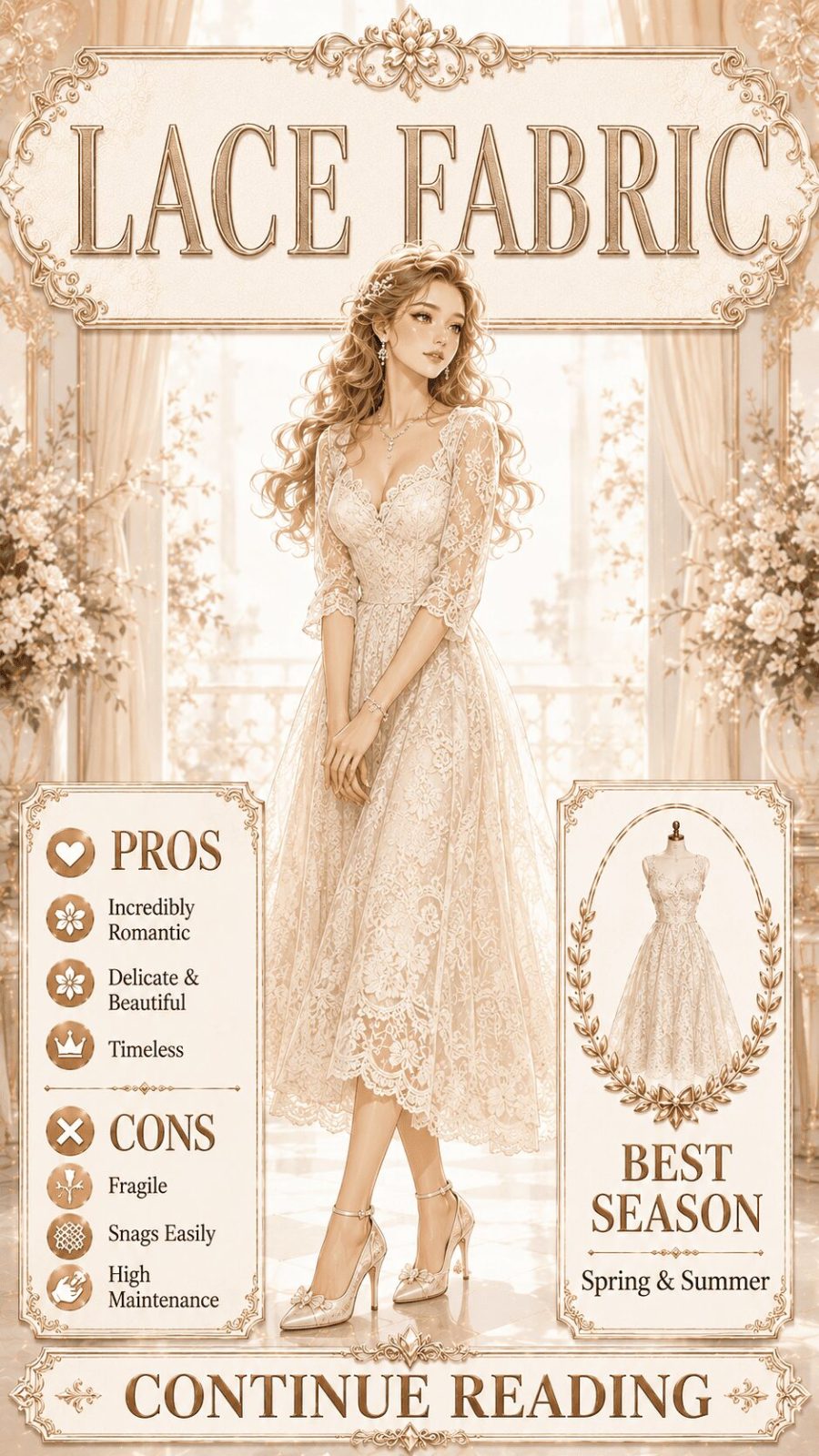
      Lace Fabric

      Lace Fabric for Women's Clothing

      An open-weave textile with a decorative pattern created by looping, twisting, or knitting threads — traditionally by hand (needle lace, bobbin lace) but now almost universally by machine. Chantilly lace, Venetian lace, and Alençon lace are the most celebrated historical varieties. Modern fashion lace is typically nylon or polyester with cotton or silk for premium versions. For a complete breakdown of how lace appears across fashion garments, our dedicated guide to lace details in women's fashion covers every variety.

      DesignOpen decorative pattern, floral or geometric, delicate visual quality
      SeasonSpring / Summer / Evening year-round
      Best ForBridal, lingerie, evening tops, overlay panels, feminine occasion dressing
    2. 56

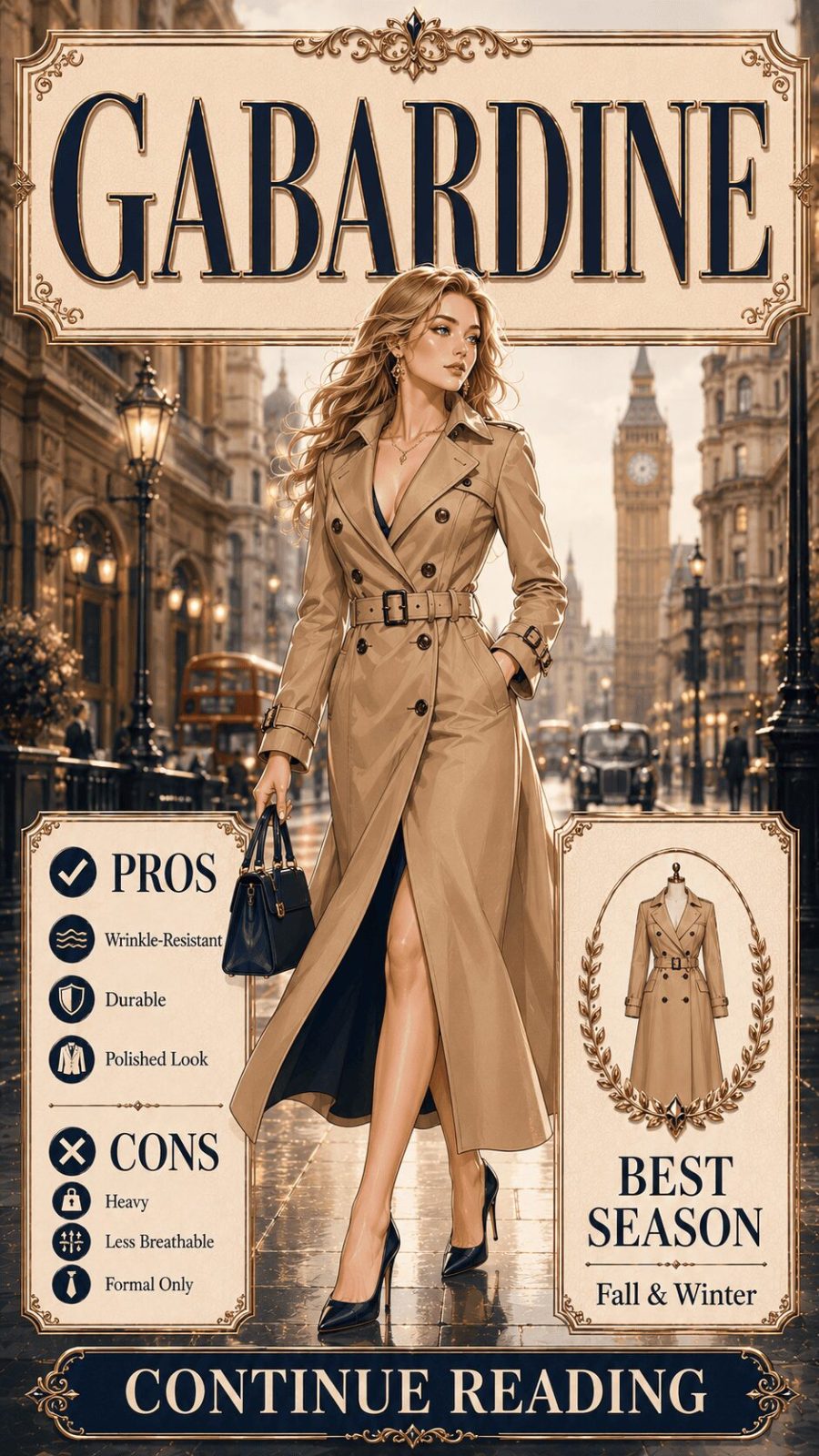
      Gabardine

      Gabardine Fabric for Women's Clothing

      A tightly woven twill fabric with a very fine, steep diagonal rib — the fabric of the classic trench coat, invented by Thomas Burberry in 1879 as a waterproof wool for military officers. Modern gabardine is wool, cotton, or polyester — all share the characteristic smooth surface, clean drape, and resistance to creasing. It tailors beautifully, holds a pressed crease cleanly, and has excellent shape retention. The trench coat's enduring relevance in fashion is essentially a 145-year testimonial to gabardine.

      DesignFine diagonal rib, smooth surface, excellent shape retention
      SeasonSpring / Autumn / Winter (wool); all seasons (polyester)
      Best ForTrench coats, trousers, tailored blazers, structured skirts
    1. 57

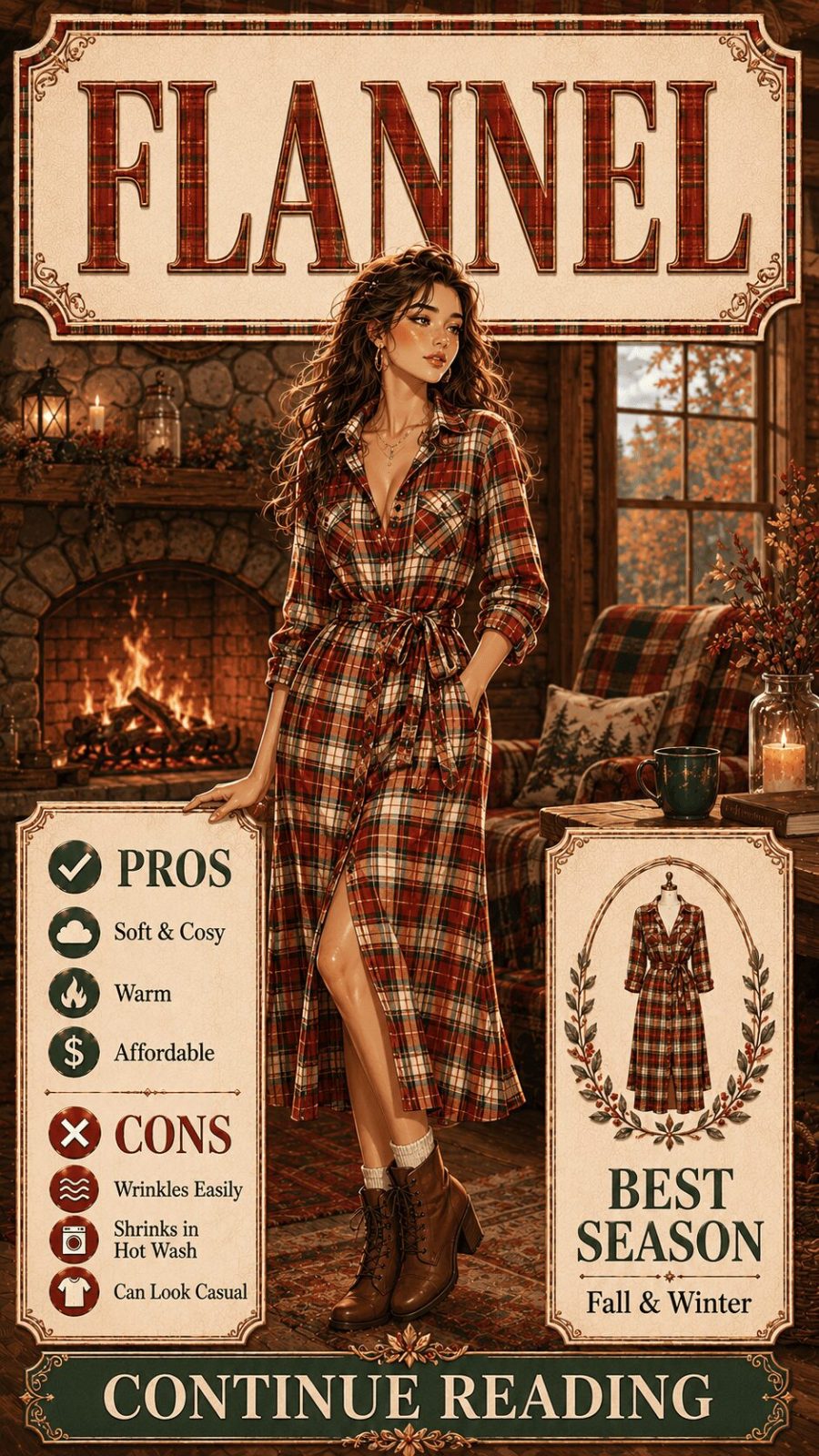
      Flannel

      Flannel Fabric for Women's Clothing

      A soft, woven fabric — wool or cotton — that has been napped (brushed to raise the fibres) on one or both sides. The napping creates a soft, slightly fuzzy surface and traps air for warmth. Welsh flannel (wool) is distinct from American flannel (cotton), though both share the soft brushed character. Plaid flannel shirts have become a wardrobe symbol of casual cool — from lumberjacks to grunge to contemporary street style — and remain perennially in fashion for good reason.

      DesignSoft brushed surface, plaid patterns dominant, warm tactile quality
      SeasonAutumn / Winter
      Best ForShirts, casual tops, overshirts, loungewear, winter casual wear
    2. 58

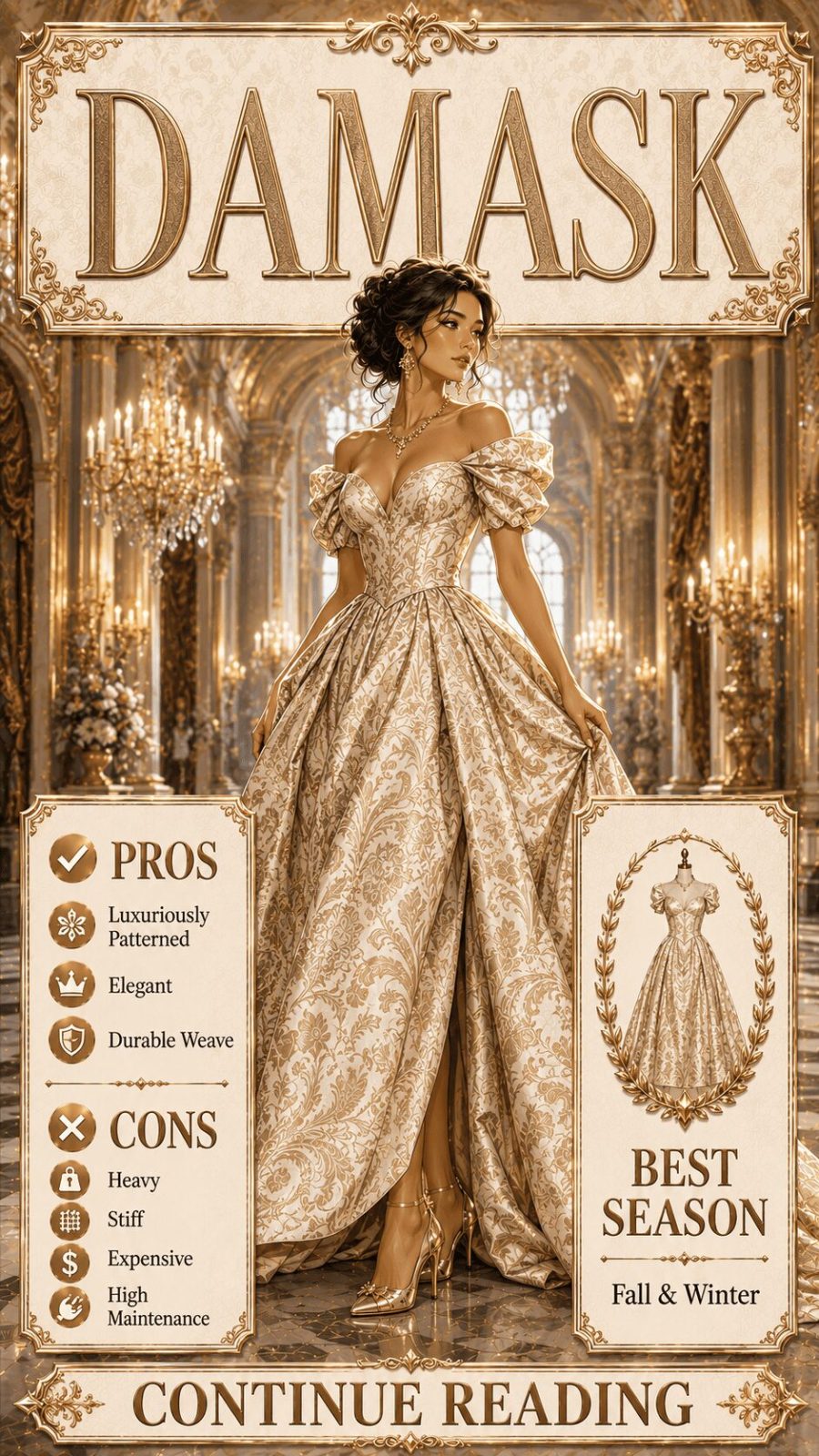
      Damask

      Damask Fabric for Women's Clothing

      A Jacquard-woven fabric where the pattern is created by contrasting satin and sateen weave areas on the same fabric — producing a reversible design visible from both sides, where the pattern appears in opposite sheen on front and back. Named after Damascus, the medieval Syrian trading city through which this luxury fabric reached European markets. In contemporary fashion it appears in structured blouses, eveningwear, and upscale home-influenced fashion pieces with interior-design energy.

      DesignReversible pattern, matte/satin contrast surface, intricate woven motifs
      SeasonAutumn / Winter / Occasion
      Best ForStructured tops, occasionwear, blazers, statement blouses

    Category 6: Knit Fabric Constructions (#59–#66)

    Interlocked loops rather than interlaced threads — stretch, softness, and comfort by design

    Woven fabrics use two sets of threads crossing at right angles. Knit fabrics use a single yarn looped continuously — producing inherent stretch without the addition of elastane. This structural stretch is why a cotton jersey T-shirt moves with you while a poplin shirt doesn't. The loop structure also creates a softer hand, better thermal insulation per weight, and a forgiving, body-adapting fit. For the full picture on how knitwear silhouettes work, our guide to women's sweater styles connects fabric to garment form.

    1. 59

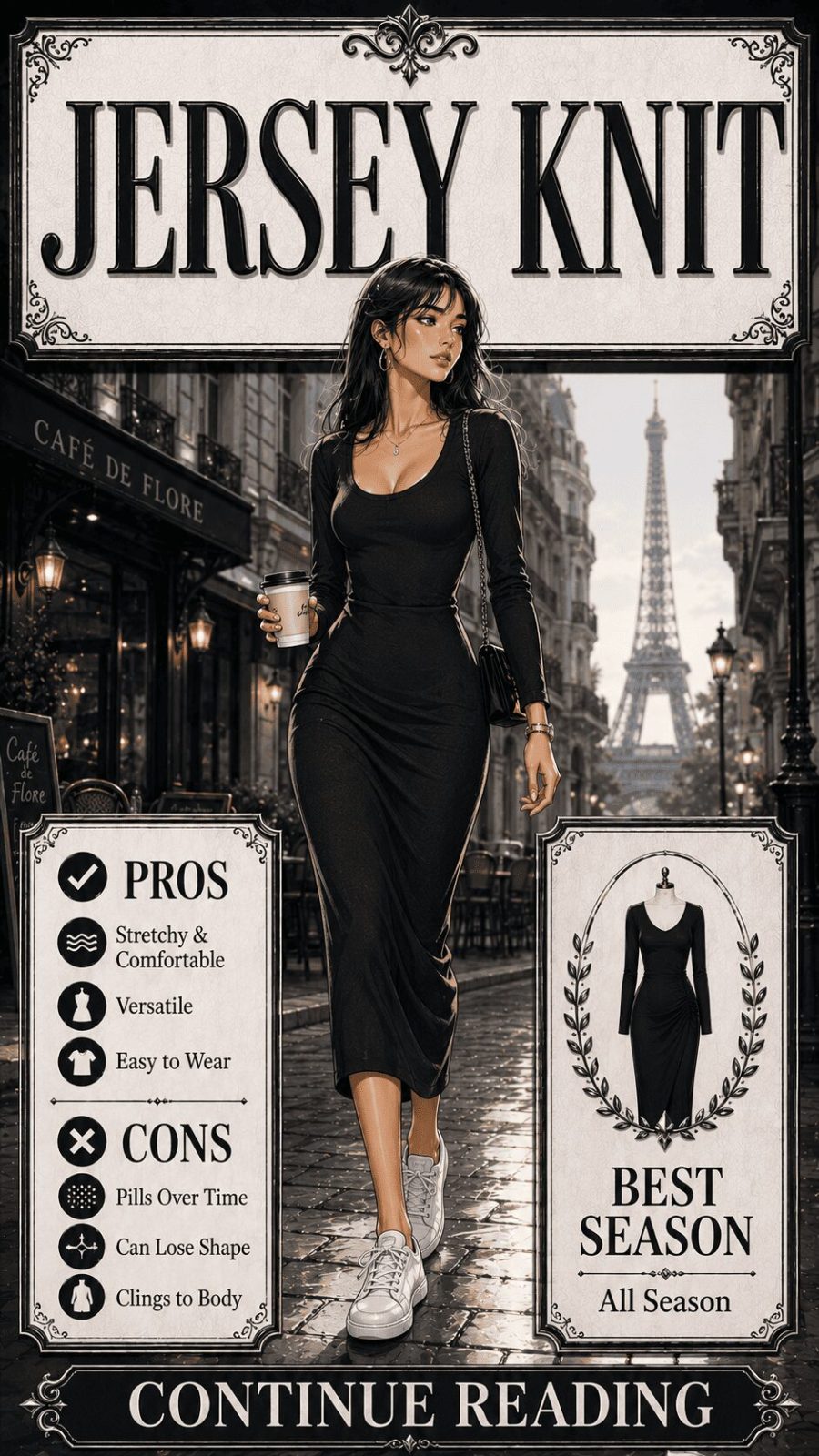
      Jersey Knit

      Jersey Knit Fabric for Women's Clothing

      The most ubiquitous knit construction — produced on circular knitting machines, with a smooth face and a slightly textured back. Single jersey (the standard T-shirt fabric) is lightweight with good horizontal stretch and a slight tendency to curl at the edges. Double jersey is heavier, more stable, and used for dresses and structured casual pieces. The name originates from Jersey, the Channel Island historically associated with wool knitting — long before it became associated with cotton basics.

      DesignSmooth face, slight body, horizontal stretch, matte surface
      SeasonAll seasons by weight
      Best ForT-shirts, casual dresses, everyday basics, layering tops
    2. 60

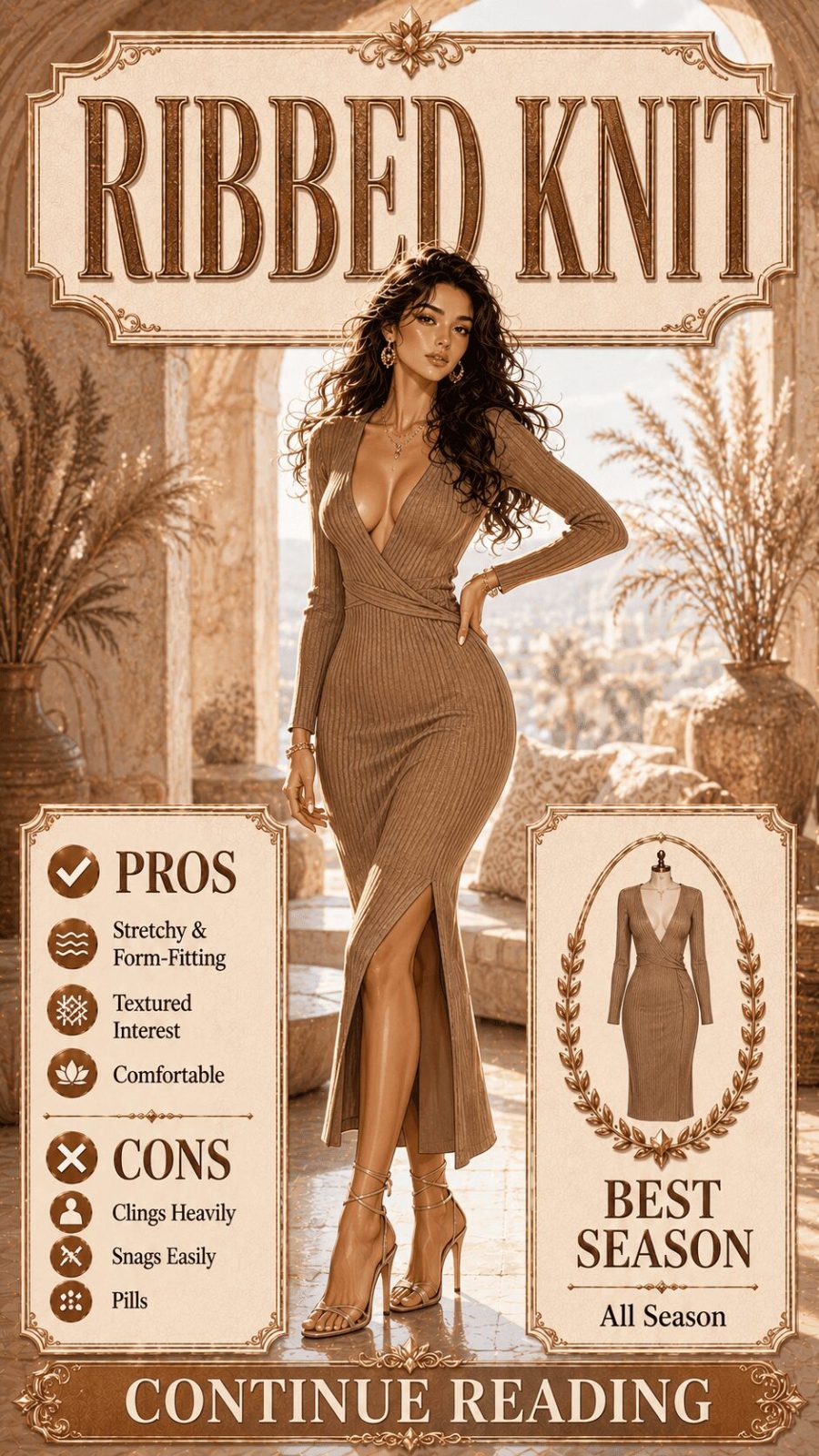
      Ribbed Knit

      Ribbed Knit Fabric for Women's Clothing

      Created by alternating knit and purl stitches in vertical columns, producing the characteristic raised ridges on both sides of the fabric. Ribbed knit has exceptional horizontal stretch and — critically — excellent stretch recovery, snapping back to its original width after being stretched. This makes it the standard for neckbands, cuffs, and waistbands on knitwear. As a fabric in its own right, fine ribbed jersey is the material of the bodycon turtleneck, the fitted top that never sags out of shape.

      DesignVertical ribs on both faces, excellent stretch recovery, body-hugging
      SeasonAll seasons; winter as main fabric, year-round in trim
      Best ForFitted tops, turtlenecks, bodycon dresses, cuffs and neckbands
    1. 61

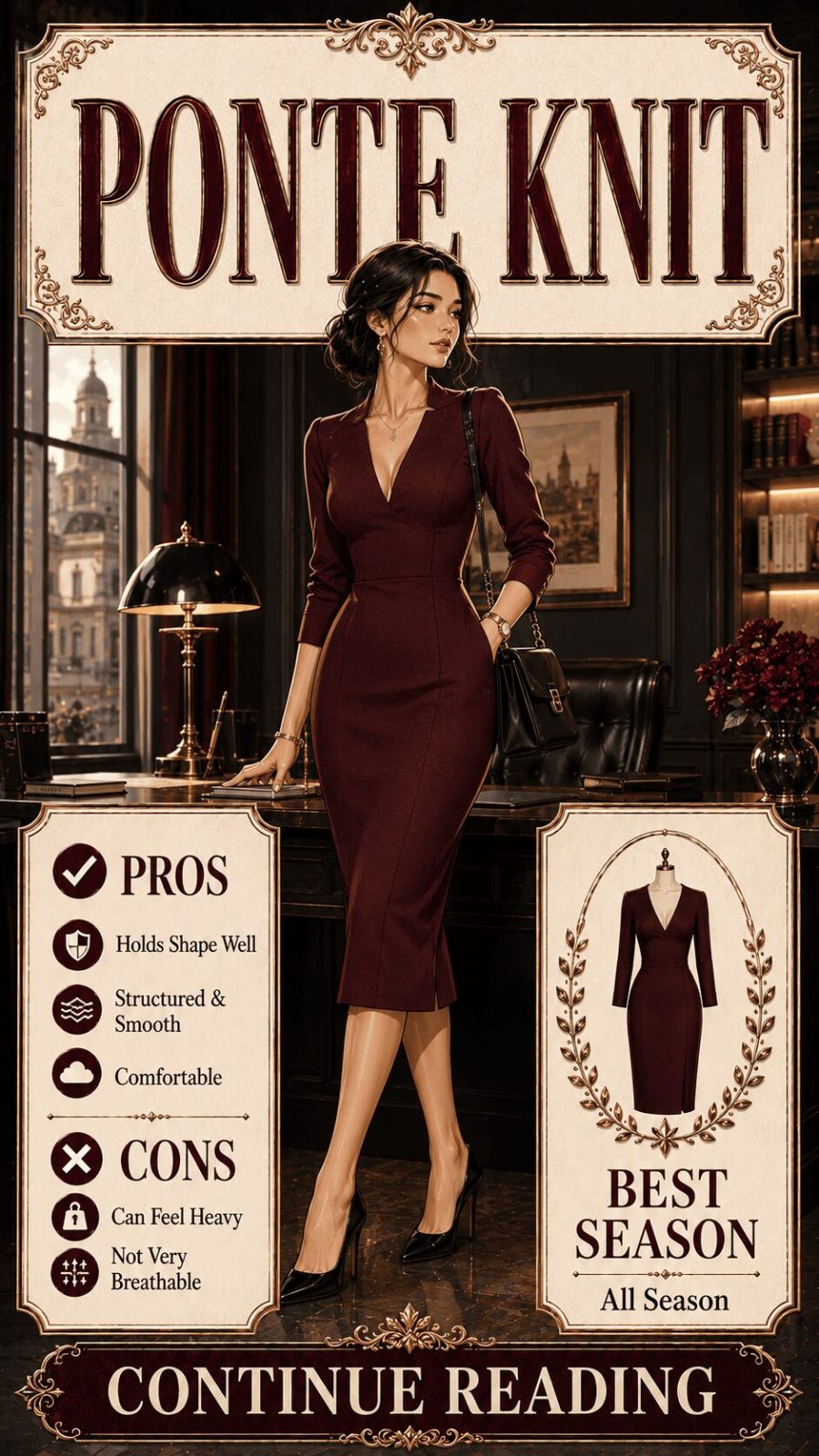
      Ponte Knit

      Ponte Knit Fabric for Women's Clothing

      A double-knit fabric with a smooth surface on both sides and minimal stretch compared to most knits — it holds its shape firmly and has enough body to create structured silhouettes without interfacing. This is the fabric behind the "pull-on blazer" and countless workwear pieces that look tailored but have no rigid construction. Its firmness creates a visual tidiness that softer knits can't achieve. Ponte is the working wardrobe's best friend — if you're not already using it, you probably should be.

      DesignSmooth both sides, firm body, minimal stretch, structured without tailoring
      SeasonAutumn / Winter / Year-round office wear
      Best ForPull-on blazers, office dresses, structured skirts, tailored casual trousers
    2. 62

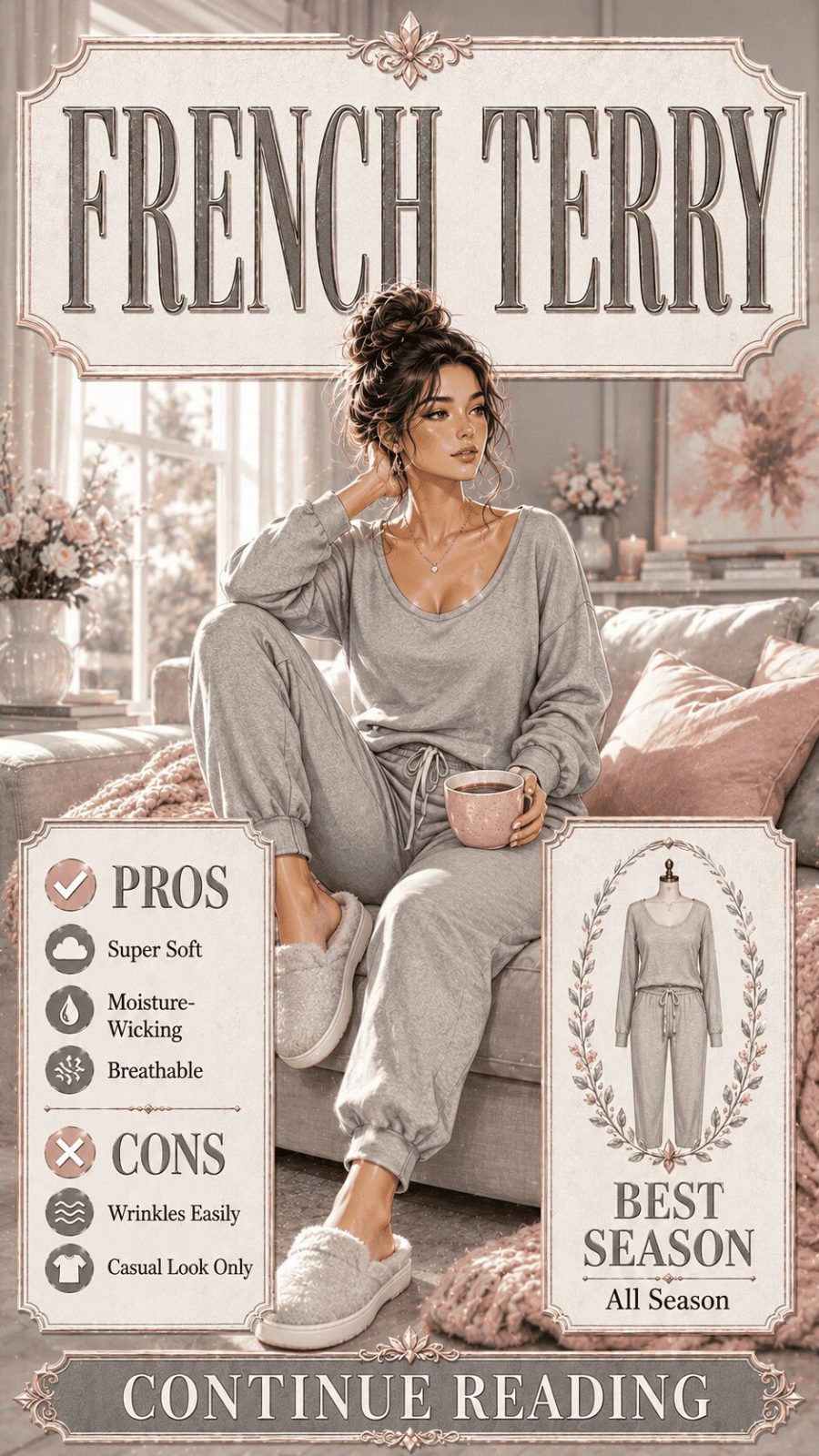
      French Terry

      French Terry Fabric for Women's Clothing

      A looped-back knit fabric with a smooth face and an uncut loop interior — the loops create absorbency and softness without the nap of fleece. Lighter than fleece and more polished-looking, French terry is the fabric of elevated sweatshirts, quality hoodies, and casual-luxe separates. It sits at the precise meeting point of comfort and presentability — which is exactly why athleisure and casual luxury brands use it extensively. You've worn it; you might just not have known the name.

      DesignSmooth face, looped interior, heavier than jersey, slightly structured
      SeasonAutumn / Spring transitional
      Best ForQuality sweatshirts, hoodies, casual-luxe separates, joggers
    1. 63

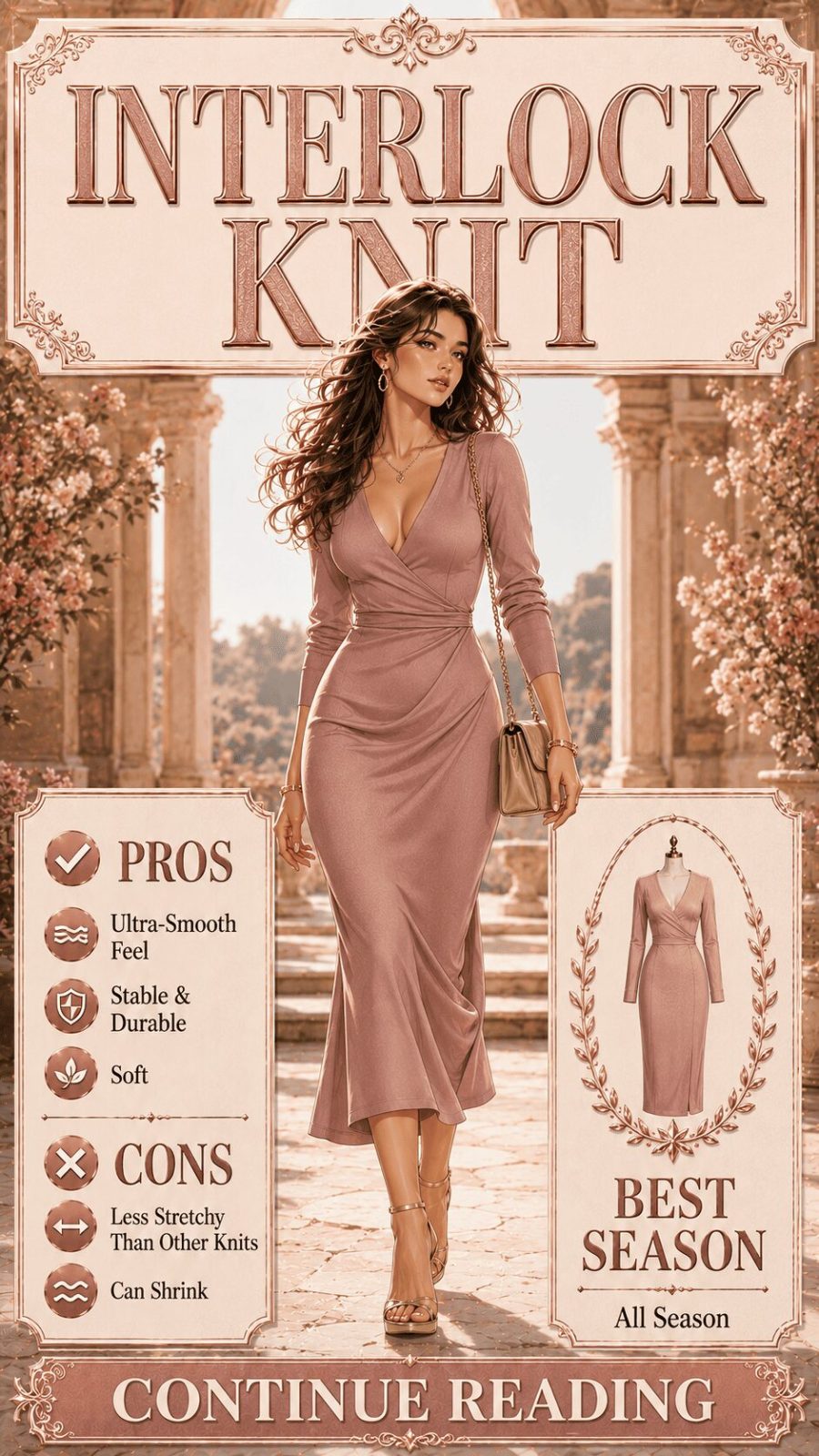
      Interlock Knit

      Interlock Knit Fabric for Women's Clothing

      Two ribbed fabrics knitted together simultaneously, creating a smooth, double-faced fabric that looks identical on both sides. Interlock is thicker and more stable than single jersey, does not curl at the edges, and has a finer, smoother hand than standard rib. It's used for higher-quality T-shirts, baby clothing, and anywhere a stable knit with excellent drape is needed. The lack of edge curl makes it the preferred knit for unfinished hems in minimalist design pieces.

      DesignSmooth both sides, stable, no curl, finer hand than jersey
      SeasonAll seasons
      Best ForPremium basics, T-shirts, underwear, childrenswear, minimalist pieces
    2. 64

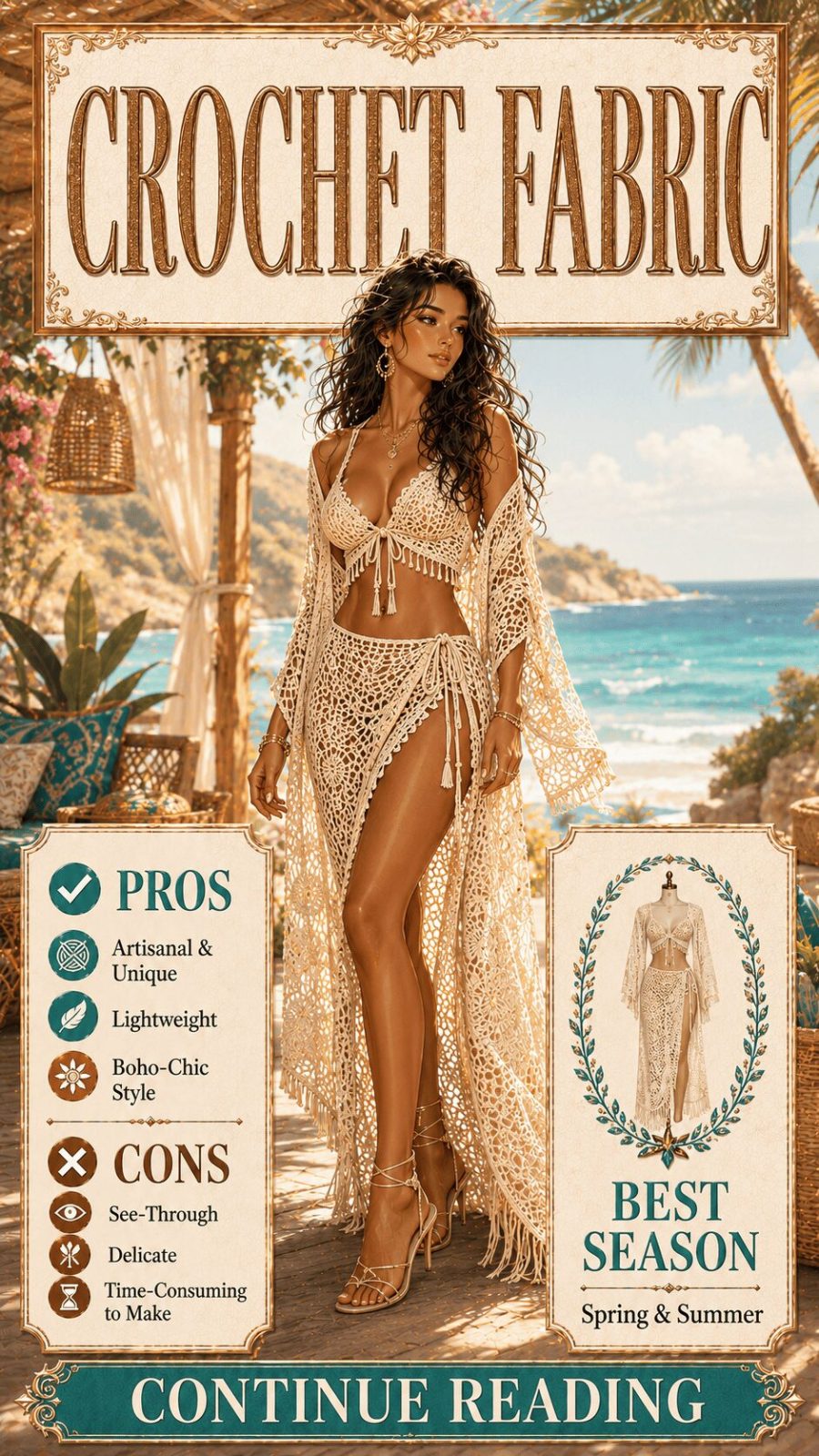
      Crochet Fabric

      Crochet Fabric for Women's Clothing

      Created by interlocking loops using a hooked needle — either by hand or crochet machine — producing an open, textured fabric with visible hole structure and artisan character. Distinct from knitting in that each stitch is completed before the next is started, creating a firmer, more dimensional texture. Machine crochet-look fabric now imitates handmade crochet at scale. In fashion, it peaks during summer — appearing in cover-ups, tops, dresses, and bags — with a beach and festival aesthetic that has persisted across multiple decades.

      DesignOpen-loop texture, artisan quality, visible hole structure, dimensional
      SeasonSpring / Summer
      Best ForBeach cover-ups, summer tops, festival wear, bohemian accessories
    1. 65

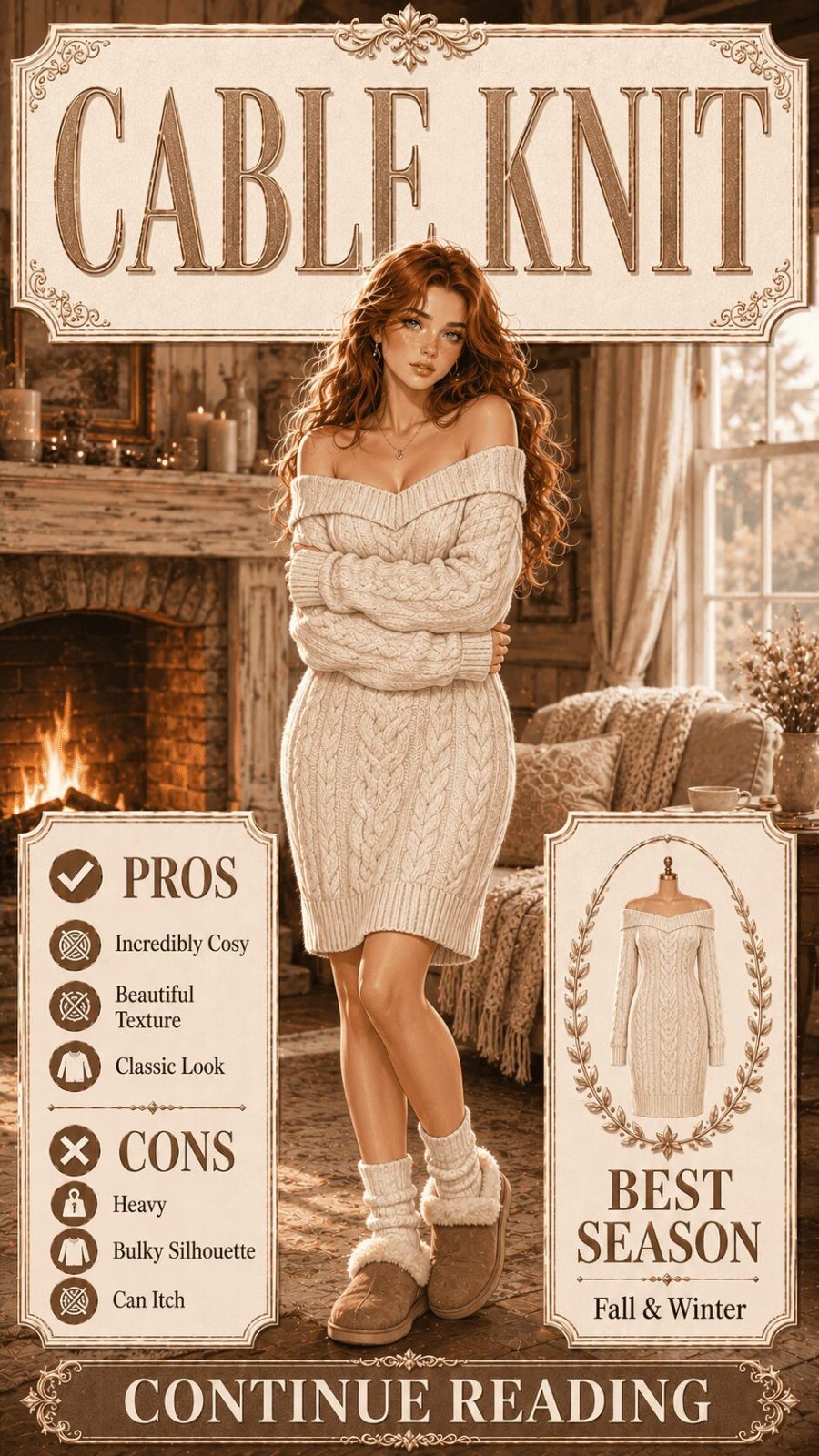
      Cable Knit

      Cable Knit Fabric for Women's Clothing

      A knit pattern where groups of stitches are crossed over each other to create raised, twisted rope-like columns on the fabric surface. Traditional Aran knitting from Ireland's Aran Islands is the most celebrated form — each family historically had distinct cable patterns. Cable knit creates significantly more yarn consumption per area than plain knit, producing a thicker, warmer, and more sculptural fabric. The three-dimensional surface creates dramatic texture without print or embellishment — fashion purely through construction.

      DesignRaised twisted rope columns, three-dimensional texture, thick and warm
      SeasonAutumn / Winter
      Best ForWinter sweaters, chunky cardigans, statement knitwear, festive dressing
    2. 66

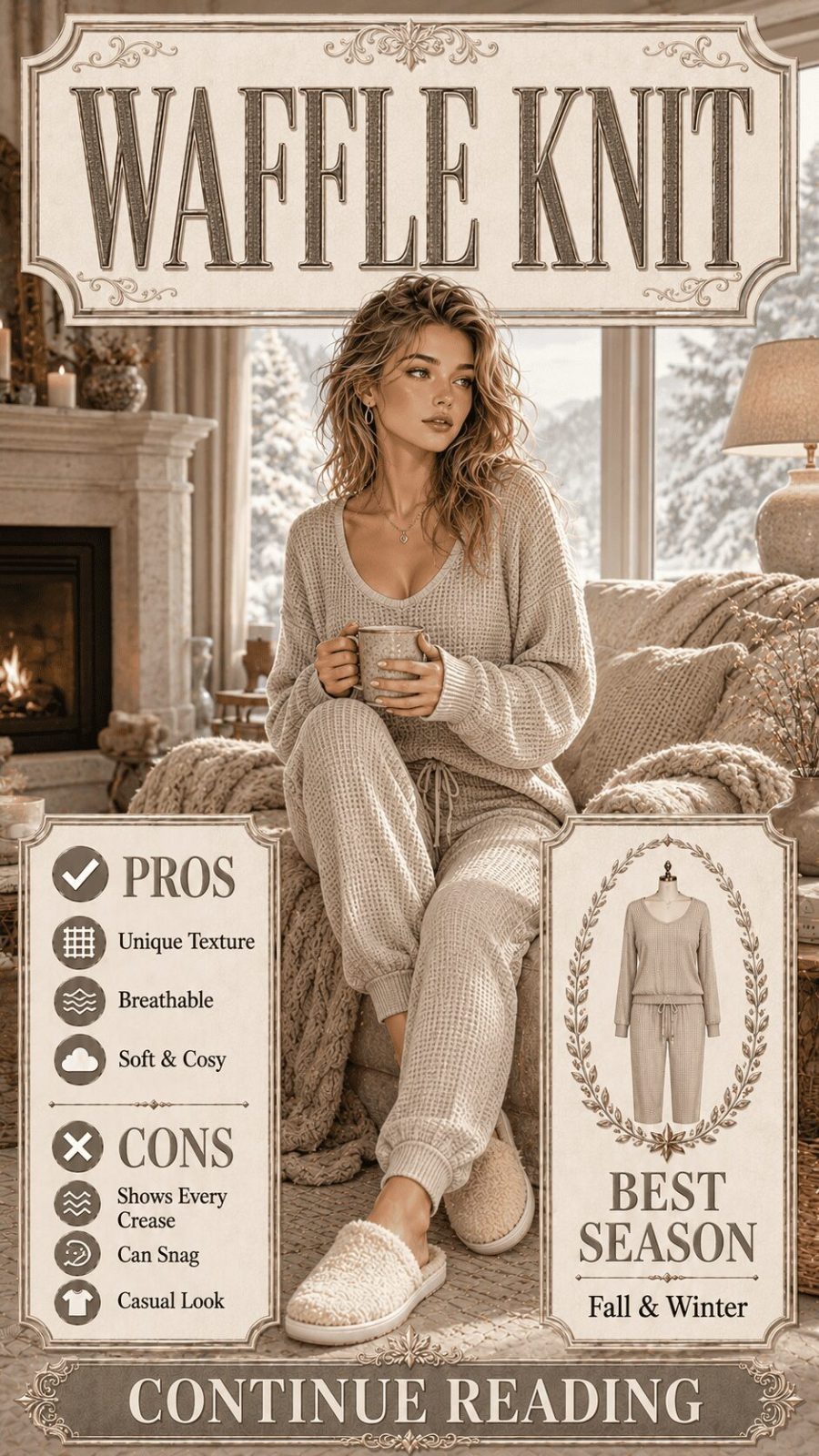
      Waffle Knit

      Waffle Knit Fabric for Women's Clothing

      A textured knit with a distinctive square-indented surface resembling a waffle pattern — created by interspersing purl and tuck stitches in a grid formation. The cells trap air, creating insulation, while the raised grid creates excellent absorbency. Originally a fabric of thermal underwear, waffle knit migrated into casualwear in the 1990s and remains a fixture in cosy loungewear, elevated thermal layers, and effortless autumn casual dressing. It pairs beautifully with denim and relaxed trousers.

      DesignSquare-grid texture, lightweight insulation, tactile and relaxed
      SeasonAutumn / Winter transitional
      Best ForLoungewear tops, thermal layers, casual sweaters, weekend dressing

    Category 7: Fabrics by Season & Climate Suitability (#67–#72)

    The same fibre in a different weight or weave can perform completely differently — season is context, not a fixed rule

    1. 67

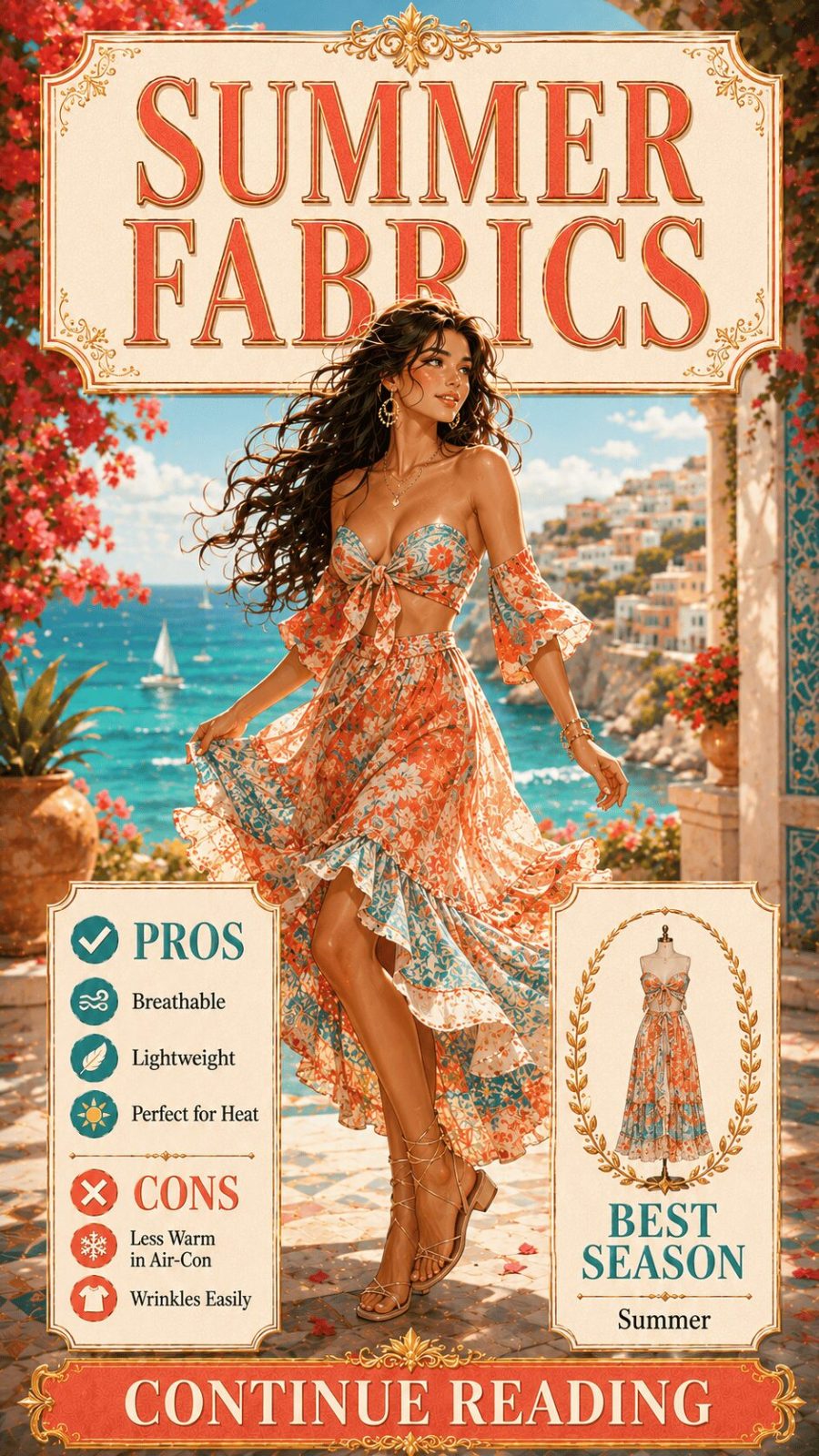
      Summer Fabrics

      Summer Fabrics for Women's Clothing

      The best summer fabrics share one property: they allow heat to escape from the body efficiently. Linen, cotton (especially lawn and muslin weights), chiffon, georgette, seersucker, voile, and bamboo viscose all achieve this through breathability or sheerness. The key distinction most people miss: breathability means air circulates through the fabric; moisture-wicking means sweat is drawn away from skin. The best summer fabrics do both. For a dedicated guide, our overview of summer fabrics for women covers every option in seasonal context.

      Key FabricsLinen, cotton, chiffon, georgette, seersucker, voile, bamboo
      SeasonSpring / Summer
      Best ForDresses, blouses, wide trousers, resort wear, vacation outfits
    2. 68

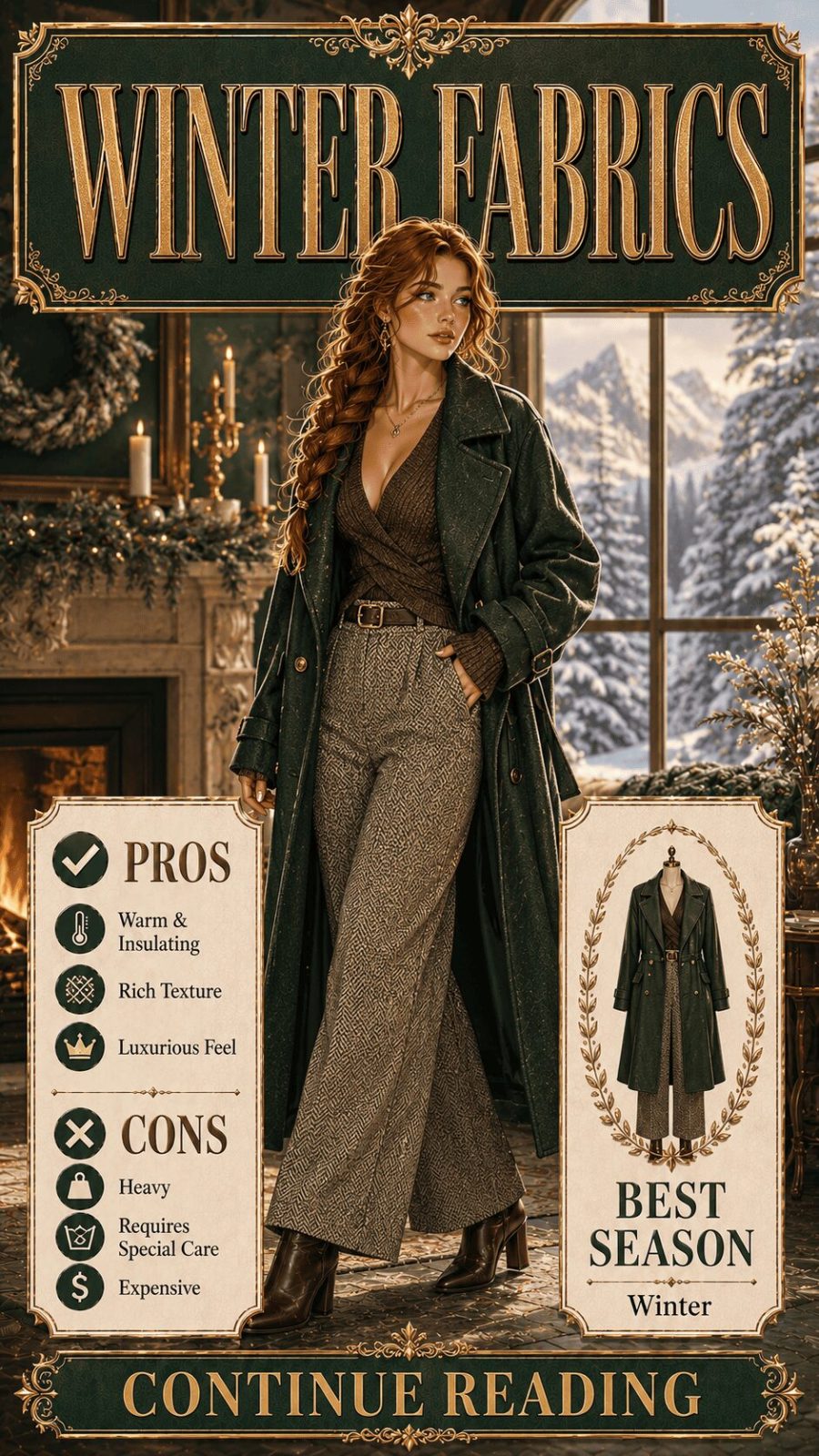
      Winter Fabrics

      Winter Fabrics for Women's Clothing

      Winter fabric performance is about heat retention — trapping warm air close to the body while managing moisture from activity. Wool (particularly merino and cashmere) leads the natural fibre category. Technical fleece and down perform in the synthetic category. Tweed, flannel, velvet, and brocade all provide winter-appropriate insulation at different style registers. The critical layering principle: a moisture-wicking base layer (merino, bamboo) under an insulating mid-layer (wool knit, fleece) under a wind/rain-blocking outer layer. For the complete guide, see our breakdown of winter fabrics for women.

      Key FabricsCashmere, wool, tweed, fleece, flannel, velvet, brocade
      SeasonAutumn / Winter
      Best ForCoats, sweaters, trousers, formal winter dressing, outerwear
    1. 69

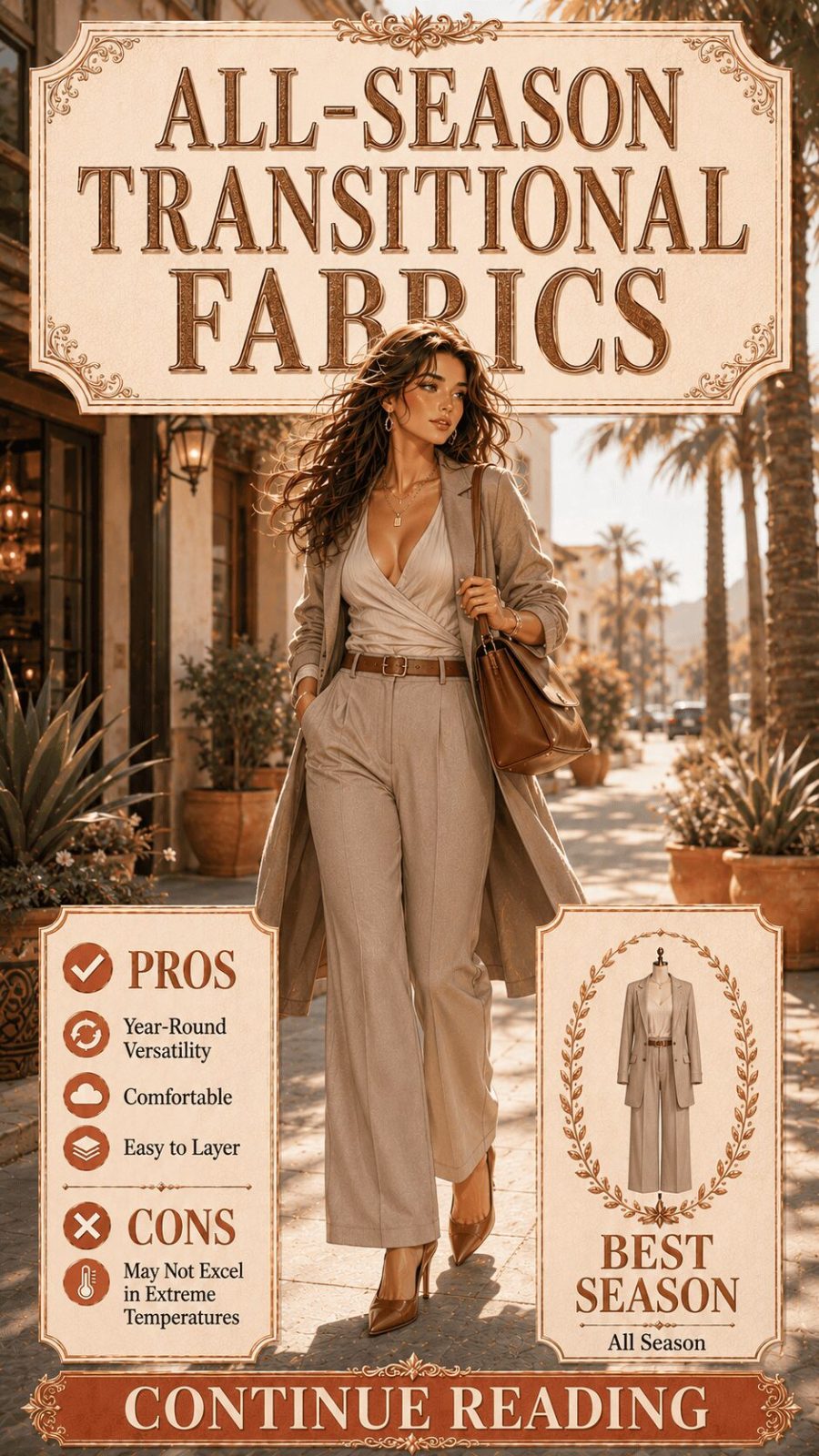
      All-Season Transitional Fabrics

      All Season Transitional Fabric for Women's Clothing

      Certain fabrics perform genuinely well across multiple seasons — not because they compromise on comfort, but because their fibre properties are genuinely temperature-responsive. Merino wool, modal, fine-weight Tencel, crepe, and ponte all fall here. The key indicator: the fabric's ability to regulate temperature rather than simply insulate. Merino actively responds to body heat; modal draws warmth away in summer and retains it modestly in cooler conditions. These are the fabrics that justify a wardrobe built on quality over quantity.

      Key FabricsFine merino, modal, Tencel, crepe, ponte, fine cotton blends
      SeasonYear-round / transitional Spring-Autumn
      Best ForInvestment basics, travel wardrobe, capsule wardrobe essentials
    2. 70

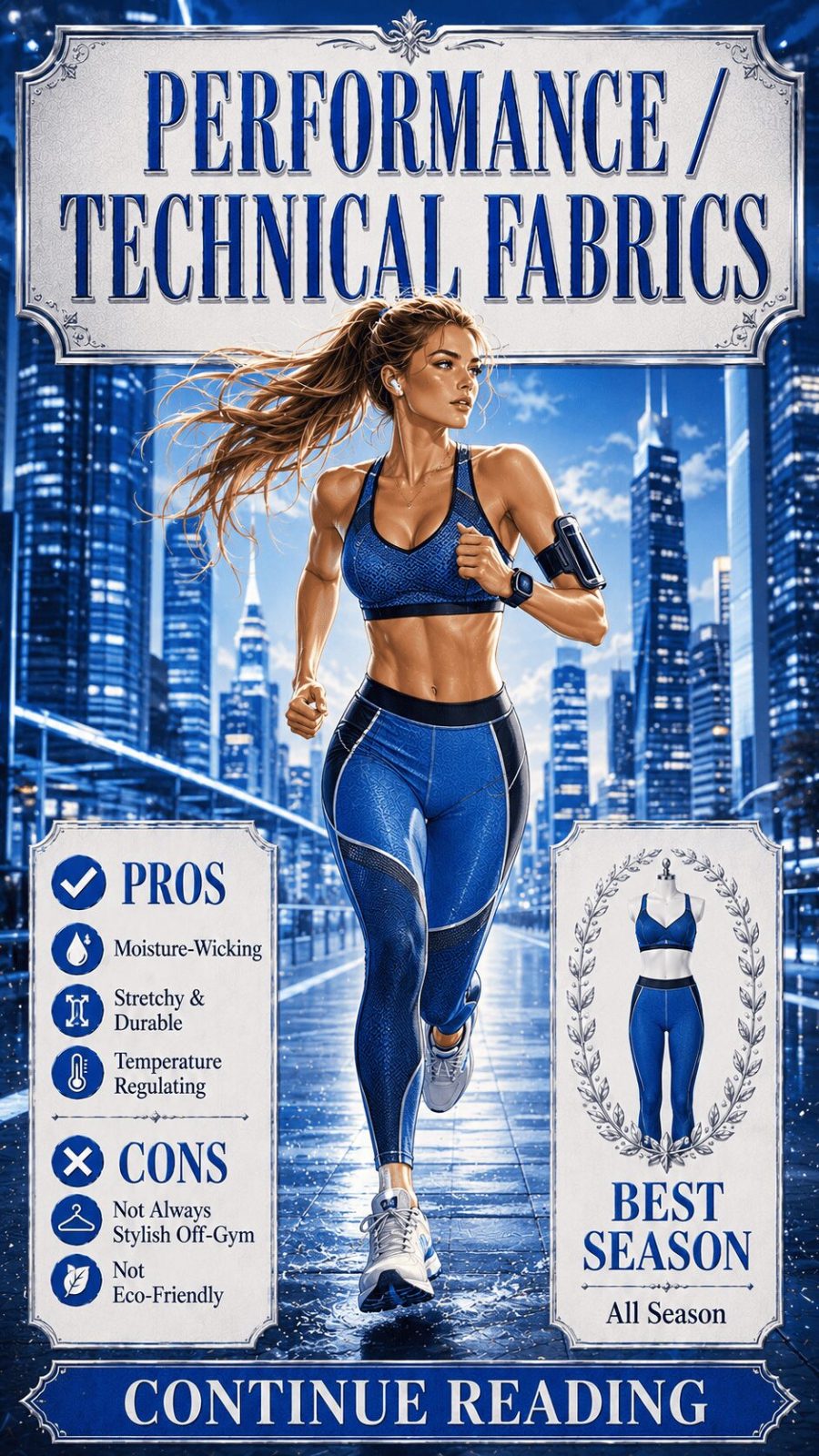
      Performance / Technical Fabrics

      Performance Technical Fabric for Women's Clothing

      Engineered fabrics designed for specific performance outcomes — moisture-wicking, compression, UV-protection, anti-odour, four-way stretch, water-resistance, or temperature regulation through technical means rather than natural fibre properties. Most are polyester or nylon blends with elastane. Brand-specific technologies (Dri-FIT, Climalite, GORE-TEX membrane) are applied treatments or constructions on top of a base synthetic fabric. Performance fabrics have genuinely transformed activewear — the question is whether their benefits justify their environmental cost for non-athletic use.

      DesignEngineered surface treatments, four-way stretch, moisture management
      SeasonActivity-dependent; year-round
      Best ForActivewear, gym wear, yoga, running, outdoor sports
    1. 71

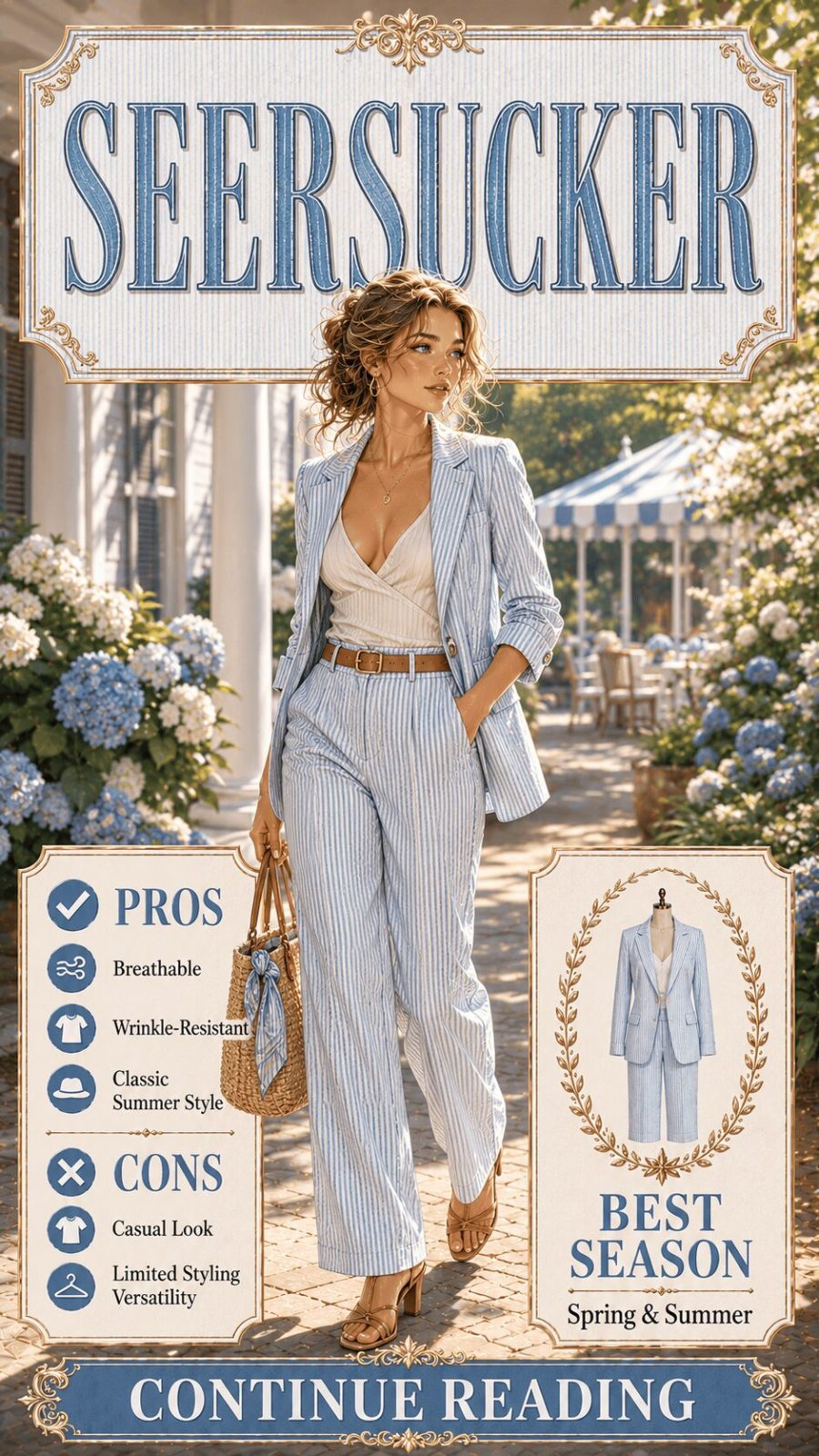
      Seersucker

      Seersucker Fabric for Women's Clothing

      A puckered cotton fabric created by alternating slack and tight warp threads — producing a characteristic crinkled, rippled stripe where the looser threads bubble up from the surface. The name comes from Persian: shir o shakar, meaning "milk and sugar." That puckered surface holds the fabric away from the skin, creating tiny air pockets that improve ventilation in humid heat. It wrinkles acceptably — and in seersucker, wrinkles are entirely expected, even appropriate.

      DesignPuckered, crinkled surface, stripe pattern, holds away from skin
      SeasonSpring / Summer
      Best ForSummer dresses, shorts, smart-casual shirts, resort wear
    2. 72

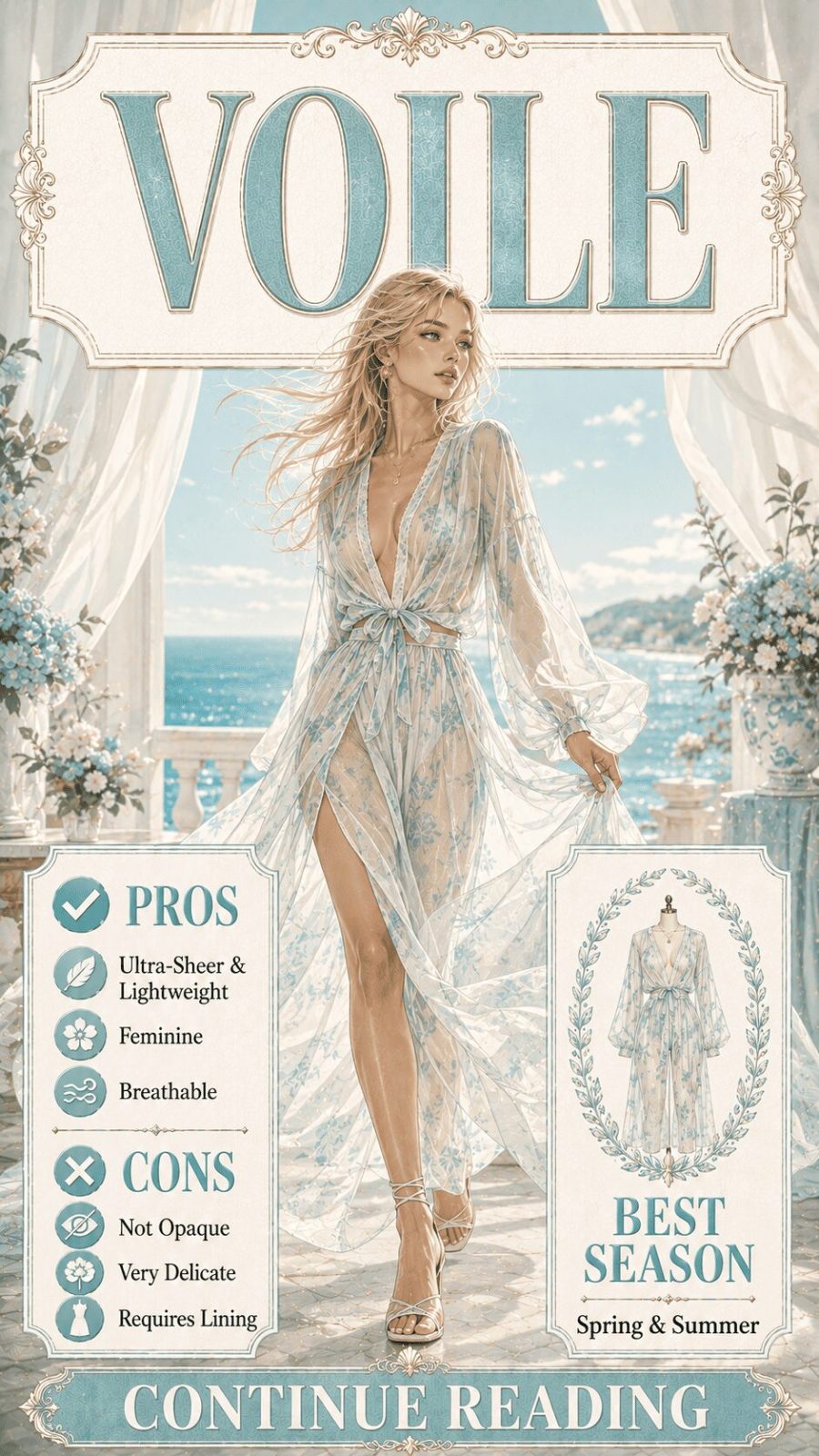
      Voile

      Voile Fabric for Women's Clothing

      A lightweight, sheer plain-weave fabric similar to chiffon but with a slightly firmer, crisper hand due to the use of tightly twisted yarns. Cotton voile is particularly valued — it has the sheerness of chiffon with the natural breathability of cotton, making it genuinely excellent in tropical heat. Swiss cotton voile is the benchmark quality for embroidered and printed summer blouses. Layers beautifully and is far easier to sew cleanly than chiffon, which makes it beloved by garment makers.

      DesignSheer, slightly crisp, light and breathable, good print clarity
      SeasonSpring / Summer
      Best ForSummer blouses, printed tops, light dresses, layering in heat

    Category 8: Sustainable & Innovative Fabrics (#73–#78)

    The next generation of textile materials — where environmental responsibility meets design innovation

    The fashion industry accounts for approximately 10% of annual global carbon emissions — a figure cited consistently across environmental research bodies. Fabric production is a significant driver of that impact. The materials in this category represent genuine efforts to reduce that footprint: through closed-loop production, bio-based alternatives to petroleum synthetics, regenerated waste materials, and agricultural methods that restore rather than deplete soil. Our guide to sustainable fabrics for women covers the verification landscape in detail — what certifications mean, which claims are marketing, and which represent real change.

    1. 73

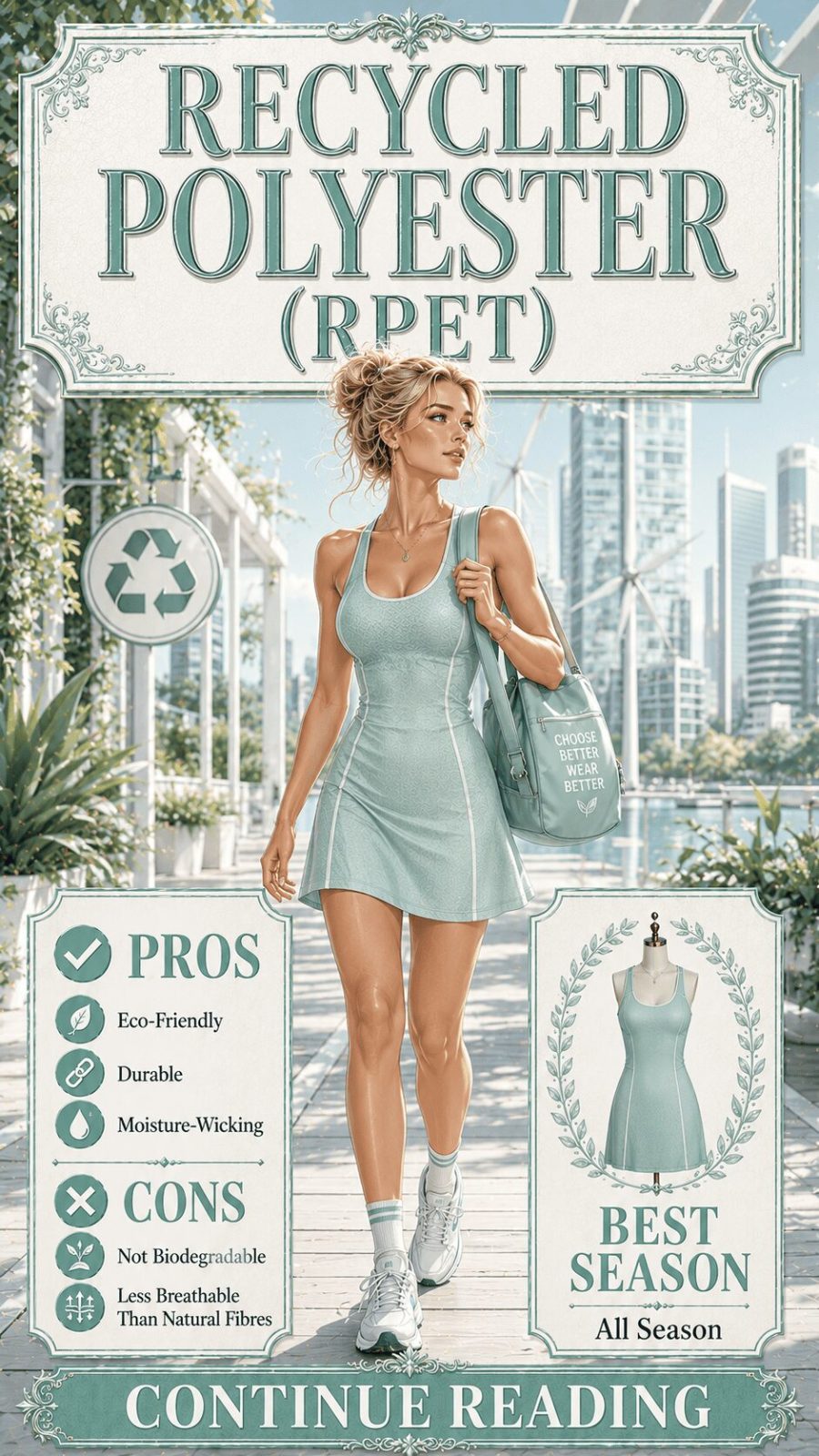
      Recycled Polyester (rPET)

      Recycled Polyester rPET Fabric for Women's Clothing

      Produced by mechanically or chemically processing post-consumer plastic — primarily PET bottles and discarded polyester textiles — into new polyester fibre. The resulting fabric is technically indistinguishable from virgin polyester in performance but requires significantly less energy and produces substantially fewer greenhouse gas emissions in its production. The environmental nuance: rPET still sheds microplastics during washing, and it does not biodegrade. Using a microfibre-catching laundry bag reduces the washing impact considerably.

      DesignIdentical to virgin polyester; look for GRS certification for verification
      SeasonAll seasons
      Best ForActivewear, outerwear, swimwear — anywhere virgin polyester would be used
    2. 74

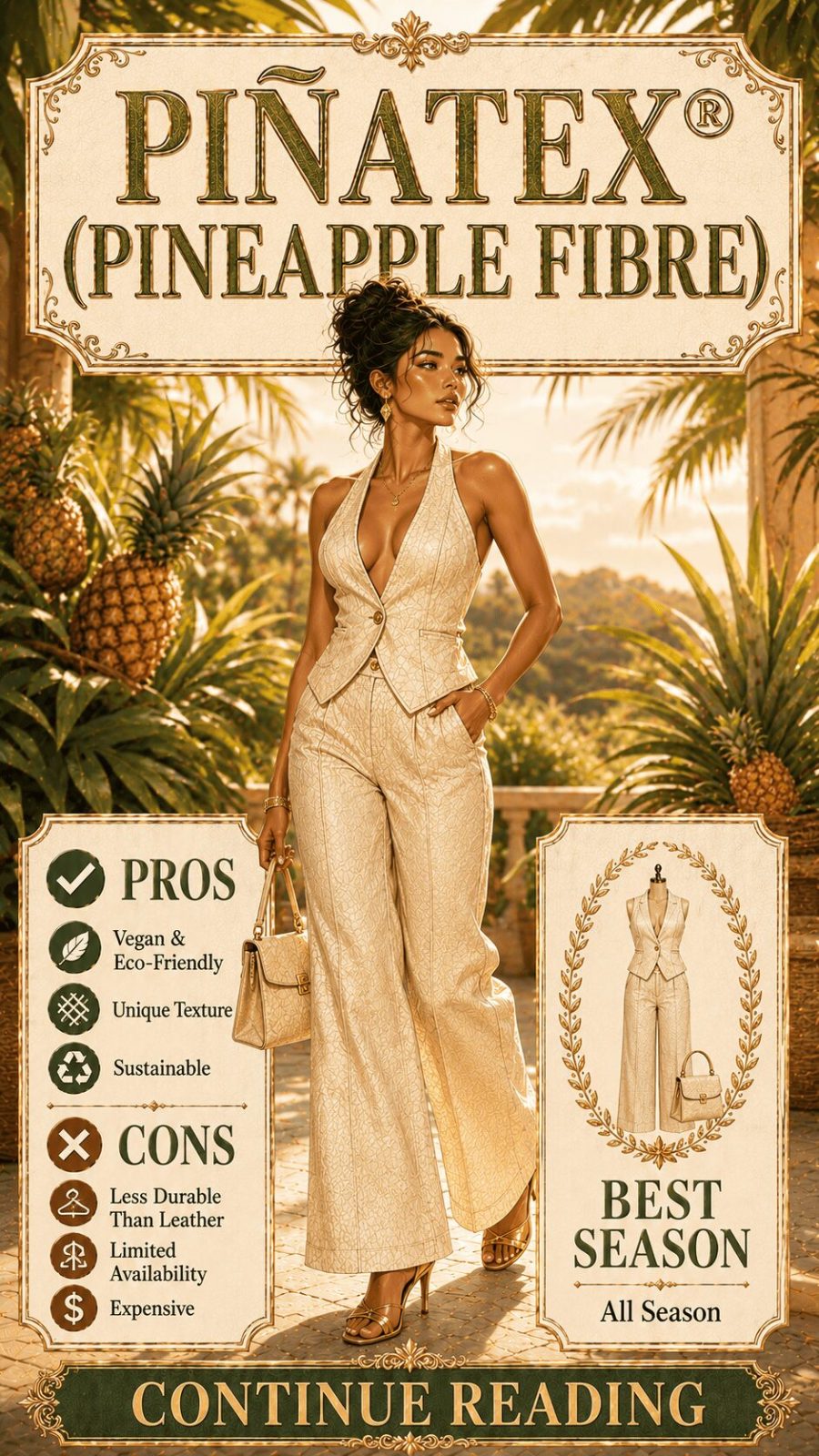
      Piñatex® (Pineapple Fibre)

      Pinatex Pineapple Fabric for Women's Clothing

      A non-woven textile made from the long fibres of pineapple leaves — agricultural by-product from pineapple harvests, previously discarded or burned. Developed by Dr. Carmen Hijosa and commercialized by Ananas Anam, Piñatex has a slightly rough, natural texture that resembles leather. It's used in bags, shoes, accessories, and occasional fashion pieces as an alternative to both leather and PU. The supply chain is genuinely innovative; the current durability still trails real leather, which manufacturers are working to address.

      DesignLeather-like texture, natural colour, slightly rough surface
      SeasonAll seasons; accessories year-round
      Best ForBags, shoes, accessories, vegan fashion statement pieces
    1. 75

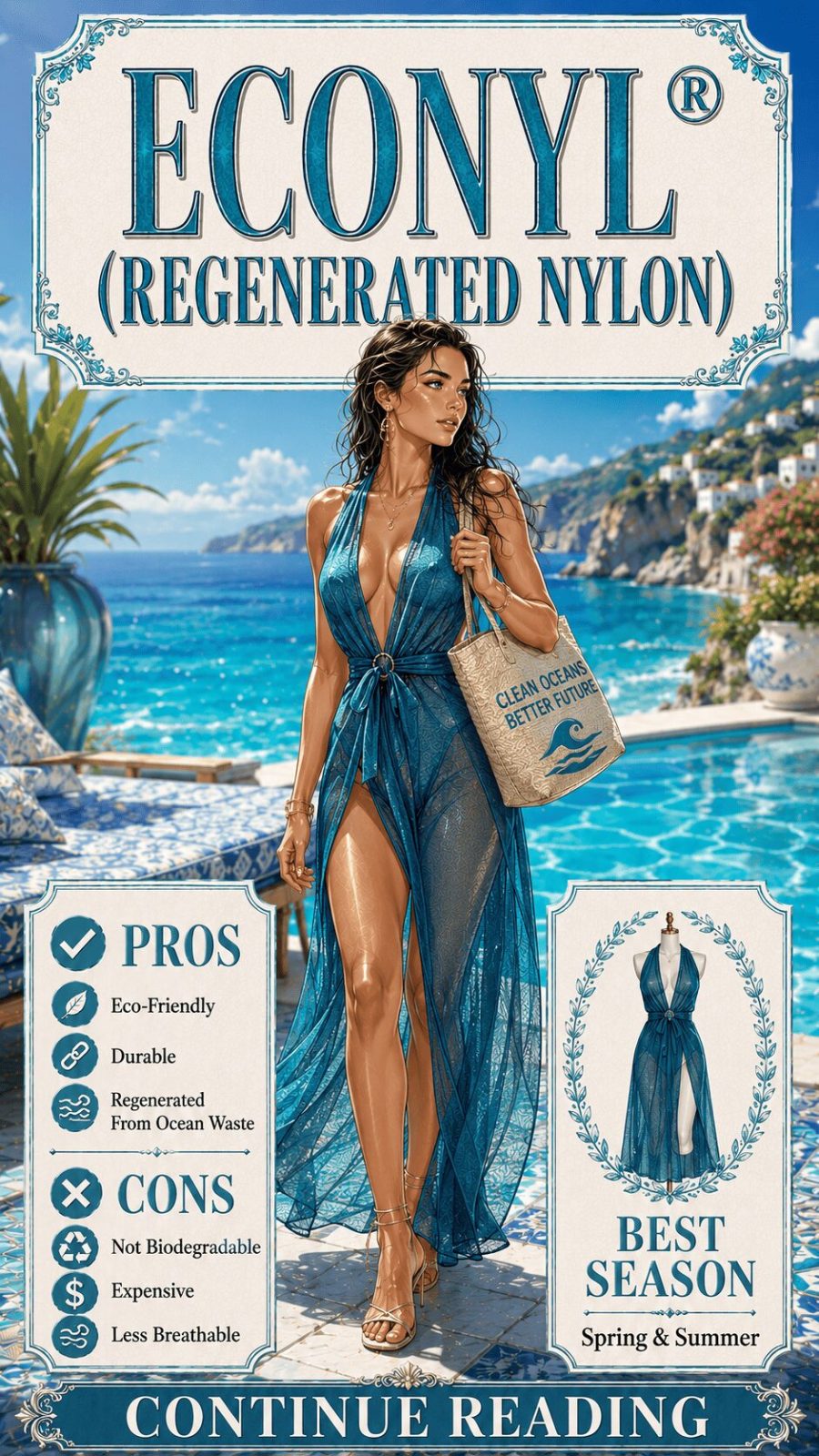
      Econyl® (Regenerated Nylon)

      Econyl Regenerated Nylon Fabric for Women's Clothing

      Produced by Aquafil, Econyl regenerates nylon from discarded fishing nets, fabric scraps, and industrial plastic waste through a chemical recycling process that restores the nylon to virgin quality — meaning it can be recycled repeatedly without degradation. The result is a nylon with identical performance to virgin nylon and a significantly reduced environmental footprint. It's now widely used in swimwear and activewear by brands committed to reducing ocean plastic pollution specifically.

      DesignIdentical to virgin nylon; look for Econyl® trademark for authenticity
      SeasonAll seasons
      Best ForSwimwear, activewear, sportswear, sustainable fashion
    2. 76

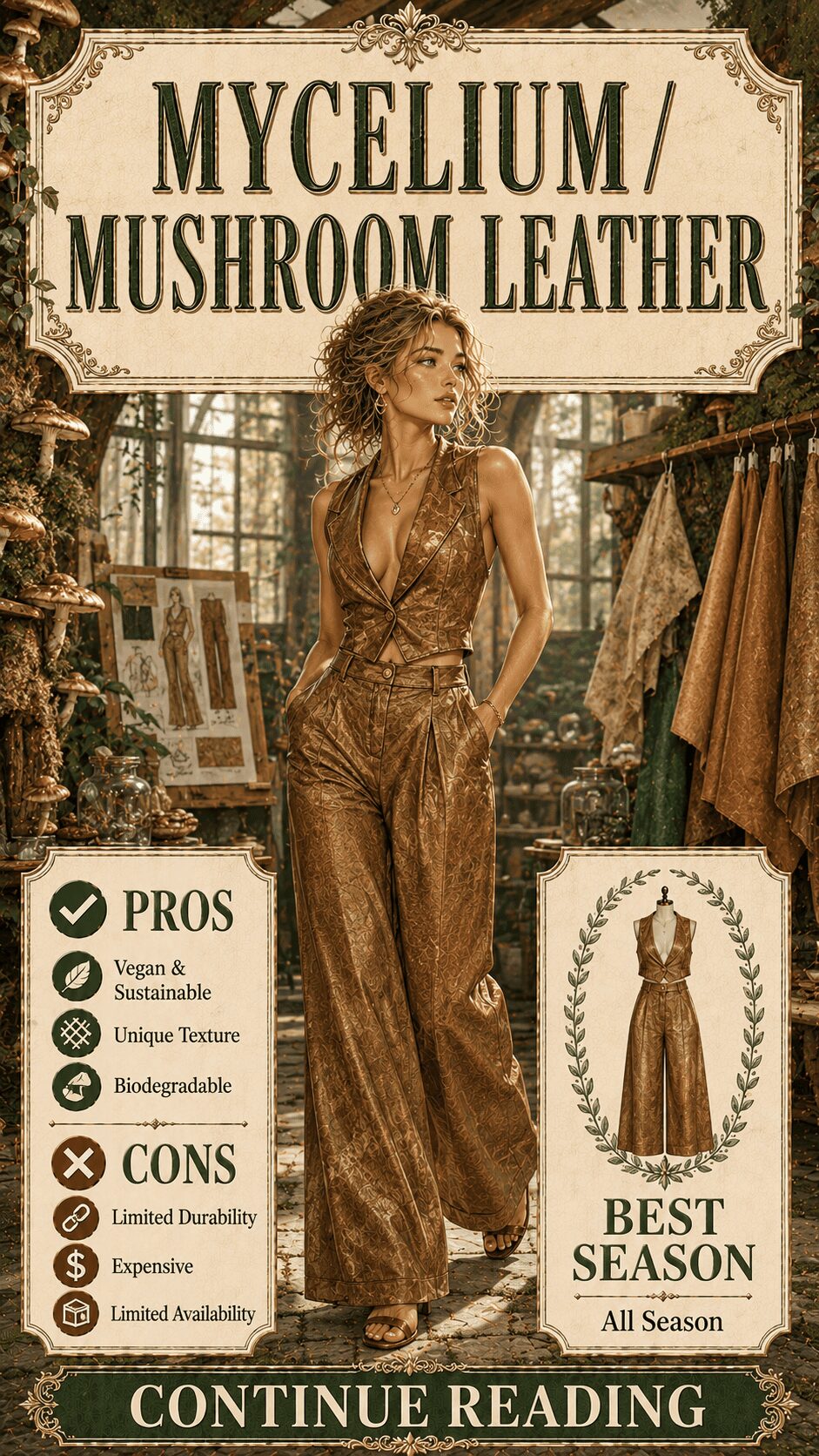
      Mycelium / Mushroom Leather

      Mycelium Mushroom Leather Fabric for Women's Clothing

      Bio-fabricated from the root structure of mushrooms — mycelium networks grown on agricultural waste substrates and then processed into flexible sheets. Bolt Threads (Mylo™) and Ecovative are the most prominent developers. The resulting material is soft, flexible, and leather-like, biodegrades at end of life, and is produced in days rather than years. Luxury fashion has taken notice: Stella McCartney, Hermès, and Adidas have all used mycelium materials in limited collections. Still in early commercial stage but increasingly viable.

      DesignSoft, leather-like, natural colour variation, biodegradable
      SeasonAll seasons; primarily accessories
      Best ForBags, accessories, luxury sustainable fashion pieces
    1. 77

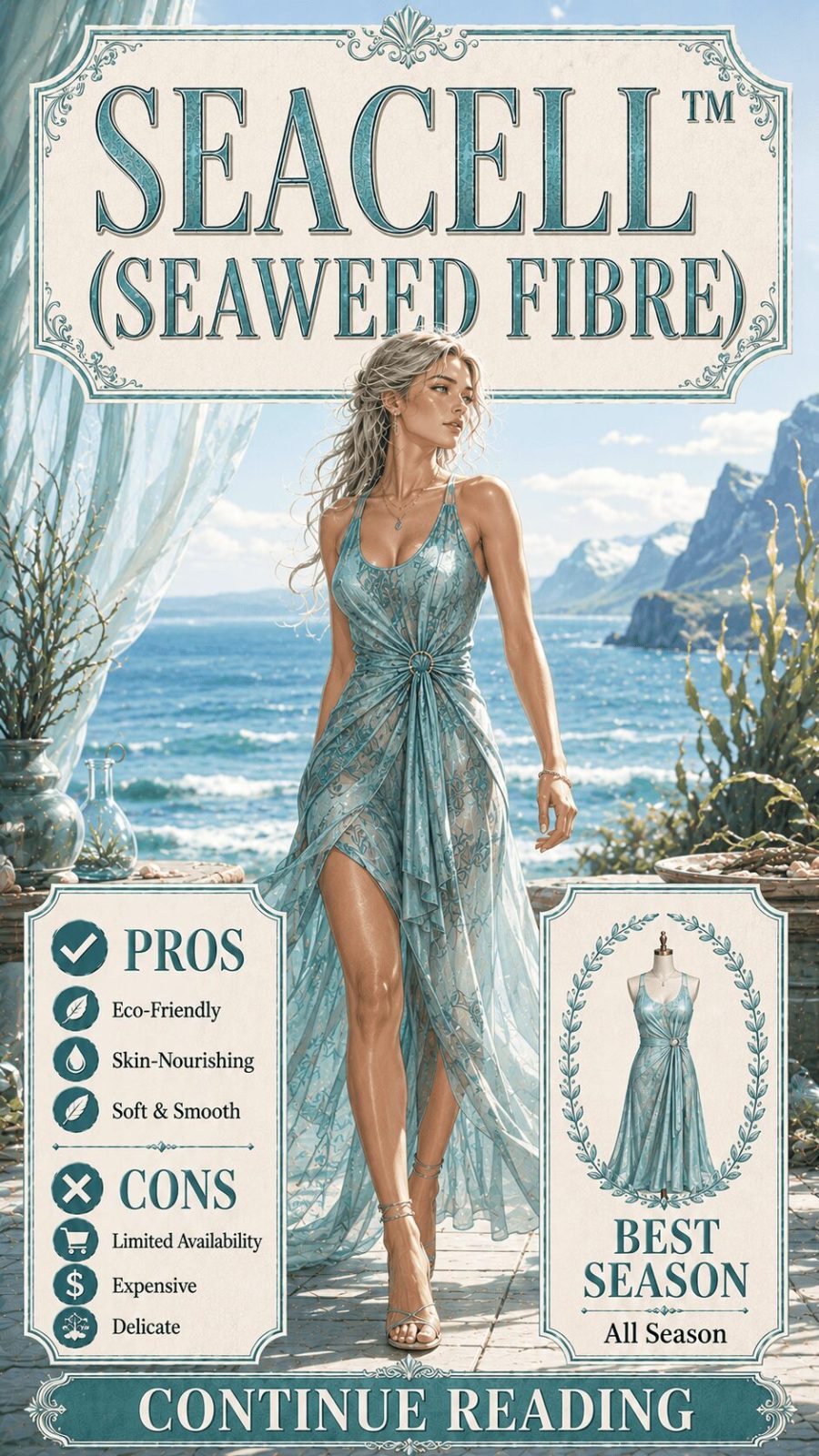
      SeaCellâ„¢ (Seaweed Fibre)

      SeaCell Seaweed Fibre Fabric for Women's Clothing

      A lyocell-based fibre incorporating seaweed — harvested from the coast of Iceland and incorporated into the fibre during the closed-loop lyocell production process. The seaweed content is said to retain minerals and trace elements that have skincare benefits through contact with the skin. Whether these benefits are preserved through processing and washing is a nuanced scientific question, but the fibre itself is genuinely sustainable, soft, and biodegradable. Most commonly blended with other fibres in premium underwear and base layers.

      DesignSoft lyocell-like hand, slight natural green tint in raw state, biodegradable
      SeasonAll seasons; base layers year-round
      Best ForUnderwear, base layers, sensitive skin garments, sustainable luxury basics
    2. 78

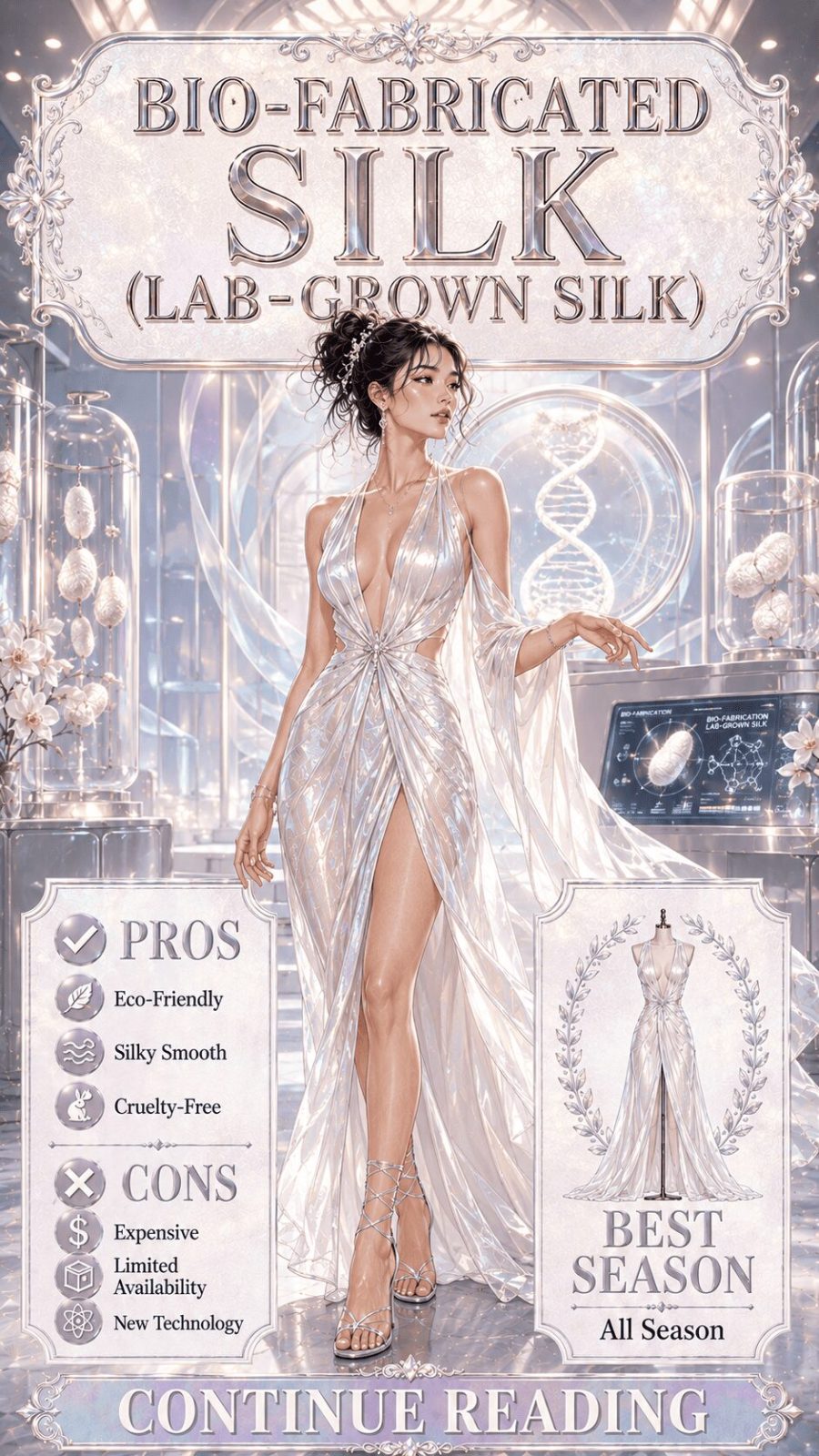
      Bio-Fabricated Silk (Lab-Grown)

      Bio-Fabricated Lab-Grown Silk Fabric for Women's Clothing

      The frontier of fabric science — synthetic biology companies including Bolt Threads (Microsilk™), Spiber (Brewed Protein™), and AMSilk (Biosteel) are engineering proteins that replicate silk's properties using fermentation rather than silkworm cultivation. The proteins are brewed from genetically engineered microbes fed on plant sugars, then spun into fibre. Early commercial applications have appeared in collaboration with luxury brands. The performance potential — spider silk has greater tensile strength than steel by weight — makes this one of the most genuinely exciting developments in textile innovation in decades.

      DesignSilk-like in drape and hand; currently in limited luxury applications
      SeasonOccasion / luxury / innovation-forward fashion
      Best ForLuxury occasionwear, innovation collaborations, future sustainable fashion

    Frequently Asked Questions: Types of Fabric for Women's Clothing

    1. Q

      What is the most breathable fabric for women's clothing?

      Linen is broadly considered the most breathable natural fabric — its hollow fibre structure allows more air circulation than cotton. Among plant fibres, it outperforms cotton consistently in high-heat conditions. Cotton muslin, voile, and seersucker also perform extremely well. Among semi-synthetics, Tencel (lyocell) and bamboo viscose offer good breathability. The key is fibre type plus weave construction: a tightly woven fabric in a breathable fibre will perform less well than a loose weave in the same fibre.

    2. Q

      What is the difference between polyester and nylon?

      Both are petroleum-based synthetic fibres, but they differ meaningfully in properties. Nylon is stronger, more abrasion-resistant, and has a slight natural lustre that polyester lacks. Polyester is more resistant to UV degradation, holds colour slightly better, and dries faster. Nylon tends to absorb slightly more moisture than polyester. In fashion, nylon dominates in hosiery, swimwear, and performance outerwear where durability matters; polyester is more prevalent in casual wear, linings, and cost-sensitive production.

    3. Q

      What fabric is best for sensitive skin?

      For sensitive skin, fibre smoothness and chemical processing are the two key variables. Organic cotton, bamboo viscose, modal, and Tencel are consistently well-tolerated — all have smooth fibre surfaces without the scale structure that makes standard wool irritating. Silk is hypoallergenic and is one of the least reactive natural fibres. Avoid synthetic fabrics in direct skin contact if you experience reactions, as they tend to trap heat and moisture rather than manage it. Certifications to look for: GOTS (organic), OEKO-TEX Standard 100 (chemical safety), and Bluesign (processing standards).

    4. Q

      How do I tell the difference between silk and polyester satin?

      The most reliable test is the burn test — a small thread from a seam allowance: silk burns slowly, smells like burnt hair, and leaves a crushable ash. Polyester melts rather than burns, smells like plastic, and leaves a hard bead. In hand, real silk warms quickly against skin (it conducts heat); polyester stays cool longer. Silk also wrinkles more readily and recovers less quickly than polyester satin. In a retail environment, silk typically has a subtle, complex lustre that shifts with viewing angle; polyester satin has a more uniform, "flat" shine.

    1. Q

      What is the most sustainable fabric for clothing?

      Sustainability in fabric is genuinely complex — it involves fibre source, processing method, transport, care requirements, and end-of-life options. Among accessible options, organic linen and organic cotton processed with GOTS certification are among the lowest-impact plant fibres. Tencel (closed-loop lyocell) is the most responsibly produced semi-synthetic. Recycled polyester (rPET) is better than virgin polyester but not a complete solution due to microplastic shedding. The most sustainable fabric is the one already in your wardrobe, cared for properly to maximise lifespan.

    2. Q

      What is the difference between viscose and modal?

      Both are cellulose-based regenerated fibres derived from wood pulp, but modal is a second-generation improvement of viscose. Modal uses beechwood as its source material and an enhanced production process that produces finer, stronger fibres with better wet strength, better resistance to shrinkage, and a notably softer, cooler hand than standard viscose. Viscose is more widely produced and less expensive; modal costs more but performs better in everyday wear — particularly for basics where softness and durability over repeated washing matter.

    3. Q

      What fabric holds its shape best without tailoring?

      Ponte knit is the clear answer for knitted fabrics — its double-knit construction holds shape without wrinkling or sagging, making it the default for pull-on office wear that looks structured without rigid tailoring. Among woven fabrics, gabardine, heavy crepe, and poplin hold their shape well through the day. For structured garments that must retain silhouette through movement, fabrics with a small percentage of elastane add recovery; for silhouettes that should hold without movement, heavier wovens or stiff interfacing achieve the same result through different means.

    4. Q

      What fabrics are best for occasion and eveningwear?

      The strongest occasion fabrics share two qualities: elevated visual surface and controlled drape. Silk charmeuse and silk satin lead for fluidity and luminosity. Velvet provides rich colour depth and tactile drama. Brocade and Jacquard add woven pattern authority. Organza creates sculptural volume. Lace adds decorative delicacy. For budget-conscious occasion dressing, polyester satin and chiffon can perform respectably in controlled lighting; the key is construction quality rather than fabric alone — a well-cut polyester gown outperforms a poorly cut silk one consistently.

    5. Q

      How do I care for delicate fabrics to extend their lifespan?

      The most impactful care habits for delicate fabrics: wash silk and wool in cold water only (heat denatures protein fibres); lay wool flat to dry to prevent gravity-stretch; store silk away from direct light (it degrades under UV); use a mesh laundry bag for anything with elastane, lace, or sequins; steam velvet rather than ironing (direct heat crushes the pile permanently); and air garments between wears rather than washing after every use — most natural fibres recover naturally from light wear without washing. Frequency of washing is the single biggest factor in fabric longevity.

    Conclusion: Fabric Literacy Is Fashion Intelligence

    Seventy-eight types. Eight classification systems. Fibre origin, season, and best-use context for every single entry.

    What this guide does — ultimately — is give you vocabulary. And in fashion, vocabulary is genuinely practical currency. The difference between "I want something smooth and flowy for a summer dinner" and being able to identify a silk charmeuse slip dress or a viscose georgette blouse is enormous. One ends in frustration and impulse purchases that don't quite work. The other ends with garments that perform exactly as expected, season after season.

    The classification framework here — natural plant, natural animal, semi-synthetic, fully synthetic, woven constructions, knit constructions, seasonal suitability, and sustainable innovation — mirrors the way professional textile buyers, fashion designers, and experienced stylists think about cloth. It isn't specialist knowledge. It's organized thinking applied to a category that the fashion industry has always had an interest in keeping opaque. Transparent fabric knowledge is good for consumers. It's not always good for brands selling low-quality materials at high-quality prices.

    To build on what you've learned here, our complete guides to cotton fabric varieties, silk fabric types, and wool fabric varieties each go deeper into their respective categories. And when you're ready to apply this knowledge to specific garment types, our comprehensive guides to women's dress types and women's top styles show fabric knowledge in practical garment context.

    Key Takeaways
    • 78 fabric types documented across 8 systems — natural plant-based, animal-derived, semi-synthetic, fully synthetic, woven constructions, knit constructions, seasonal suitability, and sustainable innovation.
    • Fibre origin ≠ fabric performance. The same fibre (cotton, polyester, silk) can produce completely different fabrics depending entirely on weave or knit structure. Knowing both fibre and construction is the complete picture.
    • Breathability is structural, not just fibre-based. A loosely woven cotton breathes better than a tightly woven cotton. Weave density matters as much as fibre type for warm-weather comfort.
    • Semi-synthetics are the most underrated category. Modal, Tencel, and cupro often out-perform both natural fibres and full synthetics in everyday wearability — softer than cotton, more sustainable than polyester, more affordable than silk.
    • Satin is a weave, not a fibre. Silk satin, polyester satin, and cotton sateen are all satin-weave fabrics — the lustre comes from the long float structure of the weave, not the fibre itself. This distinction matters enormously when shopping.
    • Sustainable fabric claims require scrutiny. GOTS, OEKO-TEX Standard 100, GRS, and Bluesign certifications are verifiable. Marketing language ("eco-friendly," "natural-feel," "green") without certification backing is often unverified. Learn the certifications, not the adjectives.
    • Care is the biggest factor in longevity. How you wash, store, and wear a garment determines its lifespan far more than fabric type alone. Cold wash, air dry, steam rather than iron where possible — these habits extend any fabric's useful life significantly.
    • The best investment fabrics are genuinely temperature-responsive. Merino wool, fine cashmere, Tencel, and silk all actively manage body temperature rather than simply insulating. These are the fabrics that justify year-round, multi-occasion use.
    • Innovation is accelerating in sustainable textiles. Mycelium leather, bio-fabricated silk proteins, and Econyl represent a generation of materials that may substantially change fashion's environmental footprint within the next decade. Following these developments is increasingly relevant to conscious purchasing decisions.

    Sources & Further Reading

    This guide was compiled through analysis of textile science references, fashion history records, industry glossaries, and sustainability certification frameworks. All classification decisions are editorial. Last reviewed: June 2026.