

There’s a moment — you’re stepping off a plane, sand still an hour away, sun warming your arms through the airport glass — when the right beach dress feels less like an outfit and more like a decision. Not just about fabric or hem length, but about who you want to be on this trip. Beach dresses are not a single garment. They are an entire language — of silhouette, occasion, drape, and attitude — and once you understand that language, every coastal trip, resort week, or sunny afternoon gets easier to dress for.
Beach dresses are the most expressive category in warm-weather dressing. And, honestly, the most underestimated.
The modern beach dress has roots deeper than most people realize. Resort wear as a distinct fashion category emerged in the 1920s and 1930s, when wealthy Americans and Europeans began spending extended winters in warm-climate destinations — and needed garments that existed between swimwear and formal evening dress. The kaftan’s lineage extends thousands of years through North Africa and the Middle East. The sarong dress is rooted in Southeast Asian traditional textile traditions that predate Western fashion entirely. Today, the category spans everything from barely-there cover-ups to structured linen maxi dresses — each carrying its own construction logic, regional heritage, and occasion register.
This guide categorizes all 75+ types across 7 classification systems. For every single entry:
-
Design
What it looks like
-
Season
When to wear it
-
Best For
Who it works for
Start here, explore everything, and browse our full visual dress reference alongside it.
All 7 Categories at a Glance
A structured breakdown of the 75+ types documented in this guide.
- 01
By Structure / Silhouette
- 02
By Length / Hemline
- 03
By Neckline & Strap Style
- 04
By Fabric & Material
- 05
By Occasion & Setting
- 06
By Cultural & Regional Origin
- 07
By Print, Detail & Embellishment
75+ Different Types of Beach Dresses for Women
Category 1: By Structure / Silhouette (#1–#16)
The foundational shape and construction identity of each beach dress — what gives it its character
Silhouette is the first thing you feel. Before the fabric whispers against your skin, before you've thought about accessories or the right sandal — the shape of a dress tells your body how to move. In beach dresses, silhouette also determines how much time you'll spend adjusting it, whether it survives a sea breeze, and what happens when it's slightly damp. These are not small considerations.
What works brilliantly about classifying beach dresses by structure is that it cuts through trend language. A "boho beach look" is styling. A tiered cotton sundress with a smocked waistband and flutter sleeves? That's construction — and construction tells you exactly how the garment will behave at the waterfront, on a boat, or at a beachside dinner. For a full picture of how different dress silhouettes work across occasions, that broader reference is worth keeping open alongside this one.
- 01
Wrap Beach Dress

A dress that crosses at the front bodice and ties at the waist — either as a true adjustable wrap or a faux-wrap with a fixed closure. The wrap silhouette was galvanized as a mainstream dress construction by Diane von Furstenberg in the 1970s, whose jersey wrap dress became one of the most culturally significant garments of the 20th century. For a beach setting, the genius of the wrap construction is the adjustable tie — it can be loosened after a meal, tightened over a swimsuit, and it dries extraordinarily fast in open fabric.
- 02
Sundress


A light, casual summer dress with a fitted bodice and a skirt that flares or flows — typically strapless, spaghetti-strapped, or with thin shoulder straps. The sundress is arguably the most democratic garment in warm-weather fashion: it requires zero formality, functions in almost any beach-adjacent setting, and exists in every price point. The construction varies enormously — some are structured at the bodice with boning or shirring; others are pure cotton rectangles with shoulder ties.

- 03
Maxi Beach Dress

A full-length dress reaching the ankles or floor — the most dramatic silhouette in beach dressing. The maxi's magic at the beach is movement: in lightweight fabric like chiffon, georgette, or cotton voile, it catches wind and walks like a painting. It also functions brilliantly as sun protection for anyone who burns easily. For the full depth on this style, there's a dedicated breakdown of maxi dress types worth exploring.
- 04
Kaftan Dress

A long, loose outer garment with wide sleeves and an open or lightly tied front — one of the oldest garment forms documented, with archaeological records in regions spanning the Middle East, North Africa, and Central Asia. In beach fashion, the kaftan underwent a significant Western transformation in the late 1960s and 1970s, when designers like Emilio Pucci and Halston brought it to resort and pool wear. It's the most culturally layered dress type on this list. For dedicated kaftan variations, this complete kaftan reference covers much more.
- 05
Tiered Beach Dress

Constructed from horizontal tiers of fabric — each layer slightly fuller than the last, creating a cascading, voluminous silhouette that moves beautifully. The tiered construction naturally adds movement without requiring heavy or structured fabric; even a simple cotton voile becomes dramatic in tiers. It's one of the most forgiving constructions for a range of proportions because the tier seams draw the eye horizontally across the body rather than up and down.
- 06
Shift Beach Dress

A straight-cut, unfitted dress with minimal shaping — no waist seam, no darts, just a clean column of fabric from shoulder to hem. In beach contexts, the shift dress is the closest thing to effortless: throw it over a swimsuit, add sandals, done. The shift silhouette was popularized in the 1960s by designers including Mary Quant and Hubert de Givenchy — its genius was in what it removed, not what it added. No structure. No fuss. Just fabric and proportion.
- 07
Smocked Beach Dress

A dress with smocking — rows of parallel elastic gathering stitched into the fabric — creating a stretchy, textured panel. The smocked bodice is one of the most practical constructions in beach dressing: it fits a wide range of sizes without needing a zip or button, accommodates a swimsuit underneath without awkwardness, and the visual texture adds depth without weight. Smocking as a decorative technique has roots in Eastern European and English folk dress traditions reaching back centuries.
- 08
Empire Waist Beach Dress

A seam placed just below the bust — from which the skirt fabric falls freely in an A-line or gathered flow. The empire waistline has been a recurring silhouette since Regency-era fashion of the early 19th century, and its staying power in beach dressing comes from its practicality: the high waist seam sits above the widest point of most bodies, allowing the skirt to fall without clinging. It works beautifully in cotton, chiffon, and jersey — all core beach fabrics.
- 09
A-Line Beach Dress

Fitted at the bodice and waist, flaring gently from the hip in the shape of the letter A. Named explicitly by Christian Dior, who introduced the term in his 1955 collection — though the silhouette itself predates that naming. For beach dressing, the A-line is quietly one of the most functional shapes: it skims rather than clings, moves without tangling around the legs, and the flare at the hem creates air circulation in heat. For a comprehensive look at this shape across dress types, explore the full A-line dress guide.
- 10
Slip Beach Dress

A thin-strapped dress in silk, satin, or silk-adjacent fabric that falls close to the body — minimal construction, maximum drape. Originally adapted from lingerie by the fashion world in the 1990s (a Versace-meets-Calvin Klein moment that defined the decade), the slip dress at the beach leans into its inherent sensuality without trying too hard. In beach-appropriate versions, it appears in cotton voile, viscose, or lightweight linen — the same silhouette, more practical fabric. For the full world of slip dress variations, this slip dress guide is worth your time.
- 11
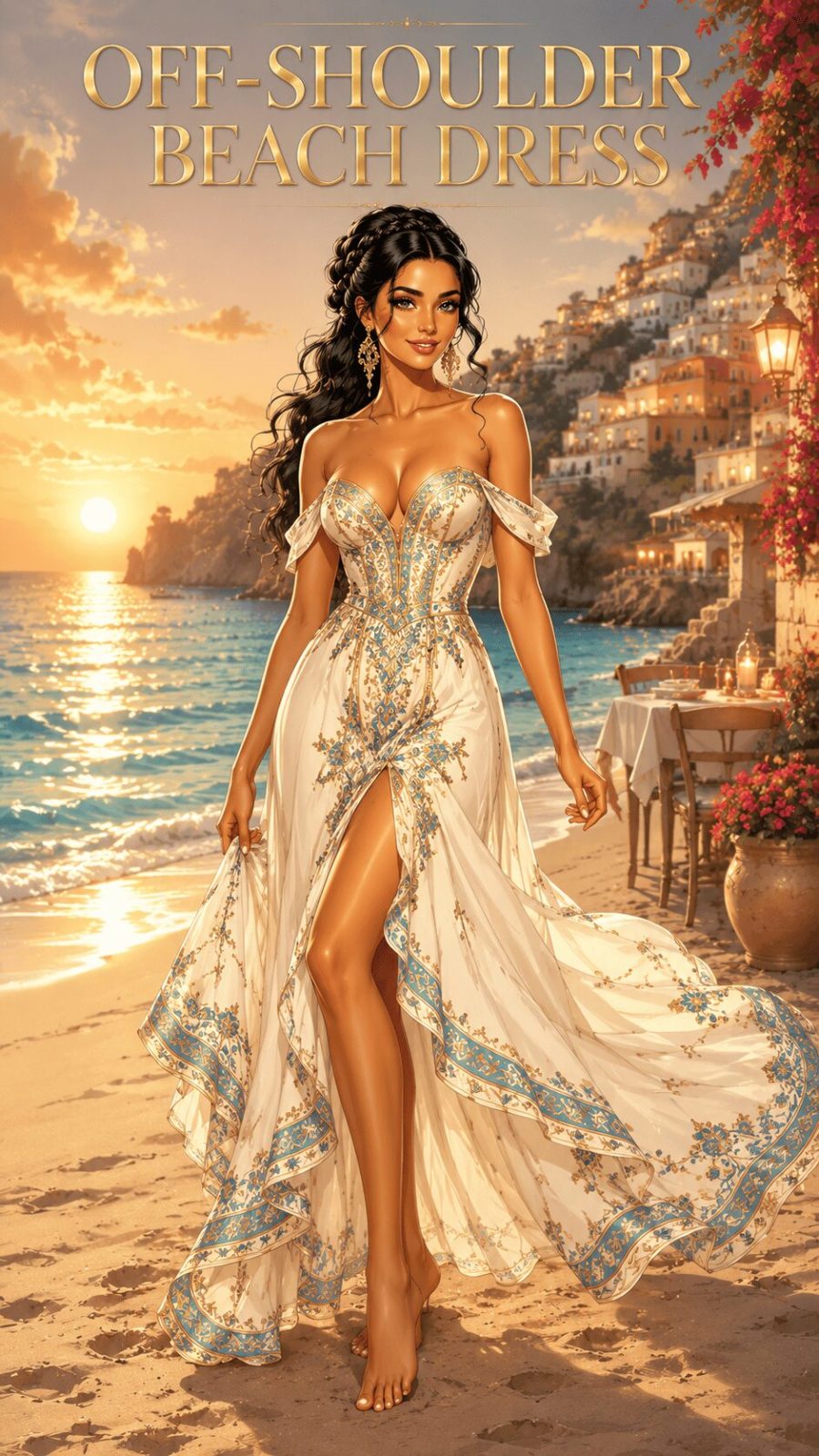
Off-Shoulder Beach Dress

![Off-Shoulder Beach Dress example]()
A dress with an elasticated or structured neckline that sits below both shoulders — exposing the collarbone, shoulders, and upper chest. In beach settings, this exposure is intuitive: you've already committed to sun and skin, and the off-shoulder silhouette simply extends that logic upward. The construction relies on an elasticated channel running through the neckline hem — the same mechanism that makes it infinitely adjustable. It does require attention to strapless bra options or built-in support for comfort in active beach movement.
- 12
Halter Beach Dress

Fabric panels extend from the bodice front and tie or fasten behind the neck — leaving the shoulders, upper back, and back entirely bare. The halter construction is singularly perfect for beach tanning: maximum back exposure without going strapless. It also creates an excellent visual line from neck to shoulder that tends to broaden narrow shoulders and elongate the torso. The neck tie means it also functions as a quick coverage layer over a bikini top of the same tie style.

- 13
Bodycon Beach Dress

A figure-skimming, stretch-fabric dress cut to follow body contours closely — minimal ease, maximum shape visibility. At the beach, the bodycon dress occupies the evening end of resort dressing: too form-fitting for active beach use, perfect for sunset cocktails or a beach club setting. The construction typically uses jersey, ribbed knit, or a matte stretch fabric that recovers cleanly after sitting. For a broader exploration of this silhouette, there's a detailed breakdown of bodycon dress types worth consulting.
- 14
Sarong Dress

A large rectangular or oval piece of fabric wrapped and tied around the body — adapted from the traditional garments of Southeast Asia, South Asia, and the Pacific Islands, where sarongs are worn by people of all genders as everyday dress. In Western beach fashion, the sarong-as-dress interpretation involves wrapping the fabric across the chest or hips and securing it with a knot or tuck. No sewing. No construction. Just fabric, knowledge of wrapping technique, and confidence. The same piece of cloth becomes a skirt, a top, a strapless dress, or a halter depending entirely on how it's tied.
- 15
T-Shirt Beach Dress

Essentially an oversized T-shirt extended to dress length — cut in jersey knit with short or sleeveless construction, falling anywhere from mid-thigh to knee. This is the most casual entry point in beach dressing, and perhaps the most honestly useful: it functions as a swimsuit cover-up, a sleep dress for warm hotel nights, a quick outfit for a market run, and a layering piece under a denim jacket for evening. The construction is identical to a standard T-shirt; only the hem length changes the classification.
- 16
Shirt Beach Dress

A collared, button-front shirt extended to dress length — often in linen, chambray, or cotton with a relaxed or oversized cut. The shirt dress is the most versatile dress type for beach adjacent dressing: belted for a defined silhouette; left loose as a cover-up; half-buttoned with the collar up; or worn completely open over a swimsuit as a layer. It travels extremely well, resists wrinkles better than most beach fabrics, and moves fluidly between beach, town, and casual dining without changing. There's more on this in the detailed shirt dress guide.
Most women pack too many beach dresses and too few that genuinely work across multiple moments of the day. The most versatile beach suitcase isn't the fullest — it's built around three or four constructions that each do double or triple duty. A linen shirt dress covers a swimsuit at noon, transitions to dinner with a belt and sandals, and travels without ironing. That kind of construction logic beats ten single-use dresses every time.
- 16 types defined by their construction identity and silhouette — not by trend or print
- Silhouette determines how a dress behaves at the beach — movement, coverage, practicality
- Wrap, shirt dress, and maxi offer the highest cross-occasion versatility at the beach
- Kaftan and sarong carry genuine cultural heritage extending far beyond modern Western beach fashion
Category 2: By Length / Hemline (#17–#24)
Where the hem falls — and how that single decision changes everything about occasion, coverage, and styling
Hem length in beach dressing is not purely aesthetic — it's genuinely functional. A micro-mini at the beach reads as active and uninhibited; a floor-length maxi in the same setting reads as romantic and considered. The same woman. The same beach. Completely different dress. Length is a powerful modifier, and understanding its grammar means you can manipulate the occasion register of any beach dress by simply choosing where the hem falls.
- 17
Micro Mini Beach Dress

Hemline falls at the very upper thigh — maximum leg exposure, minimum fabric. At the beach, this is the natural territory for over-a-bikini coverage that barely qualifies as a dress but still technically fulfills the function of "not walking around in just swimwear." Works best with a simple, non-fussy construction: jersey, cotton, or crochet.
- 18
Mini Beach Dress

Hemline falling mid-thigh — shorter than above the knee but not as extreme as a micro mini. The sweet spot for active beach days: enough coverage to feel dressed without the restrictions of longer lengths when getting in and out of water, climbing rocks, or sitting cross-legged on the sand. For a deep dive into this length category, the complete mini dress guide covers it thoroughly.
- 19
Above-Knee Beach Dress

Hemline falling 1–3 inches above the knee — not quite a mini, not quite a midi. The most classic proportional choice for beach dressing that needs to transition into a restaurant or shop without requiring a wardrobe change. Pairs cleanly with flat sandals, espadrilles, or wedges without the deliberate informality of shorter lengths.
- 20
Knee-Length Beach Dress

Hemline sitting directly at or just below the knee — a classically proportioned length that communicates modesty without formality. At a beach destination, this length is ideal for anyone navigating cultural contexts where shorter hems would be inappropriate (religious sites, conservative local norms, family beach outings with mixed-generation groups). In linen or cotton voile, it remains entirely cool despite the additional length.
- 21
Midi Beach Dress

Hemline falling between the knee and ankle — specifically the mid-calf to lower calf range. The midi occupies a particularly interesting position in beach dressing: it's the most formal-adjacent length that still reads as genuinely casual when constructed in the right beach fabrics. A midi in linen? Resort appropriate and dinner-ready. A midi in jersey? Comfortable sun protection for a long beach day. For the full midi dress landscape, there's a dedicated midi dress reference.
- 22
Asymmetric Hem Beach Dress

A deliberately uneven hemline — typically shorter at the front and longer at the back or sides, or cut on a diagonal. The asymmetric hem creates visual interest and movement without any additional embellishment: the hemline itself is the design detail. At the beach, the high-low version has a particular advantage — shorter at the front for ease of movement and sand navigation; longer at the back for a more considered silhouette from behind.
- 23
High-Low Beach Dress

Shorter in front, significantly longer at the back — creating a dramatic visual cascade. A specific subtype of the asymmetric hem, the high-low construction combines the freedom of a short front hem with the elegance of a trailing back. In beach settings, flowing chiffon or georgette in a high-low cut becomes one of the most movement-oriented and visually dynamic silhouettes possible — particularly in wind.
- 24
Floor-Length Beach Dress

The hem grazes or touches the floor — the most dramatic length category available. At the beach, a floor-length dress is essentially a statement of intent: you're not about to go in the water, you're about to look extraordinary walking along the shoreline at golden hour. Requires a fabric with genuine draping ability — chiffon, georgette, silk, or cotton voile. Avoid polyester; it lacks the weight and fluidity that make this length work.
Category 3: By Neckline & Strap Style (#25–#36)
How the top of the dress is constructed — the detail that shapes exposure, support, and visual focus
The neckline and strap construction of a beach dress determines more than aesthetics — it decides whether the garment can be worn over a strapless swimsuit, whether it requires a specific undergarment, and how much sun exposure hits the shoulders and chest. These are real practical considerations, not just styling ones. A woman choosing between a strapless and a halter beach dress at a beach destination is making a functional decision as much as an aesthetic one.
- 25
Strapless Beach Dress

No shoulder straps — the dress is held in place entirely by bodice construction: boning, elastic, or structured seaming. Maximum shoulder and décolletage exposure. For the beach, the strapless construction pairs seamlessly with a strapless swimsuit underneath, creating a clean line with no visible strap contrast. The construction challenge is keeping it in place during active movement — look for versions with internal boning or a wide elasticated top band rather than just a tube of gathered fabric.
- 26
Spaghetti Strap Beach Dress

Extremely thin shoulder straps — essentially a thin cord or narrow strip of fabric. The spaghetti strap is the quintessential beach dress construction: thin enough to align with most bikini top strap positions, leaving maximum shoulder exposure for tanning while still providing the structural function of keeping the dress up. The construction requires minimal shoulder architecture, which is why so many beach dresses default to it — less construction overhead, more fabric freedom below.
- 27
One-Shoulder Beach Dress

A single strap on one side — the opposite shoulder entirely bare. Asymmetric by definition, the one-shoulder construction creates immediate visual interest without any additional embellishment. The asymmetry draws the eye diagonally across the body, which tends to create a sense of length and movement. At the beach, the practical tradeoff is a single shoulder tan line — which either bothers you or it doesn't. The construction pairs beautifully with simple A-line or column skirts that let the shoulder detail do all the work.
- 28
V-Neck Beach Dress

A V-shaped neckline — the most elongating neckline construction. The V-neck creates a vertical line at the centre front that visually extends the neck and torso. In beach dresses, V-necklines work across virtually every fabric and construction type: they appear on linen shirt dresses, on cotton smocked dresses, on maxi sundresses in chiffon. The depth of the V varies from a modest notch to a deep plunge — and that depth calibrates the occasion register accordingly.
- 29
Square Neck Beach Dress

A straight-edged geometric neckline forming a square or rectangular opening across the chest. The square neckline creates a horizontal line that tends to visually broaden the shoulder and chest area — a detail that many find particularly well-suited to narrower frames. In beach and resort dressing, it creates a slightly retro-romantic feel when combined with a tiered or A-line skirt, and a more modern minimal aesthetic when used on a slip-style silhouette.
- 30
Sweetheart Neck Beach Dress

Two curved arches meeting at a central dip — shaped like the top of a heart. The sweetheart neckline is one of the most historically enduring neckline constructions in women's fashion, appearing in formal gowns, strapless bodices, and resort dresses alike. In beach fashion, it typically appears on strapless or thin-strapped sundresses, creating a feminine, romantic quality. The curved shape tends to draw attention upward and frames the décolletage in a particularly considered way.
- 31
Scoop Neck Beach Dress

A wide, U-shaped neckline that scoops lower and wider than a crew neck. The scoop neck is one of the most uncomplicated and comfortable neckline constructions — it sits below the base of the neck without requiring any structural engineering, which is why it appears on everything from simple jersey dresses to elaborate resort sundresses. At the beach, it allows maximum sun access to the chest and collarbone without the vulnerability of a strapless or halter construction.
- 32
Backless Beach Dress

Significant back exposure as the defining design feature — either a fully open back with neck ties, a low-cut back with a clasp or button closure, or a crossback strap arrangement that leaves the majority of the back bare. The backless construction is one of the most sophisticated moves in beach dressing — the front can be entirely modest while the back provides all the drama. It also solves the bra-at-the-beach problem elegantly: many backless dresses include built-in cups or sew-in pads that eliminate the need for a separate bra entirely.
- 33
Boat Neck Beach Dress

Also known as the bateau neckline — a wide, horizontal neckline running from one shoulder tip to the other. The boat neck creates a clean, architectural line across the chest that exposes the collarbone and upper shoulder without dipping toward the chest. In beach dressing, it appears most commonly on structured linen or striped cotton dresses, giving them a Breton-coastline quality — that precise combination of French Riviera aesthetic and relaxed ease that feels inherently right near the water.
- 34
Tie-Back Beach Dress

Fabric ties at the back of the dress — either at the waist for cinching, at the neck for a halter effect, or running the full back for an open-back laced aesthetic. The tie-back construction is one of the most adjustable in beach dressing: the ties create fit flexibility that rigid closures can't match. A tie-waist construction in particular allows the same dress to function at multiple body moments across a trip — morning, midday, after-meal, in the water's aftermath.
- 35
Plunge Neck Beach Dress

A deeply cut V or U neckline extending significantly below the standard bust line. The plunge neckline is the most evening-appropriate neckline construction in beach dressing — it immediately shifts the register of any dress from casual to intentional. In beach resort contexts, it appears most effectively on maxi dresses or structured midi dresses in silk or satin, where the plunge feels like a deliberate design statement rather than an accidental styling choice.
- 36
Cold Shoulder Beach Dress

Strategic cutouts at the shoulder points — fabric is present above and below the opening, but the shoulder itself is exposed. A cold-shoulder beach dress retains the coverage of a sleeved or strapped construction while adding a detail-oriented skin exposure that reads as considered rather than casual. The shoulder cutout was a significant trend in the mid-2010s and has settled into a recurring wardrobe option rather than a dated trend piece — particularly in beach and resort contexts where it performs exactly the function it was designed for.
Here's what most beach dress guides miss entirely: neckline compatibility with your swimsuit matters more than aesthetics alone. A strapless beach dress over a bikini with thick shoulder straps looks like a wardrobe malfunction in slow motion. A spaghetti strap dress over a halter-neck swimsuit creates double-strap chaos around the neck. Before you pack, lay the dresses and swimsuits together and check whether the strap configurations actually work as cover-up pairings. It takes two minutes and saves real frustration.
Category 4: By Fabric & Material (#37–#46)
What the dress is made of — which governs how it breathes, drapes, dries, and behaves in heat
Fabric is where beach dress decisions get genuinely practical. The same silhouette — say, a loose A-line maxi — behaves completely differently in linen versus polyester versus chiffon. Linen breathes and softens with wash. Polyester traps heat and doesn't wick moisture. Chiffon floats in a breeze but clings when damp. Understanding fabric behavior in heat, humidity, and proximity to salt water is the single most underrated skill in beach packing. For the complete fabric literacy picture, the summer fabrics reference covers every material in this context.
- 37
Linen Beach Dress

Made from linen — a natural fibre derived from the flax plant, documented in human clothing traditions for over 30,000 years. Linen is the single best beach fabric in existence. Full stop. It breathes better than cotton, dries faster after sweat or a sea-spray encounter, softens with every wash, and has a characteristic relaxed texture that looks genuinely better slightly rumpled than completely pressed. The wrinkles aren't a flaw. They're the point. A linen beach dress in a neutral — sand, white, terracotta, navy — is the most honest and functional thing you can wear at the coast.
- 38
Cotton Beach Dress

Made from 100% cotton — the world's most widely worn natural fibre. Cotton beach dresses are the most democratic option: affordable, washable, widely available, and genuinely comfortable against sun-warmed skin. The performance varies by weave — a lightweight cotton voile is almost as airy as chiffon; a heavier cotton canvas can feel oppressive in serious heat. The sweet spot for beach cotton is a mid-weight jersey or poplin. Cotton absorbs sweat but doesn't always release it quickly — a minor consideration in coastal wind, a real one in humid still heat.
- 39
Chiffon Beach Dress

An almost weightless, sheer woven fabric with a delicate, floating drape — made from silk or synthetic filaments twisted tightly to create a slightly rough texture that catches light. Chiffon at the beach is pure movement poetry. In wind, it behaves unlike any other fabric: fluid, responsive, dramatic. The tradeoff is transparency — chiffon beach dresses almost always require either a lining, a slip underneath, or a swimsuit that functions as visible layering. It also clings when damp, which is worth knowing before standing in sea spray.
- 40
Crochet Beach Dress

Constructed from crocheted yarn — an interlocked loop structure with an open, textured appearance that is inherently translucent. The crochet beach dress is one of the most visually distinct garments in resort fashion: it combines the aesthetic of handcraft with the function of a cover-up that doesn't really cover up so much as it creates a decorative layer over a swimsuit. The open-weave construction means it's almost always worn over a bikini or one-piece that becomes intentionally visible. Cotton crochet is the most breathable and practical; acrylic crochet is cheaper but traps heat.
- 41
Silk Beach Dress

Made from genuine silk or a high-quality silk charmeuse — the most elevated fabric in beach dressing. Technically temperature-regulating, naturally breathable, and with a drape and lustre that no synthetic can accurately reproduce. A silk beach dress belongs at the resort dinner end of the beach spectrum, not the active-sunbathing end. Silk does not forgive salt water, sunscreen stains, or rough handling — it requires proper care. But for a special evening at a beach destination, nothing else quite achieves the same level of considered luxury.
- 42
Viscose / Rayon Beach Dress

Made from viscose (also known as rayon) — a semi-synthetic fibre derived from wood pulp cellulose, processed to create a soft, silk-like fabric with a gentle drape. Viscose is probably the most common fabric in budget-to-mid-range beach dresses, and for good reason: it drapes beautifully, feels cool against skin, prints vividly, and costs a fraction of silk. The weakness is moisture management — viscose becomes quite limp when wet and takes longer to dry than linen. Avoid viscose for active beach use; excellent for resort dining and casual evenings.
- 43
Jersey Beach Dress

Made from jersey knit — a stretchy, single-knit fabric that is soft, flexible, and forgiving of fit variations. Jersey beach dresses are the everyday workhorses of the category: they pack flat without wrinkling, stretch to accommodate movement, and don't require structural engineering to look polished. The stretch factor also means they work over a wider range of sizes than woven fabric constructions. Cotton jersey is breathable; polyester jersey is not — that distinction matters significantly in heat.
- 44
Broderie Anglaise Beach Dress

Made from broderie anglaise — a white or off-white cotton fabric with a pattern of small, punched holes edged in embroidery stitching, creating a textured, perforated surface that is simultaneously decorative and subtly breathable. The holes in broderie anglaise allow air circulation beyond what a solid cotton weave provides. In beach dressing, broderie anglaise has a timeless quality: it appeared on summer dresses in the Victorian era, was revived in the 1970s, and continues to recur with regularity in beach and resort collections — a genuinely enduring fabric choice rather than a trend.
- 45
Satin Beach Dress

Made from satin-weave fabric — characterized by a smooth, high-lustre face and a matte reverse. Satin beach dresses occupy the elevated evening end of resort dressing: they shine under low light, drape with a structured fluidity that flatters most silhouettes, and signal intention. The construction challenge is showing sunscreen, body lotion, and sweat — satin is unforgiving with surface marks. Reserve it for evenings when the beach day is done and the setting is a restaurant or beach club with flattering lighting.
- 46
Swimwear-Fabric Beach Dress

Made from chlorine-resistant, quick-dry swimwear fabric — the same lycra-nylon or polyester-spandex blends used in swimsuits. This is the genuinely water-ready dress: it can go in the ocean, air-dry in under an hour, and return to a presentable state without ironing or washing. Swim-fabric dresses are essentially long swimsuits styled as dresses, and they are singularly practical for anyone whose beach day involves actual water activity rather than decorative poolside positioning. Not the most elevated aesthetic — but the most honest in terms of function.
Category 5: By Occasion & Setting (#47–#58)
The context the dress is built for — beach morning vs. resort evening vs. boat day vs. beach wedding are genuinely different design briefs
"Beach dress" covers a wider range of occasions than most wardrobes anticipate. The same destination — a coastal resort — might require a swimsuit cover-up at noon, a dress for a beach-town market at 3pm, a casual dinner outfit at 7pm, and something genuinely special for a sunset wedding ceremony at 6pm the following day. These are four distinct design briefs, and understanding which occasion each dress type serves best is what separates a frustrating packing experience from a seamless one. For broader occasion dressing ideas, our vacation outfit guide covers the full picture.
- 47
Swim Cover-Up Dress

A dress designed specifically to be worn directly over a swimsuit — minimal construction, quick-off, quick-on, compatible with wet skin. The cover-up dress is the most purely functional entry in this guide: it doesn't pretend to be anything other than what it is. The best cover-up dresses have an open or loose neckline that doesn't require pulling over wet hair, a fabric that doesn't cling to damp skin, and a hem length that actually covers the swimsuit without requiring adjustment. Shift constructions, sarong wraps, and open-front kaftans all excel here. For a dedicated view of this category, the swim cover-up guide goes deeper.
- 48
Beach-to-Dinner Dress

Designed for the specific transition moment that every beach holiday produces — the gap between beach time and evening plans that doesn't allow for a full wardrobe change. The ideal beach-to-dinner dress reads as intentional at a restaurant without being overdressed at a casual beachside setting. In practice, this means: a midi or maxi length rather than micro-mini, a fabric that doesn't show sand or crumple, a neckline that doesn't require a specific swimsuit underneath, and a neutral or semi-elevated print. Linen wrap dresses and viscose maxis in block colours consistently perform this function best.
- 49
Resort Evening Dress

A dress specifically designed for warm-climate evening occasions — elevated enough for a fine resort restaurant, relaxed enough to not feel misplaced in a coastal setting. Resort eveningwear operates in a unique register: it permits more skin exposure than most formal dressing (backless, low-cut, thin-strapped), while maintaining formality through fabric quality (silk, satin, chiffon), silhouette refinement, and detail work. The category has its own dedicated resort wear reference for the full occasion spectrum.
- 50
Beach Wedding Guest Dress

Navigating a beach wedding as a guest requires careful construction thinking — the combination of sand, outdoor heat, possible wind, and a formal occasion means that almost every conventional wedding-guest dress choice has a problem. Stiletto heels are impractical on sand. Heavy fabrics are oppressive in outdoor heat. Dark colours absorb sun. The sweet spot: a flowing midi or maxi in chiffon or silk charmeuse, in a soft colour or floral print, with block heels or espadrilles. For more on navigating formal beach occasion dressing, the wedding guest outfit reference is thorough.
- 51
Boat Day Dress

Specifically designed for or suited to time on a boat — where the breeze is stronger, the social register is slightly more elevated than a public beach, and movement between levels requires something that doesn't blow dramatically in the wrong direction. Boat day dresses tend to have a slightly more structured construction than pure beach dresses: a more secure neckline, a hem that doesn't require constant adjustment, and a fabric (linen or cotton) that won't be defeated by sea spray. Navy, white, and nautical stripe are not accidents — they're the historic palette of boat dressing for genuine reasons.
- 52
Tropical Vacation Dress

Characterized primarily by tropical or botanical print — palm leaves, hibiscus, birds of paradise, exotic florals — in a vivid, saturated colour palette. The tropical vacation dress is as much about the visual language of holiday as it is about construction: wearing it is an explicit statement that you are on vacation, fully committed. In terms of construction, they appear across every silhouette — the print is the defining feature, not the structure. Works best in lightweight viscose or cotton that prints boldly without distorting the pattern at the seams.
- 53
Modest Beach Dress

Designed to meet modest dressing requirements — extended coverage of arms, legs, and/or neckline — while remaining appropriate and comfortable in beach and resort settings. Modesty in beach dressing is both a religious and personal preference consideration, and the fashion landscape has expanded significantly in this area. Maxi length, long sleeves or sleeve options, high necklines, and non-clinging constructions in breathable fabrics (linen, cotton voile, lightweight chiffon with lining) make beach participation possible across a full range of personal modesty standards. For a broader view of this category, the modest fashion guide covers the complete spectrum.
- 54
Festival Beach Dress

Designed for outdoor beach festivals — where the visual register is maximalist, the practical requirements are durability and movement freedom, and the occasion is simultaneously casual and performance. Festival beach dresses lean heavily into crochet, fringe, embroidery, tie-dye, and bold print — constructions that survive crowd movement, sand, and repeat wearing without looking depleted. The bohemian aesthetic that dominates this category has roots in the 1960s and 1970s countercultural festival scene, filtered through decades of subsequent reinvention.
- 55
Maternity Beach Dress

Designed with the specific fit considerations of pregnancy — additional volume at the abdomen, non-restrictive waistband construction, breathable fabric, and often adjustable tie or elastic elements that accommodate body changes across a pregnancy. Empire waist constructions perform particularly well because the high seam placement naturally accommodates a growing abdomen without requiring size changes. Smocked bodices are similarly practical. The market for thoughtful maternity beach dressing has expanded considerably, moving well beyond utility-only options.
- 56
Lounge Beach Dress

A supremely soft, relaxed beach dress designed for maximum comfort — worn on the lounger, in a beach cabana, or as a hotel room-to-pool transition garment. The lounge beach dress is essentially luxury loungewear adapted for a coastal setting: modal jersey, bamboo fabric, or a softly washed cotton in a loose, minimal-construction silhouette. The lounge dress category covers the full domestic and resort range of this construction. No zipper. No shapewear. Just softness.
- 57
Beach Town / Market Dress

Worn for the non-beach parts of a beach destination — the morning market, the coastal town walk, the souvenir shop visit, the ice cream stop. This is real-life resort dressing rather than beachside fashion. It needs to be comfortable for walking, culturally appropriate in local shops and restaurants, cool in heat, and sufficiently put-together to photograph well on cobblestone streets. A cotton midi or knee-length wrap dress in a non-fussy print or block colour tends to be the most reliable choice.
- 58
Sun-Protection Beach Dress

Designed with UV protection as a primary design consideration — either through UPF-rated fabric (typically a tight-weave polyester or nylon blend rated UPF 30–50+) or through generous coverage in tightly woven natural fabrics. Sun-protection dresses are particularly relevant for those with fair skin, sun sensitivity, or a medical requirement to limit UV exposure. A tightly woven dry linen provides meaningful UV protection; a loose cotton voile does not, regardless of coverage. The construction tends toward long sleeves, high necklines, and maxi or midi length — coverage by design, not limitation.
The most common beach packing mistake isn't bringing too little — it's bringing dresses that all serve the same moment. Five casual day dresses and nothing for a resort dinner is a genuine problem. The best beach wardrobe covers four distinct moments: active beach (swimsuit cover-up), casual day (town and beach), casual evening (beach restaurant), and one elevated option (for the inevitable special dinner or event). Four moments, four dresses. That's the real edit.
Category 6: By Cultural & Regional Origin (#59–#68)
Dress types rooted in specific cultural traditions — garments with histories that long predate Western resort fashion
Several of the most recognized beach dress types have deep cultural roots that Western fashion has borrowed, adapted, and sometimes recontextualized without full acknowledgment. This category documents those origins — not to complicate a shopping decision, but because understanding where a garment comes from is part of understanding why it works. A kaftan is not merely an aesthetic choice; it's a garment form that evolved over thousands of years in specific climates and cultural contexts for specific practical reasons. That history is part of its design logic.
- 59
Muumuu Dress

A loose, flowing dress of Hawaiian origin — rectangular in cut, with minimal shaping, typically in a bold floral or tropical print. The muumuu originated in 19th century Hawaii from Western missionary influence on indigenous dress traditions, and was subsequently adopted as everyday practical wear in warm, humid Pacific Island climates. In contemporary beach fashion, it functions as a maximally comfortable, maximally colorful resort dress that communicates an explicit joy in warm-weather dressing. It's not trying to be sleek. It knows exactly what it is.
- 60
Pareo Dress

A pareo (also spelled pareu) is a large rectangular piece of fabric from Polynesian tradition — particularly associated with Tahiti and French Polynesia — that is wrapped and tied around the body in multiple configurations to create a skirt, dress, or top. Closely related to the sarong but with a specifically Polynesian cultural context and often a distinct hand-screened or block-printed pattern. The pareo as a beach dress is worn by wrapping and knotting in various ways — a practice with deep roots in Pacific Island daily dress. The fabric itself is typically lightweight cotton or rayon in vivid island-inspired patterns.
- 61
Dashiki Beach Dress

A loose, colorful garment of West African origin — typically featuring embroidered or printed decorative panels at the neckline and chest, with wide sleeves and a straight, unstructured body. In dress form, the dashiki silhouette extends to midi or maxi length. The embroidered neckline detail is the identifying construction element — it functions both decoratively and as a reinforcement of the neckline opening. At the beach, a dashiki dress in lightweight cotton or African wax print brings genuine textile heritage into coastal dressing.
- 62
Batik Beach Dress

Made from batik fabric — cloth decorated using a wax-resist dyeing technique where molten wax is applied to fabric before dyeing, creating a pattern where the dye penetrates only the unwaxed areas. Batik has UNESCO Intangible Cultural Heritage status in Indonesia, where the technique is most extensively developed, though wax-resist dyeing traditions exist across West Africa, South Asia, and Southeast Asia. A batik beach dress carries genuine artisanal value — the crackle pattern created by the wax-resist process is nearly impossible to replicate through printed simulation.
- 63
Ikat Beach Dress

Made from ikat fabric — woven from yarn that has been resist-dyed before weaving, creating a characteristic blurred-edge pattern where the design appears to bleed slightly at the boundaries. Ikat traditions span Central Asia, Southeast Asia, West Africa, and Latin America. The feathered, imprecise pattern edges are the identifying visual signature — and unlike a printed simulation, the pattern in true ikat is part of the weave structure of the fabric itself. In beach dressing, ikat prints often appear in the deep blues, rust, and earth tones associated with coastal artisan textiles.
- 64
Moroccan Kaftan Dress

A specifically Moroccan interpretation of the kaftan form — typically more structured and elaborate than the generic Western beach kaftan, often featuring detailed embroidery at the neckline and cuffs, a button or loop closure at the centre front, and fabric of genuine quality (silk, brocade, or fine cotton). At the beach or coastal town context, a Moroccan kaftan occupies the elevated end of resort dressing — it communicates craft, history, and intention. Distinguished from a generic beach kaftan by the presence of hand-embroidery and a more considered construction rather than a simple cut-and-hem shirt of fabric.
- 65
Indo-Western Beach Dress

A fusion construction combining elements from South Asian dress traditions — kurta-inspired necklines, block print patterns, mirror embroidery, or hand-embroidered details — with Western dress silhouettes. Beach dresses in this category may feature a front placket inspired by the kurta, a V-neckline with mirror work, or a maxi silhouette in a hand-block-printed cotton fabric from Rajasthan or Gujarat. For the broader picture of this aesthetic, the Indo-Western outfit guide covers it fully.
- 66
Mexican Embroidered Beach Dress

A loose, white or off-white cotton dress featuring hand-embroidered floral or geometric motifs — typically in the cross-stitch or chain-stitch techniques of Oaxacan, Mixtec, or Zapotec artisan textile traditions. The style is associated with traditional Mexican folk dress, particularly the huipil and the terno. At the beach — particularly on the Mexican Pacific and Caribbean coasts — this dress type is ubiquitous for good reason: it's lightweight, breathes beautifully, and carries genuine artisanal value that a mass-printed approximation cannot replicate. The embroidery is the quality signal.
- 67
Greek / Mediterranean Linen Dress

Associated with Greek island and broader Mediterranean coastal aesthetics — loose white or ecru linen in a simple, minimally constructed silhouette. The visual vocabulary is architectural simplicity: the fabric, the drape, and the light. Greek island dressing has become a globally recognized aesthetic reference point, with the white linen sundress or maxi as its most iconic garment. The construction is minimal by design — the fabric does all the work. It reads as both deeply casual and effortlessly refined at once, which is a genuinely rare trick for any garment to pull off.
- 68
Kimono-Style Beach Dress

Inspired by the construction principles of the traditional Japanese kimono — wide, straight sleeves cut at right angles to the body, a wrap-front closure, and a T-shaped silhouette. In beach and resort contexts, the kimono-style dress is typically a lightweight, open-front cover-up garment in printed chiffon, cotton gauze, or silk. It differs from a genuine kimono in material construction and context, but borrows the sleeve and silhouette architecture — wide sleeves, straight cut, crossover front. Pairs naturally with simple swimwear underneath.
Category 7: By Print, Detail & Embellishment (#69–#78)
The surface language of the dress — how print, texture, and embellishment communicate occasion, mood, and origin
Print is the most immediate communication layer of a beach dress. Before anyone reads the silhouette or registers the fabric, they see the print — and at the beach, print carries specific social language. A white minimalist dress communicates considered restraint. A bold tropical print announces unbothered vacation mode. A nautical stripe places you firmly in French Riviera visual territory. Understanding what a print communicates helps you choose dresses that say what you actually want them to say rather than defaulting to whatever happens to be on the rack.
- 69
Floral Print Beach Dress

The most persistently popular print in beach dressing — floral patterns appear across every silhouette, every length, and every price point in resort fashion. The floral print communicates femininity, warmth, and occasion-readiness without formal stiffness. Large-scale florals read as bold and fashion-forward; small-scale florals read as refined and classic. The key variable is colour palette: neutralized florals in dusty terracotta or sage tend to read as elevated; saturated tropical florals read as genuinely, unambiguously on holiday.
- 70
Striped Beach Dress

A stripe pattern — horizontal, vertical, or diagonal — in contrasting or tonal colours. The horizontal Breton stripe (navy and white) is the most culturally loaded stripe in beach fashion, with roots in the traditional marinière of French sailors (officially adopted in 1858) and a subsequent fashion history reaching from Coco Chanel to the present day. Vertical stripes create a lengthening visual line. Diagonal stripes (bias-cut stripe) create a spiraling visual movement that is inherently dynamic. The direction of the stripe is a design decision with real visual consequences.
- 71
Tie-Dye Beach Dress

A dress featuring a tie-dye pattern — fabric bound and dyed to create irregular, fluid colour patterns. Tie-dye as a textile technique has roots across multiple cultures including Japan (shibori), Indonesia (plangi), and West Africa — though its association with beach and festival dressing in the West comes primarily from American counterculture of the late 1960s. Modern tie-dye beach dresses span the spectrum from genuine hand-dyed artisan pieces to digital-printed simulations. The irregular, organic color bleeding of a genuinely hand-dyed piece is not replicable by print — the variation is the authenticity signal.
- 72
Block Colour / Solid Beach Dress

A single, unbroken colour across the entire dress — no pattern, no print, no embellishment. The block colour beach dress is the most versatile packing choice of any dress type because it accessorizes in any direction, doesn't date, and lets the silhouette communicate without competition from a print. White is the canonical choice at the beach and tends to photograph flawlessly in natural light. Deep cobalt, terracotta, and sage also recur consistently in coastal fashion for the way they respond to natural seaside light. The construction must be impeccable because there's nowhere to hide — with no print to distract, every seam and cut is visible.
- 73
Animal Print Beach Dress

A dress featuring an animal-inspired print — leopard, zebra, snake, or tiger. Animal print at the beach operates as a statement of confident self-presentation rather than camouflage; the social coding of animal print in Western fashion has shifted considerably across decades, currently occupying a space of deliberate, self-aware sophistication. In beach settings, a leopard-print maxi in a neutral tan-and-black reads as elevated and intentional; a bright-background animal print reads as playfully bold. The neutralized version — with a muted base colour — travels furthest between casual and evening registers.
- 74
Sequin / Metallic Beach Dress

A dress featuring light-reflective sequin embellishment or metallic fabric — gold, silver, bronze, or copper. The sequin or metallic beach dress belongs exclusively to the evening end of the beach occasion spectrum: under natural daylight, it can read as overdressed; under evening lighting at a beach club or outdoor restaurant, it photographs extraordinarily well and creates exactly the impact it's designed for. In warm coastal settings, lightweight sequin mesh or metallic jersey avoids the heat problem that heavier embellished fabrics create. These are not for the beach itself — they're for what happens after.
- 75
Embroidered Beach Dress

A dress featuring decorative stitching applied to the fabric surface — either by hand or machine. Embroidery at the beach carries a specific quality signal: mass-market embroidered beach dresses typically feature repeated machine embroidery in limited colours; artisan-quality pieces feature hand embroidery with visible variation and irregularity that cannot be replicated mechanically. The construction detail most commonly applied to beach dresses is neckline and hem embroidery on a white or off-white cotton base — the broderie anglaise relative applied more freely. The result is a dress that is both casual and considered.
- 76
Ruffle / Frill Beach Dress

A dress featuring gathered or pleated fabric extensions — ruffles or frills — as a key design element at the hem, neckline, sleeve, or across the body. Ruffles at the beach move exceptionally well: a ruffled hem on a short dress creates playful movement in coastal wind; a ruffled neckline on a maxi adds a romantic, considered quality to a simple silhouette. The volume created by ruffles is soft rather than structured — which distinguishes it from the tiered construction above. A tiered dress has horizontal seam-divided layers; a ruffled dress has gathered fabric attached at a single seam point.
- 77
Cut-Out Beach Dress

A dress with deliberate fabric cutouts — at the waist, back, sides, neckline, or across the body — creating skin exposure as an intentional design element rather than as structural necessity. The cut-out has been a recurring construction trend across several fashion cycles, and in beach dressing it performs particularly well: the cutouts allow tan lines to form in places that remain unexpected rather than the predictable strap lines of conventional beachwear. The waist cut-out is the most common beach variant — it creates a visual waist definition without a seam, and performs beautifully in a simple jersey or crepe construction.
- 78
Fringe Beach Dress

A dress featuring fringe trim — cut, knotted, or hanging strips of fabric or yarn — as a design detail at the hem, neckline, cuffs, or across the body. Fringe at the beach performs uniquely: in motion, it becomes a secondary visual layer that responds to movement and wind with theatrical animation. A simple jersey dress with fringe at the hem becomes dramatically different in motion than it appears on the hanger. Fringe also has deep roots in beachwear's bohemian aesthetic and connects to multiple folk-textile traditions globally. It photographs and moves beautifully — two things that matter in beach dressing.
Print and embellishment perform differently in beach environments than in any other setting. What a dress looks like on a hanger or in a shop is genuinely different from what it looks like on a body in natural coastal light, in wind, in motion. A ruffle hem is static in a fitting room. On a beach, in a breeze — it's a completely different garment. The same applies to fringe, sequin, and lightweight chiffon. If you can, always assess beach dresses in outdoor light before committing.
Frequently Asked Questions — Types of Beach Dresses for Women
What is the best type of beach dress for all-day wear?
For all-day beach wear, a linen shirt dress or a cotton smocked midi dress tends to perform best. Both transition comfortably from beach to town without requiring a change; linen breathes exceptionally well in heat and improves with wear; cotton smock construction accommodates a swimsuit underneath without awkwardness. The key is choosing a construction that doesn't cling when damp, doesn't require ironing to look presentable, and has a neckline compatible with whatever swimsuit you're wearing underneath.
What is the difference between a kaftan and a sarong dress?
A kaftan is a constructed garment — it has a defined shape, a head opening, and often sleeves. It is sewn, finished, and worn as made. A sarong is a length of fabric that is wrapped and tied around the body in various configurations; it has no fixed construction and requires knowledge of wrapping technique to wear effectively. The kaftan has ancient roots in North African and Middle Eastern dress traditions; the sarong originates in Southeast Asian, South Asian, and Pacific Island textile traditions. Both are adapted into Western beach fashion, but their construction logic is fundamentally different.
What fabric is best for a beach dress in tropical heat?
Linen is the superior choice for tropical heat — it is the most breathable natural fibre available, releases moisture faster than cotton, and its natural texture means it looks intentionally relaxed when slightly rumpled rather than just dishevelled. Cotton voile or gauze is a close second: lightweight, breathable, and available in a wide range of constructions. Avoid polyester and most synthetics in serious heat — they trap moisture against the skin rather than releasing it. Viscose/rayon is acceptable for evenings but performs poorly in active daytime heat or anywhere you might encounter sea spray.
What length beach dress is most versatile for a holiday trip?
The midi length — falling between the knee and lower calf — offers the most genuine versatility for a beach holiday. It is appropriate for active beach days in lightweight fabric, correct for resort dining without being overdressed, culturally appropriate in a wider range of settings than a mini, and proportioned for both flats and wedges. A linen or cotton midi wrap dress in a neutral or simple print tends to be the single most reliable packing decision for a coastal holiday. The maxi is close behind for destinations that include formal evening settings.
What type of beach dress is best for a beach wedding?
For a beach wedding as a guest, a flowing midi or maxi in chiffon, silk charmeuse, or lightweight crepe in a soft colour or floral print tends to work best. Avoid all-white (too close to bridal), very dark colours (absorb beach heat significantly), heavy fabric (overwhelming in outdoor heat), and stiletto heels (impractical on sand). A block-heel sandal or elegant flat pairs better with a flowing beach-appropriate silhouette than a standard formal heel. The balance to hit is: formal enough to honour the occasion, practical enough to remain comfortable in an outdoor beach setting throughout a ceremony and reception.
Can a beach dress be worn as an evening outfit?
Absolutely — the right beach dress can transition to an evening outfit without difficulty. The key is fabric and silhouette: a silk or satin slip dress, a chiffon maxi with a plunge neckline, or a wrap dress in a deep jewel colour all read as evening-appropriate in a resort context. Accessories do much of the transitional work — a beach dress that reads casual with flat sandals and a tote bag reads as an evening outfit with heeled sandals, a small clutch, and simple jewellery. The dress's construction doesn't necessarily change; the surrounding choices elevate it.
What are the different types of beach dress cover-ups?
Beach cover-up dresses include: the shift dress (simple, quick, non-clinging), the sarong wrap (flexible, cultural, no construction), the kaftan (loose, wide-sleeved, full coverage), the kimono-style open-front dress (layered, elegant), the T-shirt dress (casual, practical, fast), and the smocked sundress (comfortable, swimsuit-compatible). The best cover-up construction is one that goes over a wet swimsuit without clinging, can be removed quickly, and doesn't require a mirror to put on correctly after coming out of the water.
What beach dress styles are most flattering for a variety of body types?
In beach dressing as in all dressing, the most useful framing isn't "flattering for body type X" — it's understanding which constructions create the visual effects you personally find appealing. Empire waist dresses create a high focal point and allow the skirt to fall freely from there. Wrap dresses are adjustable and tend to work across a wider range of measurements than fixed closures. A-line silhouettes skim rather than cling. Tiered dresses add volume and movement at the hem. Shift dresses and kaftans de-emphasize silhouette entirely. The choice isn't about concealment — it's about which visual effect you prefer and which construction behaviour suits your planned activities.
How do I style a beach dress for a resort dinner?
To transition a beach dress to resort dinner: swap flat sandals for heeled or wedge sandals, add simple jewellery (one statement piece or minimal layered pieces), swap a beach bag for a small clutch or crossbody, and consider a light wrap or blazer if the restaurant is air-conditioned. The dress itself doesn't need to change — the accessory choices do the work. Choose dresses in fabrics that maintain their appearance after a beach day (linen, viscose, jersey) rather than fabrics that show wear (chiffon without lining, very lightweight voile that crumples).
What is the difference between a maxi and a midi beach dress?
A maxi beach dress reaches the ankle or floor — full-length, dramatic, maximum coverage. A midi falls between the knee and ankle, specifically in the mid-calf to lower calf range. The practical distinction matters at the beach: a maxi in sand requires more care to avoid dragging on the ground and catching sand in the hem; a midi avoids this while still providing significant leg coverage and sun protection. The midi is more active-day practical; the maxi is more evening-occasion appropriate. Both are classified and compared in detail in the dedicated maxi dress guide and midi dress reference.
Conclusion: Know Your Dress, Know Your Beach
Seventy-eight types. Seven classification systems. Design, season, and best-use context for every single entry.
What this guide ultimately gives you is a vocabulary — and vocabulary in beach dressing is more practical than it sounds. The difference between "I want a beach dress that works for dinner too" and being able to identify a linen wrap midi as the construction that delivers exactly that outcome is the difference between a satisfying shopping trip and an exhausting one. Between a suitcase that works across every moment of a coastal holiday and one that has gaps.
The classification framework here — silhouette, length, neckline, fabric, occasion, cultural origin, print and embellishment — mirrors the way professional stylists and fashion buyers actually think about the category. It's not academic. It's organizational. It helps you see what's in front of you clearly, make intentional choices, and understand why something works or doesn't when you're actually wearing it at the water's edge. For a broader view of all dress types beyond the beach, the complete women's dress reference is the logical next step.
- 75+ types of beach dresses exist across 7 classification systems — silhouette, length, neckline, fabric, occasion, cultural origin, and print/embellishment.
- Fabric is the most practically important decision in beach dressing — linen outperforms all other natural fabrics in heat, breathability, and ease of care at the coast.
- Length calibrates the occasion register — micro-mini for active beach, midi for versatility, maxi for drama and sun protection, floor-length for special evening settings.
- Kaftan and sarong carry genuine cultural heritage extending thousands of years beyond Western resort fashion — their design logic reflects climates and dressing traditions developed over generations.
- The wrap dress and linen shirt dress offer the highest cross-occasion versatility of any beach constructions — both function from beach morning through resort dinner without a wardrobe change, a principle well supported by seasoned travel stylists and Business of Fashion's resort wear analysis.
- Swimsuit compatibility matters when choosing a beach dress neckline — a mismatched strap configuration between dress and swimsuit creates real wearability problems that aesthetics alone don't solve.
- Print communicates before silhouette — at the beach, the first read is always the print, and its colour palette and scale calibrate the occasion register before the cut or construction is visible.
- Body-neutral shopping starts with construction language — seek the visual effect you want (flowing, defined, elongated, relaxed) rather than language about concealing or minimizing any part of your body.
- The most effective beach packing is built around four moments: active beach, casual day, casual evening, and one elevated option — four constructions that cover the full occasion range of most coastal holidays.
Sources & Further Reading
- Vogue — Resort Fashion History & Evolution — The development of resort wear as a distinct fashion category from the 1920s onward
- Vogue UK — Diane von Furstenberg and the Wrap Dress — The cultural history of the wrap silhouette in modern fashion
- Business of Fashion — Resort Wear Guide — Analysis of the resort wear market and its distinct occasion register
- The Metropolitan Museum of Art — Textile History — Documentation of global textile traditions including kaftan, batik, and ikat origins
- UNESCO — Indonesian Batik — UNESCO Intangible Cultural Heritage designation and documentation of batik traditions


Leave a Reply