

There’s a feeling that happens when you finally get a wedding guest outfit right. Not just “fine” — actually right. Confident. Appropriate without being forgettable. Expressive without overshadowing. That precision doesn’t happen by accident. It comes from understanding what you’re actually dressing for: a ceremony, a reception, a season, a venue, a dress code that may say “cocktail attire” but really means something far more specific about the host’s expectations.
Wedding guest dressing is one of the most misunderstood categories in women’s fashion — and one of the most consequential to get right.
Wedding guest fashion as a distinct category solidified in Western culture alongside the formalization of wedding dress codes in the mid-20th century. As Vogue’s guide to wedding dress codes makes clear, the shift from rigid formality toward a spectrum of expectations — from black tie to beach bohemian — means guests today face far more decisions than their grandmothers did. The wrap dress, popularized by Diane von Furstenberg in the 1970s, remains one of the most reliably appropriate wedding guest silhouettes — adjustable, universally flattering in construction, and dressed up or down with ease. Today, the category spans midi dresses to tailored jumpsuits, floral coordinates to sleek column gowns, each carrying its own construction logic, occasion suitability, and styling potential.
This guide documents 65+ wedding guest outfit types across 7 classification systems. For every single entry:
-
Outfit Style
What it looks like
-
Dress Code Fit
When it works
-
Best For
Who it works for
Start here, explore everything, and browse our full visual wedding guest outfit reference alongside it.
All 7 Categories at a Glance
A structured breakdown of the 65+ wedding guest outfit types documented in this guide.
- 01
By Silhouette / Dress Style
- 02
By Dress Code Level
- 03
By Season & Venue
- 04
By Separates & Two-Piece Outfits
- 05
By Fabric & Texture
- 06
By Cultural & Theme Style
- 07
By Styling & Accessory Approach
65+ Different Types of Wedding Guest Outfits for Women
Category 1: By Silhouette / Dress Style (#1–#18)
The shape, cut, and structural identity of the garment — the foundational what of every wedding guest look
Silhouette is everything. Before a wedding guest outfit has a color or a fabric or a neckline — it has a shape. And that shape is the first thing that reads across a ceremony room. Is it flowy and romantic? Sleek and structured? Feminine and fitted? The 18 silhouette types here represent the foundational vocabulary of wedding guest dressing. They're the reason a certain outfit photographs well in a garden venue but feels visually wrong at a formal ballroom — not because of color, but because of shape.
What works beautifully about understanding silhouette first is that it cuts through the noise of trend language. A "garden party look" is marketing copy. A floral-print midi dress with an A-line skirt, flutter sleeves, and a fitted bodice? That's construction. And construction tells you how the outfit will behave — whether it photographs well in natural light, whether it survives a full day of standing, whether it translates from a ceremony into dancing at the reception. Understanding silhouettes in women's fashion is the single most transferable skill for navigating wedding guest shopping decisions.
- 01
Midi Wrap Dress

Front panels cross and tie at the waist; hem falls between knee and ankle. The definitive wedding guest silhouette — DVF's 1974 wrap construction was engineered for exactly this kind of forgiving, adjustable fit. It moves with the body, never fights it, and photographs beautifully across venue types. Among the most universally recommended wrap dress styles for occasions.
- 02
A-Line Midi Dress
Fitted at the bodice; skirt flares gently from the waist in a clean A-shape. The construction creates a triangular silhouette that balances the torso with the lower body. Unlike a circle skirt, the A-line's flare is disciplined — it adds volume without drama. A perennial favourite across A-line dress occasions, particularly outdoor ceremonies.


- 03
Floral Maxi Dress
Floor-grazing length with an all-over floral print. Inherently romantic in character — the combination of length and pattern signals festivity without effort. The maxi's silhouette creates a lengthened vertical line through the entire body, and a floral print on that base tends to photograph particularly well outdoors. See the full guide to maxi dress styles and occasions.
- 04
Column / Sheath Dress
Straight, slim silhouette from shoulder to hem with no flare. Clean and architectural. The column dress signals understated confidence — not trying too hard, which is exactly the correct energy for an upscale wedding. Construction holds the silhouette through dart placement and precise seaming rather than volume.


- 05
Fit-and-Flare Dress
Fitted through the bodice and hips; skirt flares dramatically from mid-thigh or knee. The contrast between the fitted upper and full lower half creates visual energy — a classic cocktail silhouette that photographs beautifully on dance floors. Distinct from an A-line in that the flare begins lower on the body, creating more pronounced contrast.
- 06
Slip Dress (Satin / Silk)
Bias-cut or straight-cut minimal dress in satin or silk; spaghetti straps, V-neck. Elegant through deliberate restraint — the less structure, the more the fabric drape does all the talking. Often styled with a blazer or tailored jacket for more formal settings. Explore the full range of slip dress styles and their occasion fits.


- 07
Chiffon Maxi Gown
Floor-length gown in sheer, lightweight chiffon — often layered over a slip lining. The multi-layer construction creates movement and visual softness that photographs magnificently in natural light. The chiffon gown occupies the upper echelon of wedding guest options, signaling genuine effort without encroaching on bridal territory. A staple across formal gown categories.
- 08
Mini Dress (Structured)


Above-knee structured dress — often in crepe, brocade, or jacquard. The structured mini reads as confident and fashion-forward rather than underdressed, particularly when the fabric is elevated and the cut precise. Best suited to evening or cocktail weddings rather than formal ceremonies. See the guide to mini dress occasion styling.

- 09
Bodycon Midi Dress

Form-fitting, stretch construction that follows the body from bust to mid-calf. Bold and fashion-forward — the bodycon's fit is the entire statement. This works best in elevated fabrics like ribbed knit, scuba, or ponte, and with restrained accessories so the silhouette reads intentional rather than accidental. A core reference in the guide to bodycon dress occasion dressing.
- 10
Shirt Dress (Elevated)

Shirt-construction dress — collar, button placket, cuff detailing — elevated in silk, linen, or jacquard. The shirt dress is the quietly clever wedding guest option for guests who resist obvious occasion dressing but still want to look appropriately dressed. Construction relies on tailoring logic rather than decorative detail. For the full range, see shirt dress styles across occasions.
- 11
Ruched Midi Dress

Gathered, pleated, or shirred fabric creating textural volume at the bodice, side, or throughout. Ruching is one of fashion's most forgiving construction techniques — the gathered fabric creates depth and visual interest while accommodating a wider range of body proportions than smooth-faced designs. It forgives. And it photographs well under evening light.
- 12
Puff-Sleeve Midi Dress

Gathered, voluminous sleeves at the shoulder combined with a refined midi skirt. The puff sleeve creates deliberate visual emphasis on the shoulder frame — a construction detail that has appeared consistently across runway and street style since the mid-2010s. According to the most recently published WGSN Trend Report from 2024, volume sleeves remain among the most persistent silhouette features in occasion dressing.
- 13
Lace Overlay Dress

A sheer lace layer constructed over a slip lining in a contrasting or tonal color. The construction creates depth and texture that plain fabrics cannot — the interplay between lace pattern and underlying color produces a garment that reads as both delicate and deliberate. Lace at a wedding guest event signals respect for the occasion's formality without competing with bridal lace.
- 14
Tiered Midi Dress

Skirt constructed in horizontal layers — each tier adds volume and movement below the previous one. The layered construction moves beautifully and photographs well in motion, making it a reliable choice when you know there'll be dancing. Light fabrics like georgette or cotton voile work especially well in tiered construction because each layer retains enough independence to catch and release light.
- 15
One-Shoulder Dress

One shoulder fully covered, the other completely bare — the asymmetric neckline creates inherent visual tension and movement. The construction's asymmetry is its entire aesthetic statement. In silk, satin, or structured crepe, this reads as elegant and fashion-aware rather than merely exposed.
- 16
Off-Shoulder Midi Dress

Fabric positioned below both shoulders; collarbone and shoulder fully exposed. The horizontal off-shoulder line creates visual breadth across the shoulder frame — elegant and romantic in satin or organza, slightly edgier in structured crepe. One of the most photographed neckline styles at outdoor spring weddings.
- 17
Pleated Midi Dress

Skirt constructed with knife or box pleats that release volume with movement. Pleating is one of the most technically elegant construction methods in dressmaking — each pleat is precisely folded and stitched, and the release creates movement that flat fabric simply cannot match. In chiffon or silk, a pleated midi has an almost sculptural quality that stands out in group photographs.
- 18
Blazer Dress

A blazer extended to dress length — lapels, structured shoulders, often belted at the waist. The blazer dress occupies a deliberately androgynous territory in wedding guest dressing that reads as both fashion-forward and effortlessly polished. Best in solid colors or tonal patterns. In double-breasted construction with strong shoulder tailoring, it becomes a full outfit with minimal accessories required.
The most consistent mistake in wedding guest dressing? Choosing a silhouette that only makes sense in one context. A flowing tiered maxi is gorgeous in a garden ceremony at noon — and looks unmoored in a basement cocktail bar at midnight. Before you buy anything, picture the venue, the lighting, the floor surface. Cobblestones and stilettos; a wrap dress and a dance floor. Construction and context are inseparable.
- 18 silhouette types — each carrying distinct construction logic and occasion relevance
- The midi wrap and A-line remain the most universally appropriate silhouettes across all dress code levels
- Construction technique — ruching, pleating, tiering — creates movement and visual interest that flat fabric cannot replicate
- Match silhouette to venue and lighting, not just dress code wording — they are not the same thing
Category 2: By Dress Code Level (#19–#28)
Understanding what each dress code actually requires — and the outfits that meet it precisely
Dress codes are a shorthand — and like all shorthand, they mean more than they say. "Cocktail attire" is not a single instruction. It's a negotiation between the host's vision for the event, the formality of the venue, the time of day, and the cultural context of the gathering. A cocktail wedding in Manhattan reads differently from a cocktail wedding in rural France. What this category does is ground each dress code in specific outfit language — the actual garments, not the abstract labels.
- 19
Black Tie Wedding Guest Look

Full-length gown in silk, chiffon, or velvet — or a floor-length column dress. Black tie is the clearest instruction in the formal wedding lexicon, and floor length remains the most appropriate response. Color is open — navy, emerald, burgundy, champagne all photograph beautifully. Avoid white, ivory, and anything that could read as bridal. See our full breakdown of formal occasion dressing for women.
- 20
Black Tie Optional Look

The instruction that causes the most confusion — and the most over-thinking. "Optional" means floor-length is welcome but not required. A sophisticated midi in silk crepe or a long sequined skirt with a structured top both read correctly. The key is elevated fabric and deliberate styling. What this does NOT mean: smart casual or cocktail-level dressing. The floor still has a raised bar.
- 21
Cocktail Attire Look

The knee-to-midi range is your playground here. Structured cocktail dress, sophisticated midi, or a polished jumpsuit all read correctly. The cocktail dress code is the most versatile in weddings — it covers more territory than any other label. Invest in fabric quality and clean construction; this is where a mid-range budget shows most clearly. For a comprehensive view of party and cocktail occasion dressing.
- 22
Garden Party Attire Look

The most atmospheric of all dress codes. Light fabrics, floral or botanical prints, midi or maxi length — the garden party instruction is an invitation to embrace femininity without apology. Floaty skirts, flutter sleeves, and soft drape all belong here. Importantly, footwear matters enormously: stilettos sink into grass. Block heels, wedges, or elegant flats are the correct footwear choice for grass-surface ceremonies.
- 23
Smart Casual Wedding Look

Polished but not formal — structured trousers with a silk blouse, a tailored midi, or a refined printed dress. Smart casual at a wedding means more dressed-up than you'd wear to a restaurant dinner, but less constructed than a cocktail requirement. This is where the quality of individual pieces matters most — one investment piece elevates an otherwise simple outfit. Explore the full range of smart casual dressing approaches.
- 24
Festive Attire Look

Often used for holiday-season weddings — the instruction signals that colour, texture, and embellishment are not just allowed, they're encouraged. Think sequined midi, velvet wrap, jewel-toned gown. This is the most genuinely fun dress code to work with. The construction can be elaborate; richly textured fabrics like brocade or velvet perform particularly well under warm, low indoor lighting. One of the most referenced festive occasion outfit categories.
- 25
Beach Wedding Guest Look

Lightweight, breathable fabric — chiffon, cotton voile, linen — in a silhouette that tolerates sand and wind. The beach setting imposes genuine practical constraints that override aesthetic preferences: stilettos sink, heavy fabrics cling when humid, and stiff construction becomes uncomfortable in heat. A flowy sundress or light-weight maxi tends to work beautifully here. Heeled sandals or flat-soled footwear are essential. Full reference for beach-appropriate occasion dressing.
- 26
Rustic / Boho Wedding Look

Romantic, relaxed, often earthy — embroidered details, smocked fabric, flowing silhouettes in natural tones. The boho dress code is an invitation to lean into texture, layering, and organic construction. Peasant blouse styles, tiered skirts, lace-trimmed dresses — all belong here. This is genuinely one of the more generous dress codes to dress for, because the style vocabulary is wide and forgiving. Deeply connected to cottagecore and bohemian fashion aesthetics.
- 27
Religious Ceremony Modest Look

Full coverage — covered shoulders, longer hemlines, nothing sleeveless or low-cut. Church, mosque, temple, and synagogue ceremonies all impose specific coverage requirements that aren't negotiable. Modest dressing for a wedding does not mean plain dressing. A beautifully constructed long-sleeve lace dress or a midi dress with a silk cardigan can be both fully appropriate and genuinely beautiful. See our detailed guide to modest fashion dressing approaches.
- 28
Destination Wedding Look

Packable, versatile, lightweight — the destination wedding wardrobe requires outfits that perform across multiple days, travel well (wrinkle-resistant fabrics matter enormously here), and suit an unfamiliar climate. The practical constraints are real: what you bring is what you have. Jersey knit, cotton gauze, and chiffon all travel well. Construction with minimal lining also packs flatter. A full guide to vacation and travel-ready outfit building.
"You should always wear a cocktail dress to a wedding."
The dress code on the invitation is the actual instruction — not a general wedding-guest convention. A beach wedding with "casual attire" doesn't want a stiff cocktail dress; it wants something that works in heat on uneven ground. A black tie wedding requires floor-length regardless of your personal cocktail preference. Reading the dress code carefully, then checking the venue type and time of day, gives you far more useful information than any generic rule.
Category 3: By Season & Venue (#29–#38)
The context in which your outfit lives — season, climate, and venue type shape every practical decision
The season and venue are not merely stylistic considerations — they're functional ones. A strapless chiffon dress at a January evening church wedding is physically uncomfortable, regardless of how beautiful it looks on the hanger. A heavy velvet column dress at a midsummer outdoor ceremony will be visually incongruous and personally miserable by the time the ceremony ends. Understanding how fabric, silhouette, and construction interact with environment is the difference between an outfit that works and one that merely looks good in theory.
Our comprehensive overview of resort and warm-climate occasion dressing covers the warm-weather end of this spectrum in detail.
- 29
Spring Wedding Outfit

Light fabrics, botanical or pastel palette, midi or maxi length. Spring weddings benefit from the full range of feminine silhouettes — the mild temperatures allow chiffon and georgette without discomfort. The challenge is unpredictable weather; a silk cardigan or lightweight blazer stored in your bag is the practical solution. Pastel colors and soft florals tend to photograph particularly well in spring natural light.
- 30
Summer Wedding Outfit

Breathable, sweat-resistant fabrics — linen, cotton, chiffon. Heat tolerance matters more than any aesthetic consideration in high summer. Bold, saturated colors perform beautifully in summer light. Natural fabrics like linen and cotton breathe significantly better than synthetics — an important distinction after four hours at a summer reception. The silhouette should allow movement without cling.
- 31
Autumn Wedding Outfit

Rich jewel tones — burgundy, forest green, rust, mustard — in velvet, satin, or textured crepe. Autumn wedding dressing is, honestly, the most satisfying category to dress for. The palette is rich, the layering possibilities are generous, and the fabric vocabulary expands significantly compared to summer. A jewel-toned velvet midi with a tailored jacket covering the shoulders is a perfect autumn wedding guest outfit. Our full guide to autumn occasion dressing covers the full spectrum.
- 32
Winter Wedding Outfit

Long sleeves, warm fabric, darker palette — navy, black, deep red, or forest green in velvet, heavy crepe, or brocade. The winter wedding sets specific functional requirements: temperature comfort, coverage, and the ability to layer a coat without ruining the look. A velvet floor-length dress or an embellished midi with tights and a structured coat creates a fully composed winter wedding ensemble. See winter occasion dressing strategies.
- 33
Indoor Ballroom Wedding Outfit

Structured, elegant — the controlled indoor environment allows heavier fabrics, bolder silhouettes, and more elaborate construction. Ballrooms photograph under warm artificial light, which means richer colors and metallic fabrics perform particularly well. There's no grass, no wind, no weather concern. This is where structured gowns, column dresses, and elaborate embellishment can be deployed without practical compromise.
- 34
Vineyard / Winery Wedding Outfit

Rustic elegance — flowing midi or maxi in warm neutral or earthy tones; block-heel footwear essential for uneven terrain. The vineyard setting is among the most forgiving for fashion because it accommodates both elegant and relaxed silhouettes. Wine-adjacent color — burgundy, terracotta, dusty rose, sage — tends to photograph extraordinarily well against the backdrop. Avoid anything too structured or heavy; the setting is inherently relaxed even when the dress code is elevated.
- 35
City / Urban Venue Wedding Outfit

Sleek, structured, metropolitan — a polished midi, tailored jumpsuit, or architectural dress. City weddings tend to occur in art galleries, rooftops, restaurants, or loft spaces; the aesthetic leans toward editorial rather than romantic. Strong silhouettes, unusual cuts, and bold single colors all read well here. Heels are practical — you're on flat pavement rather than grass. Explore the world of urban-influenced occasion dressing.
- 36
Church / Cathedral Wedding Outfit
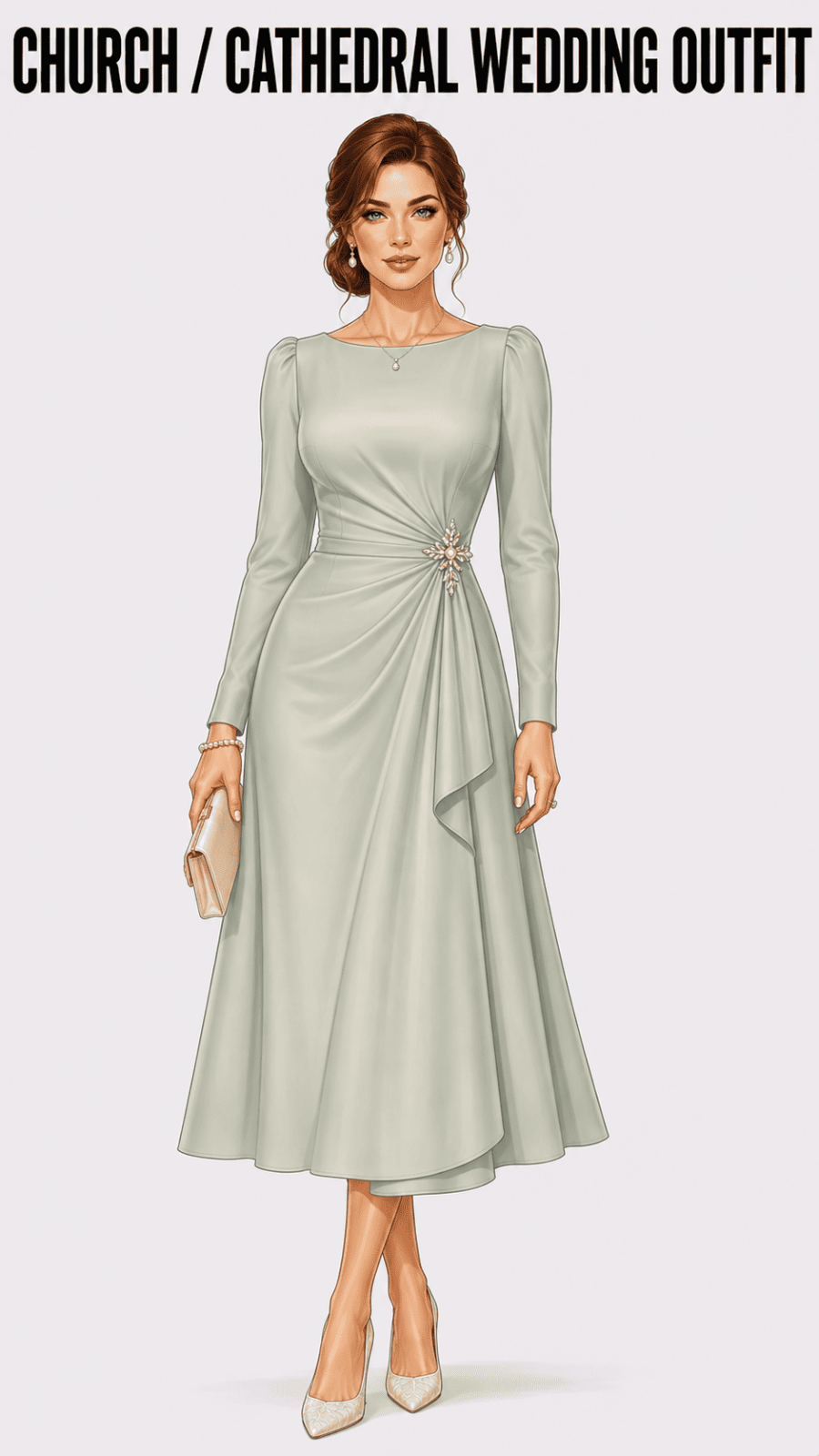
Conservative, covered, and traditionally feminine — midi or maxi length, covered shoulders, respectful neckline. Church and cathedral settings have physical requirements (coverage) and aesthetic ones (formality). The high ceilings and stone architecture of traditional churches create a specific visual scale that benefits larger silhouettes — wide-skirted midis, structured gowns, and layered looks all read well. Thin straps and short hemlines don't.
- 37
Barn / Farmhouse Wedding Outfit

Rustic warmth — warm tones, relaxed silhouettes, practical footwear. Barn floors are typically uneven; stilettos are impractical and potentially damaging. A flowing floral or linen midi with ankle boots or wedge sandals is a genuinely smart choice — beautiful and functional. Textures that evoke the organic environment (linen, cotton, light wools) tend to look more visually at home than structured satins.
- 38
Tropical / Resort Destination Outfit

Vibrant color, light breathable fabric, resort silhouette — often maxi with cutouts, or a sophisticated sundress. The tropical destination wedding gives you the widest color palette of any wedding context: saturated coral, electric blue, sunny yellow, deep tropical green. Bold prints — botanical, geometric, abstract — all work here. Construction must prioritize breathability; lined polyester in 35°C humidity is a genuinely difficult experience. More on this in our guide to resort occasion dressing.
One practical note that most styling guides skip: the venue photographs change significantly based on the floor type and lighting. An outfit that looks effortlessly polished in a hotel ballroom mirror at home may read completely differently against the backdrop of a barn in autumn afternoon light. Before you commit to a purchase, look up the venue online. The visual environment of the space tells you more about what will work than any dress code label.
Category 4: By Separates & Two-Piece Outfits (#39–#46)
The growing wedding guest category for women who'd rather mix pieces than commit to a single dress
For a long time, "wedding guest outfit" was shorthand for "dress." That's changed. Separates — a matching set, a tailored two-piece, a jumpsuit — now occupy a genuinely significant share of the category, and for good reason. They photograph differently than a single garment (more architectural, less soft), they're often more packable for travel, and they tend to be more wearable again afterward, which matters more to a lot of people than fashion media usually admits.
The full range of jumpsuit styles for occasion dressing overlaps significantly with this category, particularly for warm-weather and destination weddings.
- 39
Matching Co-Ord Set (Skirt + Top)

A fitted or cropped top paired with a midi or maxi skirt in identical fabric and print. Co-ords read as a single garment from a distance but offer more flexibility up close — the top can be re-worn with jeans, the skirt re-styled for work. The matching print creates a cohesive, intentional silhouette without the commitment of a one-piece dress.
- 40
Wide-Leg Jumpsuit

One-piece construction with a fitted or wrapped bodice flowing into wide-leg trousers — from a distance, it reads as a gown, but it moves and sits like trousers. The wide leg creates a floor-sweeping silhouette without any of the fabric volume of a skirt, which makes it considerably easier to sit, dance, and move through a reception in.
- 41
Tailored Trouser Suit (Pantsuit)

Matching blazer and trouser in the same fabric — structured shoulders, straight or wide-leg trouser line. The pantsuit has shifted from "alternative" to genuinely mainstream wedding guest territory over the last several years, and for understated formal weddings it can read as more deliberate than a dress. A silk camisole or simple bralette underneath the blazer keeps it from feeling corporate.
- 42
Culotte & Blouse Set

Wide, flowing culottes that fall to ankle length, paired with a tucked or loosely tied blouse. From across a room, culottes can read as a skirt — but they offer the practical movement of trousers, which tends to matter more than people expect once you've been standing for a ceremony and walking across uneven ground to a reception tent.
Separates get dismissed as "less dressed up" than a one-piece, and that's mostly a myth. A genuinely well-cut pantsuit or co-ord, in the right fabric, can be more formal-reading than a casual sundress — formality lives in fabric quality, fit, and tailoring, not in whether the outfit is one piece or two. If you're someone who finds dresses uncomfortable or simply doesn't enjoy wearing them, separates are not a compromise. They're a category in their own right.
- 43
Cropped Top + Maxi Skirt Combo

A fitted cropped top in a contrasting color or texture, paired with a high-waisted floor-length skirt. The high waistline creates the illusion of length through the torso, and the contrast between the fitted top and flowing skirt produces visual interest without requiring a print. Works particularly well when the skirt has movement — pleating, chiffon, or a slight A-line.
- 44
Vest + Wide-Leg Trouser Set

A fitted, often collarless vest paired with high-waisted wide-leg trousers in matching or coordinating fabric. This combination borrows from menswear tailoring but reads as distinctly modern in occasion settings. The clean lines and minimal embellishment let fabric quality do the work — a silk or satin vest set elevates instantly, while cotton reads more casual.
- 45
Cape-Sleeve Top + Skirt Set

A fitted top with attached cape-like sleeve panels that drape from the shoulder, paired with a slim or A-line skirt. The cape sleeve adds drama and movement to the upper body without requiring a full cape or jacket — useful for guests who want a statement element but find oversized outerwear impractical for a long event.
- 46
Halter Top + Palazzo Pants Set

A halter-neck top — neck strap, open back — paired with full, flowing palazzo trousers. This combination shows off the shoulders and neckline while keeping the lower body fully covered and breezy, which makes it a genuinely smart choice for warm-weather and beach weddings where coverage and comfort both matter.
- 8 separates and two-piece types — increasingly mainstream for formal and semi-formal weddings
- Formality comes from fabric and tailoring, not from whether a piece is one garment or two
- Jumpsuits and wide-leg trousers offer the visual impact of a gown with the practicality of trousers
- Separates tend to be more re-wearable, which can make them a practical long-term choice
Category 5: By Fabric & Texture (#47–#54)
How a garment is made — and what it's made from — often matters more than its shape
Two dresses can share an identical silhouette and read as completely different outfits depending on fabric alone. A column dress in cotton poplin looks crisp and daytime-appropriate; the same cut in satin becomes evening formal. Fabric carries information about formality, season, and care — and it's often the first thing a fitting room mirror tells you that a product photo can't.
For deeper fabric-specific guidance, our overview of satin occasion dressing covers one of the most popular fabric choices in this category in detail.
- 47
Satin Slip-Style Dress

A high-sheen, fluid fabric with significant drape — satin catches light in a way matte fabrics simply don't, and that sheen alone signals evening formality. The trade-off is that satin clings; a slip lining underneath is often necessary, and the fabric tends to show every seam and undergarment line, so what's worn beneath genuinely matters here.
- 48
Velvet Wrap Dress

The wrap construction in a deep-pile velvet — the fabric's density absorbs light rather than reflecting it, producing a rich, almost three-dimensional color depth that's particularly striking in jewel tones. Velvet is genuinely warm, which makes it one of the more practical fabric choices for cold-weather ceremonies, not just an aesthetic one.
- 49
Sequin Embellished Dress

All-over or placement sequins sewn onto a base fabric, catching and scattering light with every movement. Sequins are inherently celebratory — they signal "this is a special occasion" more directly than almost any other fabric choice. A fully sequined midi or mini works particularly well for evening receptions with dancing, where the light-catching effect is most visible.
- 50
Linen Shift Dress

A simple, straight-cut dress in linen or a linen blend — minimal seaming, relaxed fit. Linen's natural texture and breathability make it one of the most comfortable fabric choices for hot-weather daytime weddings, though it does wrinkle readily, which is worth knowing before a long day of travel and standing. Pairs beautifully with structured accessories to balance its casual texture.
"Heavier, more expensive-looking fabric always reads as more formal."
Formality is about the relationship between fabric, cut, and finish — not weight alone. A crisp, well-pressed cotton poplin shirt dress can look more put-together than a poorly fitted satin gown. What tends to matter most is whether the fabric holds its shape, how it photographs under the venue's lighting, and whether the construction looks deliberate. Heavier doesn't automatically mean dressier; it just means warmer.
- 51
Brocade / Jacquard Midi Dress

A fabric with a woven-in pattern — raised, textured, often metallic-threaded — that creates dimension without printing. Brocade and jacquard hold their shape well, which makes them excellent for structured silhouettes like the column or A-line. The woven pattern reads as inherently formal and tends to photograph beautifully under warm indoor lighting.
- 52
Tweed Skirt Suit

A structured jacket and matching knee-length or midi skirt in textured wool-blend tweed. Tweed brings a heritage, polished quality that works particularly well for daytime autumn and winter weddings. The boucle-like texture adds visual interest without pattern, and the structured tailoring gives the silhouette a finished, intentional appearance.
- 53
Organza Overlay Dress

A crisp, sheer fabric layered over a fitted lining — unlike chiffon, organza holds structure and can create voluminous sleeves, collars, or skirts that stand away from the body. The crispness gives a slightly architectural, fashion-forward quality that distinguishes it from softer sheer fabrics. Particularly striking in statement-sleeve or balloon-skirt silhouettes.
- 54
Ribbed Knit Midi Dress

A fine-gauge ribbed knit, fitted through the body with natural stretch and recovery. Knit fabrics bring a softness and comfort that woven fabrics can't match — genuinely useful for a long day of travel, sitting, and standing. The fine ribbing creates subtle vertical texture that elevates it beyond a simple jersey dress.
Fabric care often gets overlooked until it's too late. Linen wrinkles on the drive over. Satin shows every mark from a careless hand at the buffet. Velvet attracts lint and pet hair like nothing else. Before committing to a fabric, think honestly about how the day will actually unfold — travel time, seating, food, weather — and choose accordingly. A backup plan (a portable lint roller, a small stain pen) tends to be worth the minor inconvenience of carrying it.
- 8 fabric types — each carrying its own formality signal, season suitability, and care profile
- Sheen (satin, sequin) signals evening formality; matte natural fibers (linen, cotton) signal daytime ease
- Velvet and tweed bring warmth for cold-weather ceremonies; linen and chiffon suit heat
- Plan for fabric care realistically — travel, seating, and weather all affect how a fabric performs over the day
Category 6: By Cultural & Theme Style (#55–#60)
Outfit traditions and aesthetics rooted in global dress cultures and distinct visual eras
Weddings are one of the few remaining occasions where cultural dress traditions and contemporary fashion regularly intersect — multicultural ceremonies, themed receptions, and destination weddings in regions with distinct sartorial histories all invite (and sometimes specify) outfit choices that draw on a particular heritage or era. Approached thoughtfully and respectfully, these styles bring genuine richness and individuality to wedding guest dressing.
For guests attending ceremonies rooted in a specific cultural tradition, our guide to ethnic and traditional dress styles offers a useful starting point for understanding etiquette and construction.
- 55
Saree-Inspired Drape Dress

A modern dress that incorporates draping techniques from the traditional saree — a single length of fabric wrapped and pleated to create an asymmetric, flowing silhouette, often pre-stitched for ease of wear. Common at South Asian weddings and increasingly seen as a standalone occasion-wear option for its movement and elegance, in rich silk or chiffon with woven borders.
- 56
Kaftan Dress

A loose, flowing floor-length garment with wide sleeves, often featuring embroidery or embellishment at the neckline and hem. Rooted in Middle Eastern and North African dress traditions, the kaftan has become a popular choice for warm-climate and resort weddings for its combination of coverage, comfort, and visual richness — particularly in embellished or block-printed versions.
- 57
Cheongsam-Inspired Sheath Dress

A fitted, knee-to-midi length dress with a high mandarin collar, side slit, and often a frog-button or piped front closure — drawing on the traditional Chinese cheongsam (qipao) silhouette. Frequently seen at East Asian weddings and increasingly adapted in modern fabrics and lengths for broader occasion wear, often in silk or silk-blend with subtle florals.
- 58
Embroidered Folk-Style Dress

A midi or maxi dress featuring hand-embroidered or embroidery-inspired motifs along the neckline, cuffs, and hem — drawing on Eastern European, Latin American, and Mediterranean folk dress traditions. The embroidery adds color and craft-driven texture to an otherwise simple silhouette, and tends to suit outdoor, rustic, or harvest-season celebrations particularly well.
When a wedding draws on a specific cultural tradition, the most useful thing a guest can do — beyond choosing a beautiful outfit — is a little research. Many cultures have specific guidance for guests: colors to avoid (white is reserved for the bride in many South Asian and East Asian traditions, for instance), styles considered respectful versus overly casual, and customs around modesty that may differ from a typical Western "garden party" dress code. When in doubt, asking the couple or a member of the wedding party is always welcomed.
- 59
Vintage 1950s-Inspired Tea Dress

A fitted bodice, defined waist, and full circle or A-line skirt falling to mid-calf — the silhouette that defines the 1950s tea dress era. Often in polka dot, gingham, or small florals, this style brings a nostalgic, polished femininity that suits both vintage-themed weddings and any guest who simply loves the era's proportions.
- 60
Global Print Maxi Dress

A floor-length dress in a bold, graphic print drawing on African wax-print, Latin American, or other global textile traditions — vivid color blocking, geometric or botanical motifs, often with a matching headwrap or accessory. This style brings genuine visual energy and works particularly well for celebratory, music-forward receptions.
- 6 culturally and historically rooted styles — each with distinct construction and etiquette context
- For multicultural ceremonies, a small amount of research on colors and customs goes a long way
- Vintage and folk-inspired styles bring distinctive silhouettes that stand out in modern wardrobes
- Approached respectfully, cultural styles add genuine richness rather than feeling like costume
Category 7: By Styling & Accessory Approach (#61–#68)
The finishing choices that turn a good outfit into a complete, considered look
The outfit is maybe sixty percent of the picture. The remaining forty is how it's accessorized — and this is genuinely where a lot of wedding guest looks either come together or fall slightly flat. The good news is that styling choices are also the easiest and most affordable way to change how an outfit reads, transform last year's dress into something that feels new, or stretch one piece across multiple wedding seasons.
Our broader guide to statement jewelry styling pairs well with several of the approaches below.
- 61
Statement Earring Pairing

Large, eye-catching earrings — drops, chandeliers, sculptural shapes — paired with a simple dress and an updo or pulled-back hairstyle. This approach lets a single accessory carry the visual interest, which means the dress itself can be plain, even a basic slip or shift, while the earrings do all the talking. An efficient way to elevate a simple outfit.
- 62
Belted Waist Styling

A thin or wide belt added at the natural waist of an otherwise loose-fitting dress — shirt dress, kaftan, or wrap style. The belt defines the waistline and adds a structured focal point, transforming a relaxed silhouette into something more tailored-looking without altering the garment itself. A genuinely useful trick for re-styling existing pieces.
- 63
Layered Necklace Styling

Multiple necklaces of varying lengths and weights worn together — typically a choker paired with one or two longer chains. This styling approach works particularly well with simple necklines (round, square, scoop) that have visual "room" for the layered effect, and offers a relatively low-cost way to add personality to a minimal dress.
- 64
Structured Clutch Pairing

A small, rigid-frame clutch — box shape, hard edges — carried in a contrasting color or metallic finish. The structured clutch adds a polished, finished quality that a soft pouch or oversized bag doesn't quite achieve. Choosing a contrasting or metallic clutch against a solid-color outfit creates a deliberate focal point at the hand.
"More accessories always make an outfit look more put-together."
Past a certain point, additional accessories compete with each other rather than working together. A genuinely polished look usually has one clear focal point — statement earrings, a bold necklace, or a striking bag — with everything else kept deliberately quiet. Choosing one "moment" and letting the rest of the outfit support it tends to read as more considered than wearing several standout pieces at once.
- 65
Wrap / Shawl Layering

A lightweight pashmina, silk scarf, or structured shawl draped over the shoulders — practical for temperature changes between an outdoor ceremony and an air-conditioned reception, and visually useful for adding coverage to sleeveless or strapless dresses for modesty-conscious ceremonies. A versatile, low-commitment way to adapt one outfit across different settings.
- 66
Hair Accessory Styling

A decorative clip, comb, headband, or small floral pin incorporated into an updo or half-up style. Hair accessories add a festive, occasion-appropriate touch without competing with jewelry, and tend to photograph beautifully in close-up shots — useful for guests who'll be in a lot of group photos throughout the day.
- 67
Statement Heel Pairing

A bold-colored, metallic, or strappy heel worn with a simple, neutral-toned outfit — the shoes become the conversation piece. This approach particularly suits midi-length dresses and culottes, where the footwear is genuinely visible, and offers a way to bring color and personality into an otherwise restrained look. Comfort still matters: a block heel achieves the same visual effect with considerably more wearability across a long day.
- 68
Mini / Belt Bag Pairing

A small cross-body or belt bag worn over a dress or jumpsuit — a deliberately casual, hands-free alternative to a clutch. This pairing has moved from purely practical to genuinely fashion-forward, particularly for receptions involving dancing where a hand-held clutch becomes a nuisance. Works best when the bag's color or texture coordinates with another accessory in the outfit.
- 8 styling approaches — the most affordable way to refresh or adapt an existing outfit
- One clear focal accessory tends to read as more intentional than several competing statement pieces
- A wrap or shawl solves both temperature changes and modesty requirements in one practical piece
- Hands-free bags and block heels balance style with the practical realities of a long wedding day
Quick Comparison: Matching Outfits to Occasion & Budget
| Dress Code | Best-Fit Styles | Typical Price Tier | Season Suitability |
|---|---|---|---|
| Black Tie | Chiffon maxi gown, column dress, brocade midi | Investment | All seasons (indoor venues) |
| Cocktail | Midi wrap dress, fit-and-flare, satin slip dress | Mid-range | All seasons |
| Garden Party | Floral maxi, tiered midi, puff-sleeve midi | Budget to mid-range | Spring & summer |
| Smart Casual | Shirt dress, co-ord set, linen shift dress | Budget | Spring through autumn |
| Festive / Holiday | Velvet wrap dress, sequin dress, brocade midi | Mid-range to investment | Autumn & winter |
| Beach / Destination | Kaftan dress, halter + palazzo set, linen shift | Budget to mid-range | Summer / hot-climate travel |
- Dress code check — have you read the actual dress code on the invitation, not just assumed cocktail or smart casual?
- Venue research — have you looked up the venue online to understand the floor surface, lighting, and visual setting?
- Terrain-appropriate footwear — no stilettos on grass, cobblestones, or uneven barn floors.
- Season-appropriate fabric — not too hot, not too cold, not too prone to wrinkling.
- No bridal-adjacent colours — avoid white, ivory, champagne, and anything else that could read as bridal.
- Religious ceremony dress code — if attending one, are your shoulders covered and is your hem below the knee?
- Movement test — have you tried sitting, walking, and dancing in the outfit, or at minimum moved in it for five minutes?
- One accessory focal point — rather than several competing statement pieces.
- Cultural customs check — if it's a multicultural ceremony, have you checked on any colour or style customs that apply to guests?
Frequently Asked Questions — Wedding Guest Outfits for Women
What is the most appropriate outfit for a wedding guest?
A wedding guest outfit is most appropriate when it matches the dress code stated on the invitation, suits the venue type and season, avoids white and ivory, and allows the wearer to move comfortably across the full day. The most reliably appropriate silhouettes are the midi wrap dress and A-line midi in a non-bridal color — they suit most dress codes from garden party to cocktail. When in doubt, err slightly more formal than you think necessary.
What should a woman wear to a wedding if the dress code says "cocktail attire"?
Cocktail attire for a wedding guest means a dress or outfit that falls between the knee and the mid-calf — a midi or knee-length is the standard interpretation. Structured fabrics like crepe, satin, or jacquard read as appropriately elevated. A tailored jumpsuit or polished co-ord in a luxury fabric also works. Avoid casual cottons or anything you'd wear to the office. The cocktail dress code covers the widest range of any wedding instruction, so fabric quality matters more than silhouette specifics. For outfit examples, see our cocktail and party wear guide.
Can a wedding guest wear black to a wedding?
Black is entirely appropriate for wedding guests in most Western and contemporary contexts, particularly for evening, cocktail, and formal dress codes. It tends to work less well for daytime outdoor ceremonies where the setting is light and pastoral — a black column dress looks visually incongruous in a sun-drenched garden. For cultural ceremonies where black carries mourning associations, it's worth checking specific customs. In most cases, a well-chosen black dress is a reliable and polished choice across a wide range of venues and dress codes.
Is a jumpsuit appropriate for a wedding guest?
A jumpsuit is appropriate for most wedding guest dress codes when the fabric and fit are elevated. A wide-leg jumpsuit in silk crepe, satin, or structured chiffon reads as equivalent to a cocktail dress in most venues. Tailored pantsuits and wide-leg jumpsuits have become genuinely mainstream for wedding guest dressing over the last decade. The key considerations are fabric quality, neckline, and whether the setting is conservative — for religious ceremonies, a trouser-based outfit may read as less appropriate, though a well-cut suit with covered shoulders often works fine.
What colours should a wedding guest avoid?
White, ivory, and champagne are the primary colours to avoid in most contexts, as they risk resembling bridal attire. Beyond that, the specific culture and ceremony context matter: red tends to carry bridal associations in some East Asian traditions; in South Asian weddings, white is often associated with mourning. Nude and very pale blush shades can read as white in photographs, which is worth bearing in mind. Most other colors — including black, navy, green, burgundy, and bold prints — are generally appropriate across a wide range of wedding dress codes. When attending a multicultural ceremony, checking with the couple or wedding party is the most reliable approach.
What is the difference between "cocktail attire" and "semi-formal" at a wedding?
Cocktail attire and semi-formal are often used interchangeably, but semi-formal tends to sit slightly higher on the formality scale and frequently implies midi to floor-length options. Cocktail attire specifically references the cocktail-length dress — above the calf, below the knee — whereas semi-formal allows a longer silhouette. In practice, both dress codes welcome the same core silhouettes: structured midis, sophisticated printed dresses, and elevated jumpsuits. When both labels appear, dressing toward the higher interpretation (midi over mini, silk crepe over cotton) tends to be the safer choice.
What should I wear to an outdoor summer wedding?
An outdoor summer wedding calls for lightweight, breathable fabric above all else — linen, cotton voile, chiffon, or lightweight georgette. Bold or saturated colors and botanical prints tend to photograph well in natural light. Footwear is a significant practical consideration: stilettos sink into grass, so block heels, wedges, or flat sandals work considerably better on outdoor terrain. Bring a light wrap or linen blazer for shade and temperature changes. See our broader guide to warm-weather outfit dressing for additional ideas.
How formal should a wedding guest outfit be if the invitation says "formal attire"?
Formal attire for a wedding guest typically means floor-length or midi-length in luxury fabric — the same general territory as black tie optional, without the strict gown requirement. A long column dress in silk, a chiffon floor-length gown, or a brocade midi with structured accessories all meet this standard. The distinguishing characteristic is fabric elevation and silhouette length. Mini dresses, casual sundresses, and separates that read as smart casual are generally too relaxed for a formal instruction. When the invitation says "formal," it means the couple has planned an event that warrants a genuinely elevated wardrobe response.
Conclusion: Bringing It All Together
Somewhere in these 68 entries — 7 classification systems, hundreds of individual styling considerations — is the outfit that will work for the specific wedding you're attending. That's what this guide was built for.
Not to show you every option that exists, but to give you a vocabulary for describing what you're looking for, a framework for understanding why certain choices work in certain contexts, and the confidence to make a genuinely informed decision rather than a guess. What emerges clearly across all 7 categories is this: the best wedding guest outfits share a quality that has nothing to do with price, trend, or silhouette preference. They're considered. They reflect an understanding of where you're going, who you're celebrating, and what the environment demands — and within that understanding, they express something true about how you want to show up. That's harder to buy than the right dress. But it's what makes a dress actually work.
The midi wrap dress will still be appropriate for almost any dress code. A sequined midi will still photograph beautifully on a dancing floor. And a kaftan on a beach at sunset will always look better than a stiff cocktail dress in 32-degree heat. Construction is context. And context — not convention — is the most useful thing this guide can give you.
- Read the actual dress code on the invitation before choosing anything — it is a specific instruction, not a suggestion.
- The midi wrap dress and A-line midi are the most universally appropriate silhouettes across all dress code levels.
- Formality comes from fabric and tailoring — not from whether an outfit is a dress, a jumpsuit, or a suit.
- Silhouette choice should match the venue and lighting, not just the dress code wording.
- Footwear and terrain are inseparable — plan footwear for the floor surface you'll actually be standing on.
- Satin signals evening; linen signals daytime; velvet signals autumn/winter — fabric choice carries occasion information.
- One focal accessory always reads as more intentional than three competing statement pieces.
- For multicultural ceremonies, a small amount of research on color customs and coverage norms is always worth doing.
- White, ivory, and near-white shades remain the most reliable colors to avoid regardless of dress code.
- The most considered wedding guest outfits reflect an understanding of context — where you're going, not just what you look like.
Leave a Reply