
There is a garment that has outlasted every major trend cycle of the past two centuries, survived the death of formal dressing, the rise of athleisure, and the complete reinvention of the office — and arrived in the contemporary wardrobe not merely intact, but more useful than ever. That garment is the cardigan. And the reason it keeps surviving is not nostalgia. It’s construction logic.
The cardigan is the most adaptable layering piece in women’s fashion. And the most consistently underestimated.
The cardigan’s origin story is military: James Thomas Brudenell, the 7th Earl of Cardigan, wore a knitted waistcoat during the Crimean War of 1854 that British soldiers popularized through sheer visibility. By the early twentieth century, Coco Chanel had adapted the format into her iconic jersey suits, dissolving the boundary between knitwear and outerwear in a single collection. The 1950s saw the cardigan become a defining collegiate garment — draped backward over the shoulders became a cultural gesture. The 1990s reclaimed it through grunge and the deliberate anti-fashion aesthetic of Kurt Cobain, who wore oversized vintage cardigans as a studied rejection of mainstream style. Today the category spans everything from fitted ribbed shells to floor-length duster coats, each construction carrying its own seasonal logic, occasion range, and styling vocabulary.
This guide documents 55+ types of cardigans across 6 classification systems. For every single entry:
-
Design
What it looks like
-
Season
When to wear it
-
Best For
Occasions & styling
Start here, explore everything — and keep our full tops and knitwear visual reference open alongside it.
All 6 Categories at a Glance
A structured breakdown of the 57+ cardigan types documented in this guide.
- 01
By Length / Silhouette
- 02
By Construction & Knit Type
- 03
By Closure & Front Style
- 04
By Fabric & Fibre
- 05
By Occasion & Style Context
- 06
By Design Detail & Feature
57+ Different Types of Cardigans for Women
Category 1: By Length / Silhouette (#1–#12)
How far the cardigan falls on the body — the primary variable that determines its layering logic and occasion range
Length is the cardigan's most decisive characteristic. It determines whether the garment reads as a layering piece, an outerwear substitute, a casual top, or a statement coat — before you've considered fabric, colour, or closure. A cropped cardigan over a high-waisted skirt creates an entirely different proportional conversation than a duster-length cardigan over wide-leg trousers, even if both are made from identical yarn in identical colours. Understanding length as the primary variable cuts through the noise of trend-language and gets directly to what a cardigan will actually do on your specific body in your specific context.
The 12 silhouette types in this category are ordered from shortest to longest — a spectrum that maps directly from the most contemporary and casual at the short end to the most relaxed and statement-making at the long end. For a broader look at how length interacts with proportion across all knitwear, our complete sweater types guide covers the full range of knit silhouettes.
- 01
Cropped Cardigan

Hemline falls at or above the natural waist — typically between the midriff and the hip bone. The cropped cardigan is the silhouette most strongly associated with the Y2K revival and with contemporary high-waisted bottom pairings. Its logic is proportional: by ending the cardigan above the waistband of whatever is worn below, it creates a clean visual break that makes high-waisted trousers and skirts appear even more defined. Cropped cardigans are typically worn open or with a single button fastened, allowing the hemline geometry to do the visual work.
- 02
Waist-Length Cardigan
Hem falls precisely at the natural waist — the most balanced cardigan proportion. Unlike the cropped variant, the waist-length cardigan doesn't expose the midriff; it simply ends at the body's narrowest point. This makes it one of the most universally flattering cardigan lengths, as it neither shortens nor elongates the torso dramatically. It functions equally well tucked, half-tucked, or worn entirely open. The waist-length cardigan is the standard classic cardigan silhouette that has persisted in women's fashion since the mid-twentieth century without meaningful interruption.


- 03
Hip-Length Cardigan
Hemline falls at the fullest part of the hip — the most common everyday cardigan length and the default "classic cardigan" silhouette in most women's wardrobes. The hip-length cardigan provides coverage of the midsection and upper hip while leaving the full length of the leg visible below. It layers cleanly over most tops, sits well with both jeans and skirts, and provides enough coverage to function as a light outerwear piece in mild weather. The hip-length specification is where most button-through cardigans, classic collegiate styles, and everyday workwear cardigans sit.
- 04
Tunic Cardigan
Extends below the hips to the upper thigh — long enough to cover the seat and thighs but stopping well above the knee. The tunic cardigan occupies a specific proportional niche: it provides enough length to be worn as a standalone top over leggings or slim trousers without requiring anything underneath that provides bottom coverage. This makes it one of the most functional cardigan lengths for cold-weather layering and one of the most common silhouettes in autumn/winter knitwear collections. It also tends to be more forgiving through the midsection than shorter lengths.


- 05
Knee-Length Cardigan
Hemline lands at or just above or below the knee — transitional between a tunic cardigan and a true longline. The knee-length cardigan begins to function more like a lightweight coat than a knitwear layering piece; it provides significant warmth coverage and creates a full-length silhouette impression when worn over narrow trousers or leggings. This length tends to read as more polished and considered than shorter cardigans, which makes it well-suited to office casual and elevated everyday occasions.
- 06
Longline / Midi Cardigan
Falls between the knee and the mid-calf — the cardigan format that most directly competes with traditional outerwear in terms of coverage and visual weight. The longline cardigan became a key piece in the 2010s minimalist wardrobe movement, where it was worn over monochromatic outfits in place of a structured coat. Its appeal is the combination of warmth, visual lengthening, and the softness of knitwear construction that a coat cannot provide. The longline cardigan requires careful attention to width: too wide and it creates bulk; too narrow and it loses the relaxed quality that makes the silhouette work.


- 07
Duster Cardigan
Floor- or near-floor-length cardigan — the most dramatic and statement-making silhouette in the category. The term "duster" originally referred to long lightweight protective coats worn over clothing to shield against road dust; applied to cardigans, it describes the same extreme length in knit construction. Duster cardigans function as flowing, relaxed outerwear alternatives and create a full-length vertical line that has a distinctly editorial quality. Most are worn open and used as layering pieces rather than standalone garments. More on long outerwear layering in our coats and outerwear guide.
- 08
Oversized Cardigan


Significantly wider and roomier than standard fit — deliberately sized up to create a relaxed, enveloping silhouette. The oversized cardigan became a cultural touchstone in the early 1990s through grunge aesthetics and has since become one of the most searched cardigan types online, particularly in the context of Taylor Swift's "cardigan" cultural moment of 2020 which sparked a significant commercial revival. The key to oversized cardigan styling is the same principle governing all oversized garments: balance the volume in the upper body by keeping the lower body proportion slim.

- 09
Fitted / Slim Cardigan

Contoured closely to the body — follows the shoulder, waist, and hip curve without excess fabric. The fitted cardigan is the most office-appropriate and occasion-flexible cardigan silhouette precisely because it doesn't add visual bulk. It layers cleanly under blazers and structured coats, works over fitted dresses and blouses, and provides warmth without the volume that would disrupt a tailored outfit. Ribbed construction is most common in fitted cardigans because rib knitting has inherent horizontal stretch that accommodates body curve without the need for shaping seams.
- 10
Relaxed / Boxy Cardigan

Straight-cut with minimal waist tapering — not as deliberately oversized as an oversized cardigan but with a relaxed, non-fitted quality. The boxy cardigan hits a comfortable middle ground between structured and slouchy. It doesn't cling and doesn't overwhelm; it simply sits squarely on the body with a casual authority. Most common in lightweight cotton, linen, or sport-weight yarn, and particularly prevalent in spring and summer wardrobes where the relaxed knit functions as a light layer over sleeveless tops and dresses.
- 11
Cocoon Cardigan

Wider through the body and shoulders than a standard cardigan, tapering toward the hem to create a rounded, enveloping shape. The cocoon silhouette — borrowed from cocoon coat construction — applies to cardigans as a distinctly cocooning, warmth-prioritising shape. The widest point sits across the upper back and shoulders, narrowing as it approaches the hem, which creates an unusual proportion that reads as deliberately sculptural rather than simply oversized. Works best in medium-to-heavy weight yarns that have enough structure to hold the cocoon shape without collapsing.
- 12
Waterfall / Draped Cardigan

Open-front cardigan with cascading front panels that fall in a continuous draped line from the shoulder to below the hem — creating a flowing, asymmetric front that moves with the wearer. The waterfall cardigan emerged as a significant knitwear trend in the mid-2000s and remains a persistent choice for women who want the warmth and coverage of a cardigan without the visual weight of a fully closed front. The draped panels create a slimming vertical line while keeping the silhouette open and fluid. More on draped and layered knitwear in our sweater types guide.
The single most common cardigan mistake: choosing length by trend rather than by proportional logic. A duster cardigan that photographs beautifully on a 5'10" model may cut a shorter figure in an awkward place. The rule is simple — the cardigan hem should either end before a curve on the body or fall well below it. Hemlines that land at the widest hip point or at the middle of the thigh create visual width. Hemlines at the waist, upper thigh, knee, or below all work with the body's natural proportion rather than against it.
- 12 silhouettes ordered from shortest (cropped) to longest (duster) — length is the cardigan's primary decision variable
- Fitted and hip-length are the most versatile cross-occasion silhouettes; duster and oversized are the most statement-making
- Tunic and knee-length cardigans work over leggings without requiring separate bottom coverage
- Hemline placement relative to body curves — not trend — should drive length selection
Category 2: By Construction & Knit Type (#13–#24)
The knitting technique and structural approach — what determines how the fabric looks, drapes, and behaves
Knit construction is the cardigan's material identity. Two cardigans in the same length, the same colour, and the same yarn fibre will produce entirely different garments if one is ribbed and one is cable-knit. The rib creates a clingy, body-conscious structure; the cable creates textured dimension and a warmth-retaining air pocket. Understanding construction type cuts through the visual ambiguity of online shopping in particular — where fabric and texture are difficult to assess from photographs — and helps predict how a garment will actually behave on the body and through repeated wearing.
- 13
Ribbed Cardigan

Constructed using alternating knit and purl stitches to create vertical ridges that run the length of the garment. Ribbing has inherent two-way stretch in the horizontal direction, which gives ribbed cardigans their body-conscious, clinging quality without the need for elastic or shaped seams. A 1x1 rib (alternating single knit and purl stitches) produces a fine, tight-fitting rib; a 2x2 rib creates wider channels and a slightly more relaxed stretch. Ribbed cardigans are among the most photogenic knit constructions and are frequently associated with clean, minimal styling.
- 14
Cable-Knit Cardigan

Features twisted rope-like cable patterns created by crossing stitches over each other during construction. Cable knitting originated in the fishing communities of the Aran Islands off the Irish coast, where the technique created dense, warm fabric for fishermen. The crossing of stitches traps air pockets within the knit structure, significantly increasing the garment's thermal efficiency beyond what the yarn weight alone would provide. Contemporary cable-knit cardigans range from the traditional Aran pattern (featuring multiple distinct cable types in one garment) to modern minimal interpretations with a single wide cable panel centred on the front.
- 15
Chunky / Bulky Knit Cardigan

Knitted from thick, heavy yarn (classified as "bulky" or "super bulky" in standard yarn weight systems) with large, open stitches visible to the naked eye. Chunky cardigans are the maximum-warmth, maximum-texture end of the knitwear spectrum — they have significant visual presence as well as thermal weight. Hand-knitted or hand-knit-style chunky cardigans saw a significant commercial surge during the late 2010s, when the "hygge" lifestyle trend pushed Nordic-inspired heavy knitwear into mainstream fashion consciousness across markets well beyond Scandinavia.
- 16
Fine-Knit Cardigan

Constructed from very fine, lightweight yarn at a high stitch gauge — producing a smooth, almost fabric-like surface texture with fine stitches barely visible at a glance. Fine-knit cardigans bridge the perceptual gap between knitwear and woven garments: they drape like fabric, layer without adding bulk under structured outerwear, and photograph at formal occasions without the visual weight that heavier knits would add. Cashmere and merino fine-knits are the premium end of this category; machine-knit fine-gauge acrylics are the accessible end.
- 17
Open-Weave / Lattice Cardigan

Constructed with deliberately large gaps between stitches — creating an open lattice or net-like structure where the spaces between yarns are part of the design. Open-weave cardigans are the warmest-weather knit option: they provide the layering structure of a cardigan without meaningful warmth, functioning more as a visual layer and styling piece than a temperature-management garment. They are common in spring and summer resort wear, where a beach or garden setting demands light textures rather than heat-retaining constructions.
- 18
Intarsia / Colour-Block Knit Cardigan

Knitted using the intarsia technique — separate yarn supplies create distinct colour blocks or motifs within the fabric, with each colour area worked individually rather than carried across the row. Intarsia allows large-scale colour block patterns (distinct from the smaller-scale fair isle technique that carries yarn across the row) and is used to create cardigans with graphic, bold colour division. The technique is technically demanding and therefore associated with quality craftsmanship when executed in pure yarn. Colour-block cardigans experienced a significant revival in the 2020s across both luxury and commercial knitwear markets.
- 19
Fair Isle / Jacquard Cardigan

Multi-colour pattern knitting where two or more yarn colours are worked in the same row — the unused yarn is "carried" across the back of the work, creating a double-thickness fabric with its own distinct visual vocabulary. True Fair Isle knitting originates from the Fair Isle, a small island between Orkney and Shetland in Scotland, where the traditional pattern system of X-motifs and OXO patterns developed over centuries. Today "fair isle" describes any carried-yarn multi-colour pattern; the technique produces a warmer fabric than single-colour knitting due to the doubled yarn layers.
- 20
Pointelle Cardigan

Features a delicate openwork pattern of small eyelet holes arranged in geometric or floral configurations within a fine-knit fabric. The pointelle technique creates a semi-sheer, lace-like quality without true lace construction — the holes are created by yarn-over increases and deliberate dropped stitches in a controlled pattern. Pointelle cardigans occupy a uniquely feminine position in the knitwear spectrum: the delicate openwork pattern reads as intricate and considered without the formality of actual lace, making them a versatile choice for occasions that need texture and visual interest. More on delicate knitwear in our sweater types guide.
- 21
Crochet Cardigan

Constructed using crochet technique rather than traditional knitting — a single hook creating interlocking loops rather than the two-needle knitted stitch structure. Crochet produces a denser, less stretchy fabric than knitting at the same yarn weight, and creates its own distinctive textural vocabulary (granny squares, shell stitches, mesh patterns) that cannot be replicated with knitting needles. Crochet cardigans experienced a major handcraft revival during the pandemic era of 2020–2022 and continue to be a significant commercial category in both handmade and mass-market fashion.
- 22
Textured Stitch Cardigan

A catch-all category for cardigans featuring raised or embossed stitch patterns beyond standard rib and cable — seed stitch, moss stitch, basketweave, garter stitch, honeycomb, and any other textural construction that creates a three-dimensional fabric surface. Textured stitch cardigans derive their visual interest entirely from the play of light across raised and recessed stitch areas, meaning they tend to work best in solid or tonal colours where the stitch texture is the only surface event. The texture creates a garment that appears more interesting up-close than at a distance — a quality that translates particularly well to person-to-person dressing.
- 23
Slub / Uneven Yarn Cardigan

Knitted from slub yarn — yarn with intentional thick-and-thin irregularities in the twist — creating a naturally variegated surface texture that mimics handspun fibres. Slub cardigans have an organic, artisanal quality that even fine machine knitting can achieve; the irregular yarn itself creates a visual texture without requiring a complex stitch pattern. Most common in cotton and linen blends for spring and summer; the natural colour variation in undyed or naturally dyed slub yarns tends toward the earthy and botanical end of the palette.
- 24
Bouclé Cardigan

Knitted from bouclé yarn — a looped, curly textured yarn that creates a distinctive nubby, fuzzy surface characteristic of Chanel-style tweed suiting. Bouclé cardigans sit at the intersection of knitwear and structured tailoring: the yarn's tight loop construction creates a fabric with enough body to hold a structured silhouette while retaining the softness of knitwear. The Chanel association is inescapable and intentional — bouclé has been the house fabric of Chanel since Coco Chanel introduced her jersey suits in the 1920s. A high-quality bouclé cardigan is genuinely investment-level knitwear.
Knit construction type is the most-overlooked variable when buying cardigans online. The same yarn in a ribbed construction and a stockinette construction will produce garments that behave differently on the body, photograph differently, and care differently. Rib clings; stockinette drapes. Bouclé holds shape; slub flows. Before purchasing, check what stitch pattern is used — not just what fibre. A "merino cardigan" tells you almost nothing useful without knowing whether it's ribbed, cable-knit, fine-knit, or open-weave.
Category 3: By Closure & Front Style (#25–#34)
How the cardigan opens, closes, or wraps — the front construction that defines its wearability and visual character
The front closure is where a cardigan declares its formality register and practical personality. A buttoned cardigan with a neat placket reads as polished and professional; an open-front cardigan without any closure reads as relaxed and casual; a zip-front cardigan reads as sporty and functional. These are not arbitrary style choices — they reflect genuine differences in construction approach that affect how the garment hangs, how it layers, and what visual impression it creates before any other styling decision has been made. Understanding closure types also helps enormously in functional situations: if you know you'll be putting the cardigan on and taking it off repeatedly throughout a day, a button closure is significantly more practical than a zip or pin closure.
- 25
Button-Through Cardigan

Buttons running the full length of the front opening from collar to hem — the defining classical cardigan format. The button-through design is the original cardigan construction from which all other variants deviate. Its appeal is complete versatility: worn fully buttoned it functions as a structured layering piece; worn partially buttoned it creates a more relaxed open-collar effect; worn fully open it becomes a lightweight layering coat. The choice and size of button matters significantly — tortoiseshell, wood, metal, and plastic buttons all read differently and affect the garment's formality register. For button and fastening types, our buttons guide covers every variety.
- 26
Open-Front Cardigan

No buttons, zips, or closures — the front falls open naturally. The open-front cardigan is permanently in its layering configuration: it cannot be closed to create warmth, but it creates an effortlessly open, drapey visual that the button-through cardigan only achieves when deliberately worn unbuttoned. The absence of a closure removes any visual interruption down the front of the garment and creates a cleaner vertical line than a button placket. This makes open-front cardigans particularly effective for elongating the visual silhouette when worn over a contrasting inner layer.
- 27
Wrap Cardigan

Front panels wrap across the body and tie or tuck at the waist — borrowing the wrap dress's construction logic and applying it to knitwear. The wrap cardigan is simultaneously a layering piece and a waist-defining garment: the self-tie creates an adjustable cinching effect that gives the wearer control over how fitted or relaxed the silhouette appears. This adjustability makes wrap cardigans exceptionally flattering across different body shapes and sizes, which is part of why the format remains commercially consistent season after season. More on wrap styling in our wrap style guide.
- 28
Zip-Front Cardigan

A zip replaces the button placket — providing a smooth, flat front closure that opens and closes rapidly without the visual interruption of individual buttons. Zip-front cardigans read as more sporty and functional than button-through versions — the zip itself carries associations with activewear and casual outerwear rather than classic knitwear. This makes them well-suited to smart-casual office environments and active leisure contexts. Half-zip cardigans (where the zip covers only the top third to half of the front) are a distinct sub-variant that functions more like a mock-neck top with adjustable collar ventilation.
- 29
Belted Cardigan

An open-front or loosely structured cardigan with an attached or separate belt that cinches the waist. The belt transforms the cardigan's proportional relationship with the body: without it, the cardigan falls straight and relaxed; with it, the waist is defined and the garment takes on a coat-like structured quality. Belted cardigans are particularly effective in longline or duster lengths, where the belt prevents the long open panels from looking shapeless. The belt also functions as the garment's closure without the visual interruption of buttons or zip, which creates a cleaner front line.
- 30
Single-Button Cardigan

One single button or clasp positioned at the chest or waist — the minimal-closure variant that provides just enough fastening to keep the cardigan in place without creating a structured button-through placket. The single button creates a distinct styling moment: it draws the eye to a specific point on the garment, and the choice of where to position it (bust, waist, or lower) changes the visual emphasis. A bust-level single button references blazer styling; a waist-level single button defines the waistline; a lower single button creates a relaxed open-lapel effect above it. The single-button cardigan is always partially open by design.
- 31
Shawl-Collar Cardigan

Front panels roll back at the collar to form a continuous, rounded lapel that wraps across both shoulders in a shawl-like drape. The shawl collar is one of the most classically elegant collar treatments available in knitwear — it references both the robe-style garments of Eastern dress traditions and the smoking jackets of 19th-century European menswear. In a cardigan, the shawl collar adds a significant visual quality upgrade over a standard V-neck or crew-neck opening, transforming what might otherwise be a casual garment into something with genuine occasion range. More on collar styles in our collar types guide.
- 32
Lapel / Notched-Collar Cardigan

Structured lapels at the front opening that mirror blazer construction — a distinct notch or peak where the collar meets the lapel, exactly as in tailored suiting. This construction sits furthest from traditional knitwear aesthetics in the cardigan category, deliberately blurring the boundary between knitwear and tailoring. The lapel cardigan is often used as a soft blazer substitute in professional environments, providing the visual authority of a jacket collar with the comfort of knit construction. Works particularly well in bouclé, structured jersey, and heavier ribbed fabrics that hold the lapel shape.
- 33
Snap-Closure Cardigan

Metal or plastic press-studs replace traditional buttons as the closure mechanism — snapping shut quickly rather than threading through a buttonhole. Snap closures are particularly common in utility-influenced fashion and in garments designed for ease of dressing and undressing. On cardigans, the snap provides a flatter, less visually prominent closure than traditional buttons, keeping the front surface cleaner. The functional click of a snap closure carries slightly different connotations than buttons — more practical, slightly more modern, occasionally more utilitarian.
- 34
Asymmetric-Front Cardigan

Front panels are deliberately uneven — one side longer than the other, or the closure running diagonally rather than vertically. The asymmetric front creates visual dynamism without relying on colour, print, or embellishment to do it: the construction itself generates the interest. Common in fashion-forward and designer knitwear collections where straightforward construction would read as insufficient for the price point. The asymmetric opening also creates a more dramatic lapel or drape effect than a symmetrical front can achieve.
The button is the cardigan's most neglected design element — and the easiest upgrade available. A good-quality tortoiseshell or horn button on an otherwise ordinary knit transforms the cardigan's formality register immediately. Replacing cheap plastic buttons with quality wooden, metal, or shell alternatives is one of the highest-return-per-effort alterations in women's fashion. The cost is minimal; the impact is significant. Always check button quality before buying and factor in replacement cost if the buttons are poor.
Category 4: By Fabric & Fibre (#35–#44)
The raw material — what the cardigan is actually made from and how that changes its performance, feel, and care requirements
Fibre is where the cardigan's long-term value is determined. Two identically constructed cardigans — same pattern, same stitch, same colour — in cashmere and acrylic will perform differently in every measurable way: warmth, weight, pilling rate, longevity, care requirements, and the way the fabric moves against the body. Understanding what a cardigan is made from is arguably more important than understanding what it looks like, because the fibre determines what the garment will actually be like to own and wear for the next five to twenty years. For a comprehensive overview of yarn and fabric fibre types, our fabric types and fibre guide covers every material in womenswear construction.
- 35
Cashmere Cardigan

Constructed from the fine, soft undercoat fibres of the Cashmere goat — a material that is significantly warmer by weight than standard wool, extraordinarily soft against skin, and among the most expensive natural fibres commercially available. Cashmere cardigans are investment-tier knitwear: a well-made pure cashmere cardigan, properly cared for, can last decades without meaningful degradation. The primary quality indicator is ply count — two-ply cashmere is standard quality; four-ply is robust and longer-lasting; single-ply is sometimes used in lightweight cardigans but pilles more quickly.
Care Note: Always hand-wash or use a gentle wool cycle in cold water. Never hang cashmere — fold and store flat to prevent stretching. Cedar blocks deter moths without chemical damage.
- 36
Merino Wool Cardigan

Made from the fine, non-itchy wool of Merino sheep — a fibre that offers the warmth of traditional wool with a significantly finer fibre diameter that doesn't prickle against sensitive skin. Merino wool's natural moisture-wicking properties make it function-optimised knitwear: it pulls moisture away from the skin, regulates temperature in both warm and cold conditions, and resists odour more effectively than synthetic alternatives. Merino cardigans are the workhorse tier of quality knitwear — substantially more accessible than cashmere but delivering significantly better performance than standard wool or acrylic blends.
- 37
Cotton Cardigan

Knitted from cotton yarn — the most breathable and washable natural fibre available for knitwear. Cotton cardigans are the definitive warm-weather layering piece: they provide the layering structure of a cardigan without meaningful warmth addition, making them practical for air-conditioned offices in summer and for spring and autumn transitional days. Cotton's lack of elasticity means cotton cardigans typically have less stretch recovery than wool alternatives and may grow slightly with wear — construction in rib stitch compensates for this by adding horizontal recovery. More on cotton construction in our cotton fabric guide.
- 38
Linen Cardigan

Knitted from linen or linen-blend yarn — providing the natural breathability and slight texture of linen in a knitted construction. Linen knit cardigans sit at the most relaxed, artisanal end of the cardigan market: the slight irregularity of linen fibre gives the knit a relaxed, lived-in quality that reads as deliberately effortless rather than polished. Linen improves with washing — the fibre softens and the characteristic natural crinkle becomes more pronounced — which makes linen cardigans genuinely investment pieces even at accessible price points. Best in open-weave or light-weight constructions where the fibre's breathability advantage is fully utilized.
- 39
Alpaca Cardigan

Knitted from alpaca fibre — a hollow-shafted natural fibre from the Andean alpaca that is hypoallergenic, exceptionally warm by weight, and has a distinctive silky-soft surface quality. Alpaca cardigans occupy a distinct position between merino and cashmere: warmer than merino, not as soft as cashmere but less prone to pilling. Baby alpaca (fibres from the first shearing) is the softest and most desirable grade. Alpaca has minimal lanolin, making it particularly suitable for people with wool sensitivities. The fibres have less elasticity than wool, so alpaca cardigans may need more careful storage to prevent stretching.
- 40
Mohair Cardigan

Constructed from mohair fibre — the lustrous, long-haired fleece of the Angora goat — which creates a distinctive halo effect of fine filaments extending beyond the knit structure. Mohair cardigans are visually unique in a way that no other fibre replicates: the halo creates a soft, blurred outline that photographs beautifully and changes character depending on lighting conditions. Pure mohair can feel scratchy against sensitive skin; most commercial mohair cardigans blend it with silk or merino to soften the handle. The halo effect means mohair cardigans should be stored carefully to prevent fibre felting — fold rather than hang.
- 41
Viscose / Bamboo Cardigan

Knitted from viscose (also called rayon) or bamboo-derived fibre — semi-synthetic materials that combine the breathability of natural fibre with a drape quality that wools cannot achieve. Viscose and bamboo cardigans have a distinctly silky, fluid quality: they drape rather than holding shape, which makes them the most dress-like of all cardigan fibres. They are cooler-wearing than any wool alternative and photograph with a liquid quality that reads as expensive even at accessible price points. The main drawback is durability — viscose is significantly weaker when wet and loses shape with repeated washing if not cared for correctly.
- 42
Recycled / Sustainable Fibre Cardigan

Constructed from recycled polyester (rPET, derived from plastic bottles), recycled wool, organic cotton, or other certified sustainable fibres. The sustainable fibre cardigan is a growing commercial category driven by consumer demand for more responsible knitwear. Recycled polyester cardigans have improved dramatically in quality since their early commercial iterations — modern recycled polyester has similar performance to virgin polyester in terms of pill resistance, colour retention, and wash durability. Certifications to look for include Global Recycled Standard (GRS), GOTS (for organic cotton), and RWS (for responsibly sourced wool).
- 43
Lambswool Cardigan

Knitted from the first shearing of a young sheep — producing fibres that are softer and finer than standard wool from adult animals. Lambswool sits between standard wool and merino in terms of fibre fineness and softness: noticeably softer than regular wool against the skin, but not quite as refined as high-grade merino. British lambswool has a particularly strong heritage identity — Shetland and Scottish lambswool cardigans have been continuously produced since the 18th century and represent some of the most enduring knitwear traditions in the English-speaking world.
- 44
Acrylic / Synthetic Blend Cardigan

The most commercially widespread cardigan fibre — acrylic yarn or wool-acrylic blends that offer affordability, machine-washability, and colour vibrancy at a fraction of the cost of natural fibres. Acrylic cardigans are the market-volume category: the majority of cardigans available at any given price point under £50 globally will contain significant acrylic content. The main practical advantages are machine washability and colour stability; the main disadvantages are pilling rate, static electricity, and reduced breathability compared to natural fibres. Wool-acrylic blends (typically 50/50 or 80/20 wool-to-acrylic) provide a middle ground of easy care with improved natural fibre performance.
Category 5: By Occasion & Style Context (#45–#52)
When and where the cardigan works — how different constructions align with specific social and lifestyle contexts
- 45
Office / Workwear Cardigan

A cardigan configured for professional environments — typically a fine-knit, fitted, button-through design in a neutral colour, functioning as a layering piece over a blouse or shell top. The office cardigan's primary job is to add warmth to an outfit without disrupting its professional register. Key requirements: structured enough not to look slovenly when worn with tailored pieces; long enough to layer cleanly without bunching; fine enough in gauge to layer under a blazer if needed. The fitted ribbed cardigan in merino or cashmere is the gold standard office cardigan construction. For full office outfit context, our office outfit guide covers every wardrobe configuration.
- 46
Loungewear Cardigan

Prioritises comfort and softness over structure — typically an oversized or relaxed fit in ultra-soft yarn (cashmere, soft merino, plush acrylic), worn at home or for indoor leisure. The loungewear cardigan category expanded significantly during the work-from-home era of 2020 onwards, when the boundary between homewear and casual outerwear collapsed in most wardrobes. A good loungewear cardigan is soft enough against bare skin to be worn without a layer underneath, warm enough to replace a throw blanket at a desk, and structured enough to answer a video call without appearing undressed.
- 47
Resort / Travel Cardigan

A lightweight, packable cardigan in a breathable fibre (cotton, bamboo, lightweight merino, or viscose) designed to transition between beach-to-bar or air-conditioned-plane-to-hot-destination contexts. The ideal travel cardigan is wrinkle-resistant or wrinkle-forgiving (viscose and merino recover better than cotton), lightweight enough to compress into a carry-on, and versatile enough to layer over a swimsuit cover-up in the day and pair with dinner dressing in the evening. Merino's temperature-regulation properties make it particularly suited to travel scenarios involving multiple climate zones in a single trip.
- 48
Evening / Occasion Cardigan

A cardigan in an elevated fabric or construction — cashmere, mohair, embellished knitwear, or very fine-gauge construction — designed to work as a light layer over evening dresses or formal occasion outfits. The evening cardigan serves a practical function (warmth for air-conditioned venues) while maintaining the visual register of the outfit beneath. The most successful evening cardigans are those where the garment's own quality elevates the outfit rather than compromising it: a fine cashmere cardigan over a silk dress enhances the look; a chunky acrylic over an evening gown disrupts it entirely.
- 49
Maternity Cardigan

Constructed with extra width through the body, longer length to accommodate a growing bump, and soft fibres that don't irritate skin. Maternity cardigans serve a dual function: they extend the wearability of pre-existing wardrobe pieces (by layering over garments that can no longer button or zip) while providing warmth and coverage appropriate for the changing body shape throughout pregnancy. Open-front cardigans without buttons work particularly well as maternity cardigans because they can't become too small as the body grows. Post-partum, many maternity cardigans function as nursing-friendly layering pieces.
- 50
Sports / Active Cardigan

Performance-oriented construction — moisture-wicking technical yarn, stretch fabric for unrestricted movement, and often a zip front for ventilation management. Active cardigans sit at the sportswear end of the knitwear spectrum: they are worn to the gym, for running warm-up and cool-down, and for outdoor activities where both warmth and movement freedom are required. Technical merino cardigans (particularly those from specialist outdoor brands) occupy a high-performance tier that bridges active sportswear and versatile everyday knitwear.
- 51
Collegiate / Preppy Cardigan

V-neck or crew-neck button-through cardigan in classic colours — navy, burgundy, camel, forest green — associated with Ivy League collegiate aesthetic and preppy dressing. Often features striped or contrast ribbing at the cuffs and hem. The collegiate cardigan is one of the most consistently revived style references in women's fashion — it appeared prominently in the 1950s and 60s, was revived through the 1990s preppy revival, and continues to resurface with each generation's rediscovery of classic Americana. The Clueless-style cardigan over a short pleated skirt remains one of fashion's most durable visual references.
- 52
Grandpa Cardigan

Deliberately oversized, slightly worn-looking or vintage-feeling cardigan with a V-neck, button-through front, and often a slightly drooping shoulder line — evoking the aesthetic of an inherited vintage garment. The "grandpa cardigan" aesthetic references the ironic adoption of menswear knitwear that defined 1990s grunge and continues to be a significant reference point in contemporary vintage and thrift culture. Women's versions often feature patch pockets, elbow patches, or slightly uneven knit texture that reinforces the vintage-authentic feel. Kurt Cobain wore this cardigan at the MTV Unplugged performance in 1993; the garment sold at auction for over $334,000 in 2023.
Category 6: By Design Detail & Feature (#53–#60)
Specific construction details and embellishments that define a cardigan's character beyond its basic silhouette and fibre
- 53
Pocket Cardigan

Features one or more functional pockets — patch pockets, side-seam pockets, or welt pockets. The presence of pockets on a cardigan performs a significant practical function that the garment's otherwise purely aesthetic construction usually lacks. Patch pockets in particular carry strong visual associations with utility and workwear; welt pockets read as more refined and tailored. Women's cardigans with functional pockets command a genuine commercial premium driven by persistent consumer frustration with the fashion industry's tendency to eliminate functional pockets from women's clothing. A cardigan with real pockets is a quality signal as much as a practical feature.
- 54
Embellished / Beaded Cardigan

A cardigan decorated with beads, sequins, embroidery, or crystal embellishment — most commonly concentrated at the collar, cuffs, and front button placket. The embellished cardigan is historically associated with mid-century American fashion where beaded cardigans were a common formal accessory for women who wished to dress up a simple skirt suit or dress without adding a full jacket. Contemporary versions range from subtle pearl-button embellishment on a simple cashmere to fully sequined knits designed for party dressing. The embellishment changes the garment's care requirements significantly — hand-wash only is almost always the safest approach.
- 55
Three-Quarter Sleeve Cardigan

Sleeve ending between elbow and wrist rather than at the wrist — the three-quarter sleeve cardigan is a transitional construction that works across more weather conditions than a full-length sleeve. Three-quarter sleeves are classically considered among the most flattering sleeve lengths for women because the exposed forearm and wrist area tends to be a slimmer part of the arm, while the sleeve provides upper arm coverage. The length also avoids the practical issue of sleeve ends dipping into food, liquids, or dirt during active situations, making it a reliably useful construction for daily wear.
- 56
Elbow-Patch Cardigan

Leather, suede, or contrast-fabric patches at the elbow — originally a functional reinforcement to protect and extend the life of a heavily-worn garment, now primarily a design element with strong academic and heritage connotations. Elbow patches read as learned, bookish, and deliberately non-fashion-forward — which is part of their appeal to a significant market segment. In women's knitwear, elbow patches appear most frequently on tailored-adjacent cardigans with V-necks or shawl collars, reinforcing the professor-chic or British-countryside aesthetic associations.
- 57
Striped Cardigan

Horizontal or vertical stripe pattern knitted or printed into the cardigan — the most commercially enduring patterned cardigan format. Breton-stripe cardigans (navy and white horizontal stripes of varying widths) are among the most consistently produced and purchased knitwear items in Western fashion, with origins in the official French navy uniform stripes mandated in 1858 and popularised by Coco Chanel in the 1920s. Horizontal stripes on cardigans can create width in the visual impression; vertical stripes elongate. Stripe width, colour contrast, and spacing are independent design variables that produce meaningfully different visual outcomes. More on stripe styling in our stripes and patterns guide.
- 58
Contrast-Trim Cardigan
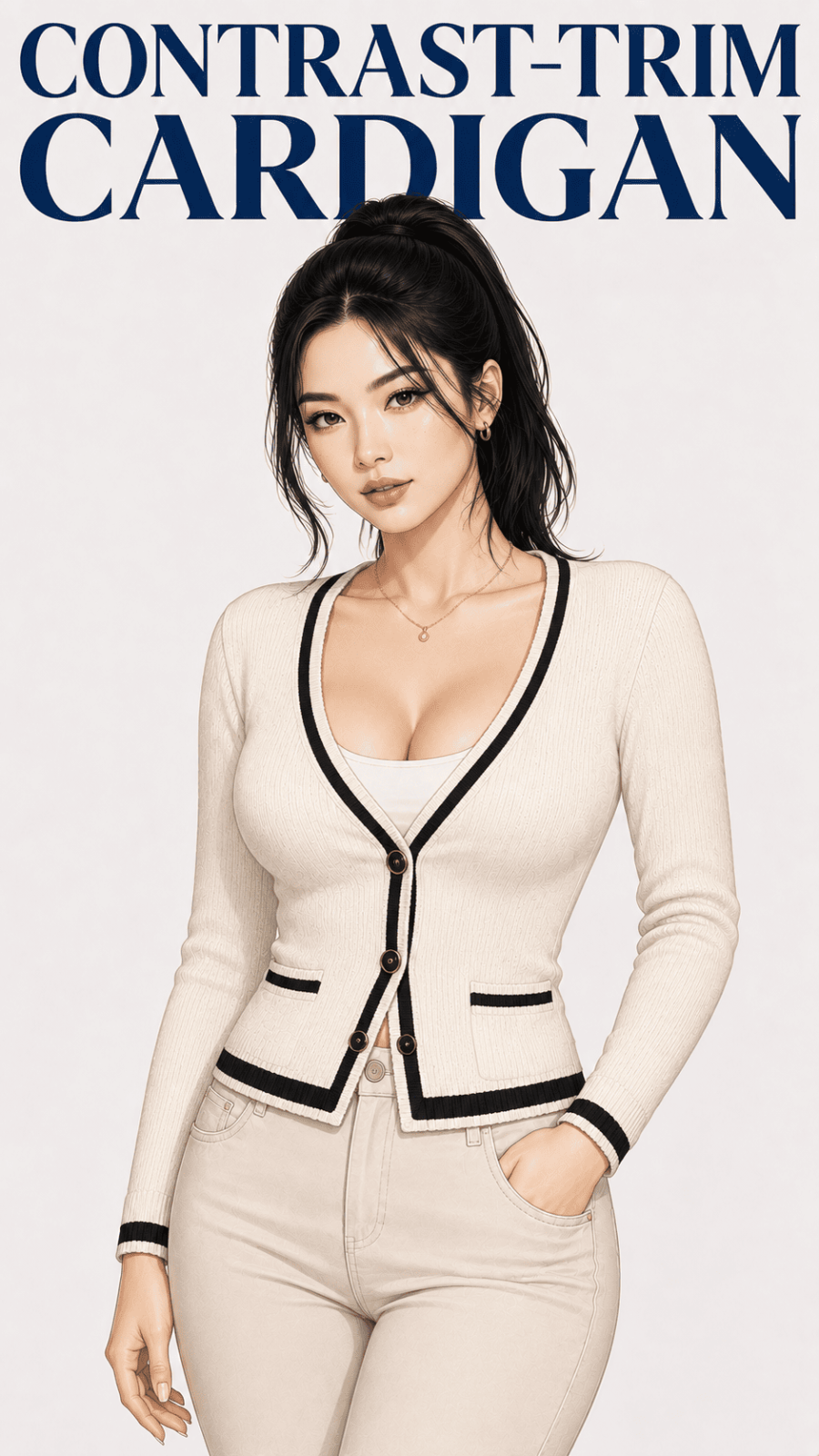
Cardigan body in one colour with contrasting ribbing at cuffs, hem, and collar — creating a clean graphic separation between the main body and the edges. The contrast trim cardigan is one of the most efficient pattern techniques available in knitwear: a single colour contrast at the garment's edges creates a banded, structured impression without the complexity of all-over pattern knitting. Classic examples include navy body with cream cuffs and hem, or camel with burgundy trim. The technique is associated with sportswear and collegiate aesthetics but appears across all formality registers.
- 59
Printed Knit Cardigan

A cardigan where pattern is applied to the knitted fabric via printing rather than being knitted into the structure — florals, abstract prints, conversational prints, or digital photographic patterns applied through screen printing or digital textile printing processes. Printed knit cardigans differ from jacquard and fair isle cardigans in that the pattern is surface-applied rather than structural. This allows much more complex and colour-rich patterns than knitting technology typically permits, at a lower production cost — but the printed surface may crack or fade differently from yarn-dyed structural patterns over time.
- 60
Sheer / Semi-Transparent Cardigan
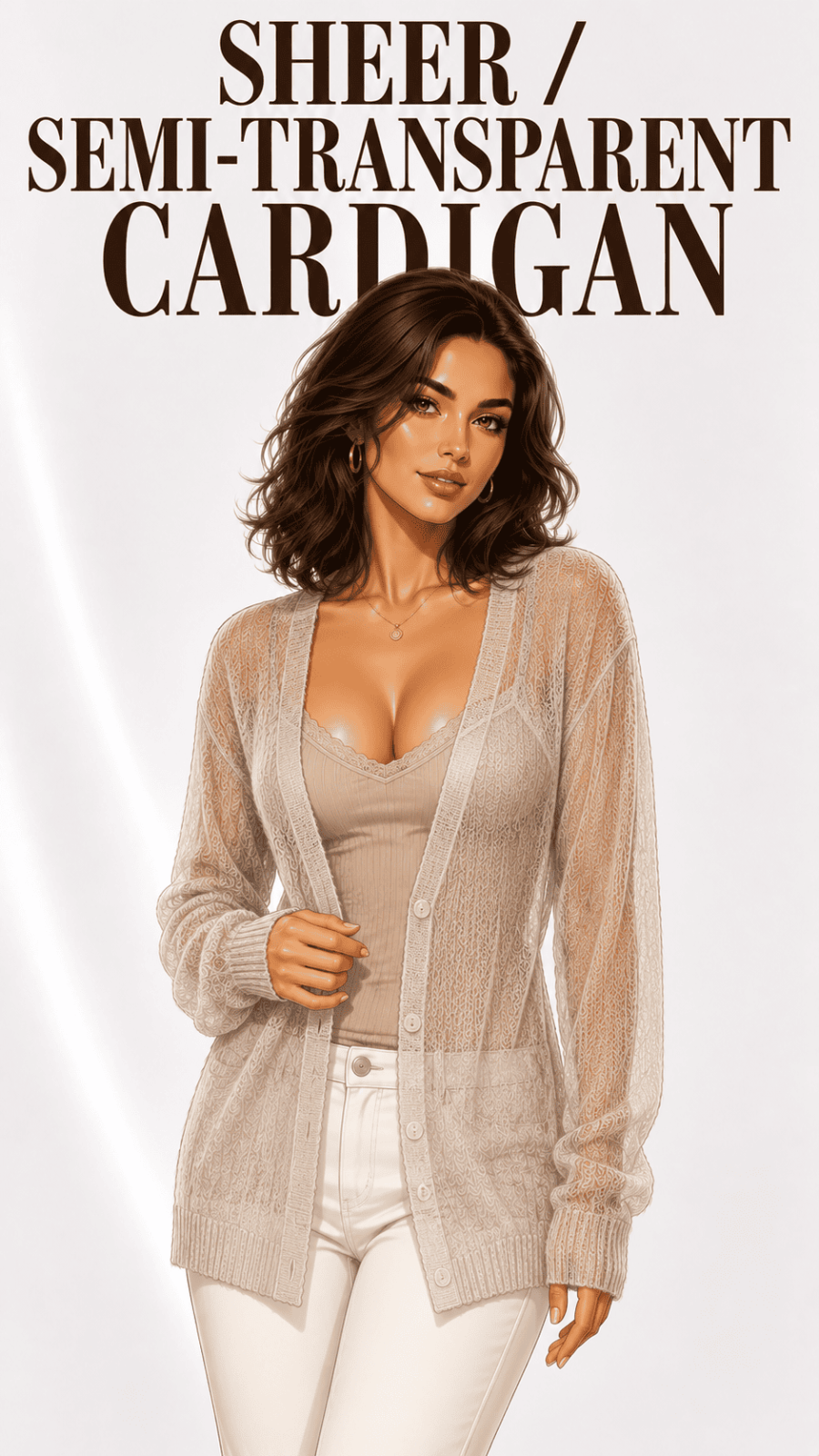
Open-weave or ultra-fine knit that creates a semi-transparent effect — you can see through the fabric to whatever layer is worn beneath. The sheer cardigan is the furthest point from the garment's original warmth-providing function: it provides no meaningful temperature regulation, functioning instead as a purely visual layering piece. It creates texture, depth, and the impression of deliberate, considered layering over whatever base garment is worn beneath. Common in openwork cotton, mesh-knit synthetics, and very fine viscose constructions. Often styled over spaghetti-strap tops or bralette tops where the see-through quality reveals an intentional inner layer.
"Cardigans are too casual for professional settings."
This conflates the category with its most casual variants. A fine-gauge merino or cashmere cardigan in a neutral colour, worn over a tailored blouse with structured trousers and good shoes, projects as much professional authority as a blazer — and significantly more comfort. The garments that made cardigans seem "too casual" for offices were chunky, oversized, or brightly coloured knits worn as standalone pieces. Fitted, fine-knit cardigans in office-appropriate colours have been legitimate professional dressing since Coco Chanel introduced jersey knitwear to the boardrooms of 1920s Paris. The garment isn't the issue; the construction and fibre choice is. For comprehensive office outfit guidance, our office styling guide covers cardigans in professional contexts in detail.
Frequently Asked Questions — Types of Cardigans for Women
What is the difference between a cardigan and a sweater?
A cardigan is specifically an open-front knitwear garment — it has a front opening that is fastened with buttons, a zip, ties, or left entirely open. A sweater (or jumper) is a closed knitwear garment pulled on over the head without any front opening. Both are knitted garments, but the cardigan's defining characteristic is its openable front, which gives it its layering versatility. All cardigans are a type of sweater in the broadest sense; not all sweaters are cardigans. For a complete comparison of knitwear types, our sweater types guide covers every variant with visual examples.
What is the most versatile cardigan to own?
For pure versatility, a hip-length, fitted or relaxed-fit, button-through cardigan in a fine-to-medium weight neutral yarn (merino in camel, navy, black, or grey) covers the widest range of occasions and weather conditions. This configuration works over everything from T-shirts to blouses, layers under blazers when needed, transitions from office to weekend, and functions across three seasons without difficulty. If budget allows a single investment piece, merino or cashmere in a neutral at hip length is the most cost-per-wear-efficient cardigan available. Our full knitwear and tops guide covers how cardigans fit into a complete wardrobe structure.
How do you style an oversized cardigan?
The fundamental rule: balance oversized volume in the upper body with slim or fitted volume in the lower body. An oversized cardigan over a miniskirt or slim straight-leg trousers creates a considered proportional contrast. The same oversized cardigan over wide-leg trousers or a full midi skirt creates competing volumes that tend to look unintentional. The most effective oversized cardigan outfits are those where the bottom half provides a clean, uncluttered counterpoint to the cardigan's volume — typically through slim jeans, leggings, mini skirts, or tailored narrow trousers. Belting an oversized cardigan at the waist is a reliable technique for adding definition to an otherwise shapeless silhouette.
What is the best cardigan fibre for sensitive skin?
Baby alpaca and fine-grade merino wool (measured at 17–19 microns fibre diameter) are the most reliably skin-comfortable natural wool fibres. Standard wool and lower-grade merino can cause itching or rash on sensitive skin because fibre diameter above 20–25 microns physically irritates skin receptors. Cashmere is also non-irritating for most people. If all wool fibres cause a reaction, cotton, bamboo, or high-quality viscose cardigans provide natural-fibre alternatives without any wool proteins. Machine-washable merino (treated with Superwash or Chlorine-Hercosett processes) maintains softness well but loses some of the fibre's natural properties in the process. Always check fibre micron ratings in product descriptions if skin sensitivity is a concern.
How do you care for a cashmere cardigan?
Cashmere cardigans require hand washing in cold water with a wool-specific or gentle shampoo (not regular detergent) — the hair-like fibre scales felt and shrink irreversibly in hot water or agitation. After washing, press out excess water gently without wringing, then dry flat on a towel rather than hanging (hanging stretches wet cashmere out of shape). Between washes, airing the garment outside for an hour after wearing refreshes it without washing — cashmere is naturally odour-resistant and rarely needs frequent laundering. Store folded, not on hangers, and use cedar moth deterrents rather than chemical mothballs which can damage fibre. Pilling on cashmere is normal and can be removed with a cashmere comb or fabric shaver — it does not indicate poor quality but rather active wearing.
Can cardigans be worn in summer?
Yes — with the right construction. Summer cardigans are typically cotton, linen, bamboo, or open-weave constructions that provide the layering structure of a cardigan without meaningful warmth addition. They serve a specific practical function in summer: air-conditioned restaurants, offices, cinemas, and aircraft where cold air can make sleeveless summer outfits uncomfortably cold while warm outdoor temperatures make heavier layers impractical. A thin cotton or bamboo cardigan in a neutral colour is a summer travel essential for exactly this reason. Resort wear collections consistently include lightweight cardigans as beach-to-dinner transition pieces. More on summer layering in our summer outfit guide.
What is a duster cardigan?
A duster cardigan is a floor-length or near-floor-length open-front cardigan — named after the long lightweight protective coats (dusters) that travellers wore in the early automobile era to protect clothing from road dust. In contemporary fashion, the duster cardigan functions as a knitted outerwear substitute: it provides a dramatic, sweeping silhouette that reads as more relaxed than a structured coat but more considered than a standard cardigan. Typically worn open without a belt over a simple outfit — jeans and a T-shirt, or a slip dress — where the cardigan itself provides all the visual interest needed. More silhouette options in our outerwear types guide.
- Length is the cardigan's most decisive variable — it determines whether the garment reads as a layering piece, a standalone top, or an outerwear substitute before any other decision has been made
- Fibre determines long-term ownership experience: merino and cashmere perform differently from cotton and acrylic in every measurable dimension — warmth, longevity, care, pilling rate, and skin comfort
- Knit construction type (ribbed, cable, chunky, fine-knit) is the most overlooked variable in cardigan selection — two cardigans in the same yarn will behave completely differently if the stitch structure differs
- The button is the cardigan's most neglected design element — upgrading poor-quality buttons on an otherwise solid garment is the highest-return-per-effort alteration in knitwear
- The hip-length, fitted, fine-knit, button-through cardigan in a neutral natural fibre is the most versatile single-piece investment in the category — covering office, casual, and smart-casual across three seasons
- Cardigans are fully appropriate for professional environments when constructed in fine-knit, neutral fibre, and worn with tailored pieces — the "too casual" perception applies to specific variants (chunky, oversized), not the category as a whole
The cardigan has survived everything fashion has thrown at it — formalism, casualisation, the athleisure decade, the blazer revival, the pandemic wardrobe reset. It survives because it solves a real problem: the need to add warmth, coverage, and layering logic to an outfit without committing to a coat. That problem doesn't go away. The specific solution — which length, which knit, which fibre, which closure — evolves constantly. But the underlying utility is permanent.
Choose a cardigan based on what it needs to do — not what it looks like on someone else's body in a photograph taken in optimal lighting.
Explore our complete knitwear reference alongside this guide: all sweater types, tops and knitwear reference, and our fibre and fabric guide for everything you need to buy knitwear with genuine confidence.
Know what you need. Choose what works. The right cardigan makes every outfit it touches better.

Leave a Reply