

There’s a length that does something unusual in fashion — it refuses to belong to just one occasion. The midi dress doesn’t commit to a season, a mood, or a single version of who you are. It falls somewhere between the knee and the ankle, that deliberate in-between placement being precisely the whole point. Long enough to feel intentional, short enough to stay dynamic. And underneath that simplicity, a genuinely staggering range of silhouettes, construction methods, fabrics, and styling territories.
The midi is not a compromise length. It’s the most considered length in a woman’s wardrobe.
The midi silhouette traces its modern identity to the late 1960s and early 1970s, when designers began deliberately pushing hemlines back down after the mini’s decade of dominance. What emerged wasn’t a retreat — it was a recalibration. Houses from Valentino to Halston began building midi proportions into fluid jersey columns and bias-cut silk constructions that moved differently from everything before them. That movement quality — the way a midi hem travels, catches air, photographs in motion — is still the defining sensory attribute of the length today. Whether it’s a structured A-line in ponte or a gossamer wrap in chiffon, the dress category rewards understanding. Because knowing what type of midi you’re looking at tells you how it will fit, how it will move, and what it will do for you.
This guide categorizes 45+ types of midi dresses across 6 classification systems. For every single entry:
-
Design
What it looks like
-
Season
When to wear it
-
Best For
Who it works for
Start here, explore everything, and browse our complete visual midi dress reference alongside it.
All 6 Categories at a Glance
A structured breakdown of the 46 midi dress types documented in this guide.
- 01
By Silhouette / Construction
- 02
By Neckline & Sleeve
- 03
By Fabric & Material
- 04
By Occasion / Purpose
- 05
By Design Details & Embellishments
- 06
By Fit & Cultural Style
45+ Different Types of Midi Dresses for Women
Category 1: By Silhouette / Construction (#1–#14)
How the midi dress is cut, shaped, and built — the foundational identity of each type
Silhouette is everything in a midi dress. Before you think about color, fabric, or occasion — there is the cut. The silhouette determines how the dress will interact with the body, how it will move, and whether it will carry tension or release it. An A-line midi and a bodycon midi are the same length — they produce entirely different experiences.
What works beautifully about classifying midi dresses by construction is that it bypasses trend language entirely. "Cottagecore midi" is a mood board. A tiered cotton dress with elasticized waist and flutter sleeves? That's construction. And construction tells you how the garment will fit your specific body — which is the information that actually matters.
- 01
A-Line Midi Dress

Fitted bodice flaring gradually from the waist to a midi hem — the silhouette traces an uppercase A. Among the most consistently flattering dress constructions in the modern wardrobe. Christian Dior's 1955 A-line collection codified this shape into fashion vocabulary, and it has never truly left the conversation since.
- 02
Wrap Midi Dress
Front panels cross over and tie at the waist, creating an adjustable V-neckline and a fluid, draped skirt that falls to midi length. Diane von Furstenberg's 1974 wrap dress established this construction as the definitive modern silhouette — universally adaptable because the tie accommodates fit rather than demanding it. See the full breakdown of wrap dress variations here.


- 03
Bodycon Midi Dress
Constructed from stretch fabric — jersey, bandage, ribbed knit — that conforms closely to the body from shoulder or bust to midi hem. No flare, no volume. The silhouette relies entirely on fit tension. At midi length, a bodycon dress reads as elevated in a way the mini version rarely does. More on the full range of bodycon dress styles here.
- 04
Slip Midi Dress
Bias-cut or straight-cut satin, silk, or satin-weave fabric with spaghetti straps — a lingerie-inspired silhouette worn as outerwear. The 1990s brought the slip dress from boudoir to street, and the midi-length version is the most sophisticated iteration. It moves like water. Explore all the types of slip dresses here.


- 05
Shirt Midi Dress
A button-front dress with shirt-style collar, placket, and often a belted waist that allows the skirt portion to fall to midi length. Shirt construction logic applied to a dress — structure at the top, movement at the bottom. One of the most versatile midi silhouettes for office environments or smart-casual settings. Explore the complete range of shirt dress styles here.
- 06
Tiered Midi Dress
Multiple horizontal layers of fabric — two to four tiers — each gathered or ruffled to create volume that compounds at the hem. A tiered dress has movement as its primary design feature. The bohemian midi par excellence — and in years of wardrobe editing sessions, consistently among the most reached-for summer pieces regardless of style preference.


- 07
Fit-and-Flare Midi Dress
A closely fitted bodice and waist that transitions — often dramatically — into a full, flared skirt at the hips or waist seam. Similar to A-line in concept but with a more pronounced contrast between fitted upper and flared lower sections. The flare is deliberate architectural intent, not gradual easing.
- 08
Smocked / Babydoll Midi Dress


Gathered or smocked elastic panel at the bust or waist releases into a loose, full skirt that falls without shaping to midi length. A babydoll silhouette at midi scale shifts the registration from playful to genuinely grown-up. The gathering is the construction — it provides fit through tension rather than darts or seams.

- 09
Sheath Midi Dress

A narrow, structured silhouette that skims the body without significant shaping or flare — a clean, continuous vertical line from shoulder to midi hem. Not a bodycon. A sheath has structure; it holds its shape off the body as well as on it. In real-world office environments, this cut consistently outperforms trend-driven shapes for sustained polish.
- 10
Prairie / Peasant Midi Dress

Gathered or smocked neckline or yoke, loose flowing body, often with ruffles, lace trim, or embroidery — referencing traditional European and American folk dress. This silhouette felt genuinely fresh during the cottagecore surge of the early 2020s, and its construction logic explains why: the fullness around the hem creates movement at the ankle that photographs beautifully in any setting.
- 11
Pleated Midi Dress

A dress with structured, uniform pleats — knife pleats, box pleats, or accordion pleats — in the skirt portion, falling to midi length. The pleat is the construction differentiator here: it creates volume through deliberate fold geometry rather than gathering. In satin or silk, it has a distinctly elevated quality. In cotton, it feels clean and workwear-ready.
- 12
Bias-Cut Midi Dress

Fabric cut on the diagonal grain rather than the straight grain — creating a drape that clings slightly then moves fluidly away from the body. The bias cut has a liquid quality no straight-grain construction can replicate. Madeleine Vionnet pioneered this technique in the 1920s; it remains the most technically demanding cut in womenswear. Best in silk, satin, or velvet.
- 13
Shift Midi Dress

Loose, straight-cut with no defined waist and minimal structural seaming. The shift midi relies on volume and drape rather than tailoring — simplicity is the entire design philosophy. At midi length, this silhouette reads as deliberately, confidently relaxed rather than oversized.
- 14
Column / Straight Midi Dress

A narrow, vertical-line silhouette without significant shaping — the body flows through a consistent tube from shoulder to mid-calf. Unlike a sheath, a column tends toward more structured, heavier fabrics like ponte or crepe. Creates a clean, uninterrupted vertical line — which is exactly why it dominates red carpet dressing in subtle, sophisticated configurations.
Most women assume they need a defined waist for a midi dress to work. In reality, the silhouette does that work structurally. A pleated midi with a banded waist creates visual definition without ever touching the natural waist. An A-line implies waist definition through contrast of fitted bodice against flared skirt. The body doesn't need to do what the construction already does.
- 14 types defined by construction — silhouette determines fit behavior and occasion range
- A-line, wrap, and sheath are the highest cross-occasion versatility silhouettes
- Bias-cut ≠ slip dress: bias is a cutting technique; slip refers to construction and strap type
- Tiered and prairie silhouettes rely on volume through gathering; pleated silhouettes use fold geometry
Category 2: By Neckline & Sleeve (#15–#22)
How the neckline and sleeve shape define the character and occasion range of a midi dress
The neckline and sleeve are the modifiers — they take a base silhouette and shift the dress into a completely different category of occasion and formality. The same A-line midi construction becomes a sundress with spaghetti straps, a business appropriate piece with a crew neck and three-quarter sleeves, or an evening option with a cowl neck and no sleeves at all. Understanding this modifier system is how a small wardrobe punches far above its weight.
- 15
Off-Shoulder Midi Dress

Fabric rests below both shoulders; collarbone and shoulder area fully exposed, paired with a midi-length skirt. The horizontal shoulder line contrasts with the dress's vertical length — it photographs beautifully in motion. An exceptional choice for summer weddings and resort events where the neckline does the visual work while the length maintains formality.
- 16
One-Shoulder Midi Dress

One shoulder fully covered, the opposite side completely bare — an asymmetric neckline at midi length. The visual tension between covered and uncovered sides creates inherent movement even in a still garment. Simultaneously formal and striking. Requires a strapless or convertible bra beneath and rewards that extra effort.
- 17
Halter Neck Midi Dress

Straps tie or fasten at the nape of the neck; shoulders and back fully exposed, flowing into a midi skirt. The construction deliberately frames the shoulders and upper back as the focal point — not afterthoughts. At midi length, the halter loses its purely casual beach associations and acquires genuine evening credentials.
- 18
Long-Sleeve Midi Dress
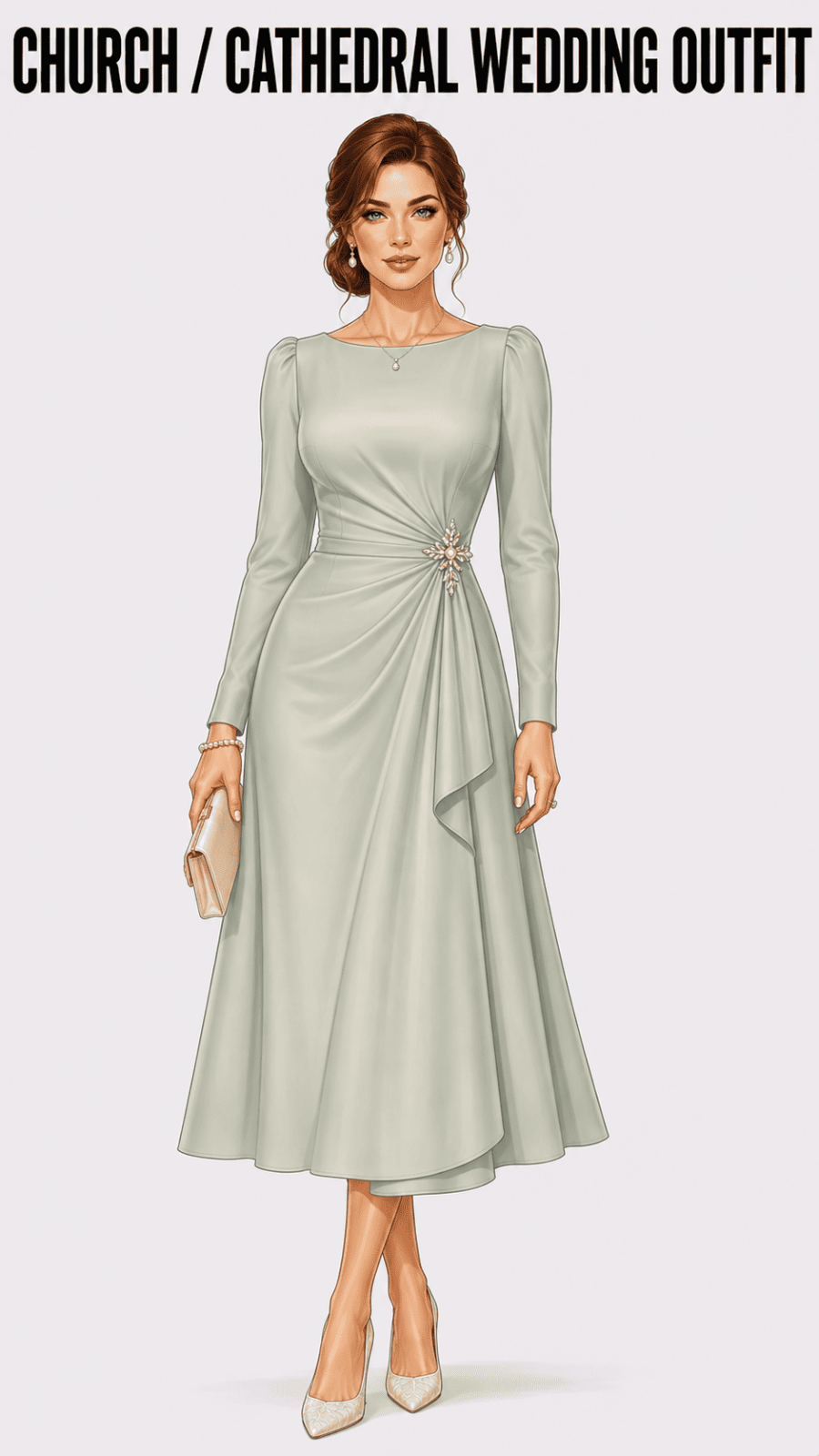
Full arm coverage from shoulder to wrist combined with a midi-length skirt — the all-seasons workhorse. Depending on fabric, a long-sleeve midi moves from summer-appropriate linen through transitional jersey to fully winter-ready wool. One of the most consistent performers in modest fashion wardrobes and structured office dressing alike.
- 19
Square-Neck Midi Dress

Three straight edges forming a square opening at the neckline, paired with any midi silhouette. Structured and modern — particularly effective at highlighting the collarbone. This neckline applied to a midi floral dress was among the most circulated dress silhouettes across fashion search trends in 2023–2024. It reads simultaneously vintage and very current — a rare combination.
- 20
Puff-Sleeve Midi Dress

Gathered, puffy volume at the shoulder with normal or fitted below, paired with a midi-length skirt. According to the most recently published WGSN Trend Report from 2024, volume sleeves including puff constructions remained among the most recurring silhouette themes in contemporary womenswear — and the midi-length pairing is what elevates the look beyond trend into considered dressing. See more on puff sleeve construction variations.
- 21
Cowl-Neck Midi Dress

Draped, gathered fabric falling in soft folds at the neckline, flowing into a midi skirt. The cowl's organic drape has a distinct visual quality — it's the only neckline that creates depth through fold rather than through cut. Particularly powerful in liquid fabrics like satin or heavy silk crepe, where the folds deepen and the entire garment achieves a sculptural quality.
- 22
Turtleneck Midi Dress

A high-rise fold-over collar combined with full arm coverage and a midi-length skirt — the definitive cold-weather dress. Simultaneously cozy and polished, this is the midi that makes winter dressing feel effortless. It draws the eye from neck to hem in a single clean line, which explains why minimalist aesthetics consistently reach for it.
Neckline photographs are almost always shot on taller models in bright studio conditions. A cowl neckline that falls in beautiful, deep folds on a 5'10" frame may bunch awkwardly on a 5'4" frame if the fabric weight isn't right. Always check the specific fabric weight listed — a heavy satin cowl behaves entirely differently from a lightweight charmeuse cowl. If in doubt, size up on cowl-neck and off-shoulder styles; the extra fabric improves the drape.
Category 3: By Fabric & Material (#23–#30)
The material determines behavior, season, care, and the way a midi dress lives in the body
Fabric is the thing most shoppers look at last — and it should be among the first. Two midi dresses with identical silhouettes in different materials behave so differently that they may as well be different garments. A linen shirt midi and a satin shirt midi share construction but diverge entirely in occasion, care, drape, and season. The fabric is not decoration; it is the dress.
Our detailed guide to dress fabrics and their properties is the companion resource for this section. Read it alongside any significant purchase decision.
- 23
Linen Midi Dress

Linen — woven from flax fibers — is crisp when freshly pressed, softens beautifully with washing, and breathes better than almost any other natural fabric. A linen midi dress is the quintessential summer wardrobe anchor: it can appear at beach restaurants, gallery openings, and office meetings depending solely on the silhouette and accessories. The wrinkling? Not a flaw — it's the texture that signals authenticity. More on summer fabric properties here.
- 24
Silk / Satin Midi Dress

True silk — protein fiber with a natural sheen — or satin weave fabric (which can be silk, polyester, or acetate) produces a liquid drape, subtle luminosity, and a weight that moves distinctly from any other material. It's both the most luxurious and most demanding fabric to wear and care for. The slip dress and bias-cut constructions are its natural habitat. More on silk fabric types here.
- 25
Jersey Knit Midi Dress

Jersey is a knit fabric with inherent stretch in both directions — T-shirt fabric elevated to dress form. At midi length, jersey creates one of the most wearable everyday dress options available: it doesn't crease, it moves easily, it requires no special care. The stretch accommodates fit variation in a way that woven fabrics simply cannot. It's not dramatic. It's deliberate.
- 26
Cotton Midi Dress

Cotton in its woven form offers breathability, washability, and a crispness that holds silhouette shape. Poplin, voile, lawn, broderie anglaise, chambray — each is cotton woven differently, producing distinct textures and weights. A cotton tiered midi and a cotton shirt midi share the fiber but create entirely different garment personalities. See the range of cotton fabric types and their properties.
- 27
Velvet Midi Dress

Velvet — a fabric woven with a cut pile that creates its characteristic plush surface — is one of the most textural materials in fashion. It catches and shifts light as you move; it reads as expensive even in synthetic form. A velvet midi dress is the winter evening dress that requires no jewellery explanation. The texture does all the work.
- 28
Chiffon / Georgette Midi Dress

Chiffon is lightweight, sheer, and floaty — it catches air and moves at the slightest breeze. Georgette is a slightly heavier, more opaque version with a textured crepe surface. Both fabrics require lining in a midi dress construction, but the resulting garment has a lightness and movement quality that no structured fabric can approximate. The flutter sleeve works best in exactly these fabrics.
- 29
Knit / Sweater Midi Dress

A dress constructed from knitted yarn — wool, cashmere, cotton, or synthetic — extending to midi length. The sweater dress's greatest asset is thermal comfort without bulk; at midi length, it produces the ideal winter dress: warm enough, structured enough, casual enough to wear on repeat. A cashmere knit midi with ankle boots? That combination outperforms virtually every winter outfit challenge.
- 30
Denim Midi Dress

Denim — twill-woven cotton in indigo dye — applied to a midi-length dress construction. The combination of structured fabric and relaxed midi length produces a casual garment with inherent credibility. Usually constructed with a button-front placket (shirt dress form) or an A-line cut. Depending on wash — dark, mid, or distressed — it crosses from truly casual to smart-casual territory.
The most overlooked fabric consideration in midi dresses is opacity — not weight. A thin jersey can be fully opaque; a heavier chiffon can be completely see-through. Always check whether your midi dress requires a slip beneath before purchasing. If the product listing doesn't mention lining and the fabric is described as "lightweight" or "flowy", assume you'll need a slip. The cost of getting this wrong in public is disproportionate to the cost of a five-second check.
Category 4: By Occasion / Purpose (#31–#38)
Midi dresses classified by their primary occasion territory — the context they were built for
Occasion classification is where the midi dress proves its unusual versatility claim. No other dress length covers as many contexts with as little restyling required. The same A-line in solid crepe moves from office to cocktail party with a shoe change. A floral tiered midi transitions from brunch to beachside wedding reception with only an accessories swap. Understanding which midi dress types were designed for which contexts removes the guesswork entirely.
- 31
Wedding Guest Midi Dress

A midi dress selected specifically for wedding guest dressing — typically in elevated fabrics (chiffon, satin, lace, floral print), with formality calibrated to the specific venue and dress code. The midi length is the safest choice for wedding guest dressing across virtually all ceremony types because it photographs gracefully, maintains decorum without overpowering, and travels without wrinkling catastrophically. For more, see the full guide to wedding guest outfit types here.
- 32
Office / Workwear Midi Dress

A midi dress calibrated for professional environments — structured fabrics (ponte, crepe, suiting), modest coverage, and silhouettes that maintain polish through a full working day. The sheath, shirt dress, and A-line in solid neutrals or subtle prints are the dominant workwear midi forms. For the full range of formal wear options for women, the midi dress earns its place as the most efficient single-piece solution for office dressing.
- 33
Resort / Vacation Midi Dress

Lightweight, often printed, designed for warm-weather holiday environments — typically in linen, cotton voile, or soft jersey. The resort midi does one specific thing well: it transitions from a poolside morning through a lunch terrace into a dinner setting without requiring a full outfit change. Explore the full range of vacation outfit ideas here.
- 34
Evening / Cocktail Midi Dress

A midi dress built for evening occasions — typically in luxury fabrics (satin, velvet, lace, sequin), with deliberate design elements (low back, one-shoulder, cowl neck) that elevate it beyond daywear. At midi length, a cocktail dress navigates the formality gap between a full-length gown and a cocktail mini with extraordinary confidence. The length adds gravitas that shorter versions lack.
- 35
Casual Everyday Midi Dress

A midi dress designed for daily, high-rotation wear — typically in jersey, cotton, or denim, with comfortable construction, easy care instructions, and a relaxed silhouette. The casual midi should function as a uniform: easy to throw on, appropriate for most situations encountered in a normal day, and resilient enough to be worn frequently. This is the wardrobe anchor category, found in detail in our casual wear guide here.
- 36
Travel Midi Dress

A midi dress built with travel's specific demands in mind: wrinkle-resistance, packability, temperature flexibility, and the ability to look put-together after hours in transit. Jersey, ponte, and matte crepe excel here. A well-chosen travel midi handles an airport, a dinner reservation, and a museum in sequence — without needing to return to the hotel. See our airport outfit guide here.
- 37
Party / Going-Out Midi Dress

A midi dress designed for social evening settings — typically with bold design elements: sequins, ruching, cut-outs, dramatic necklines, or high slits. The party midi is deliberately attention-seeking while the midi length itself keeps the overall look polished rather than purely provocative. A sequined bodycon midi is the most visible example: bold from the waist up, refined from the waist down. See more in the full party wear guide here.
- 38
Lounge / Relaxed Midi Dress

A midi dress designed for comfort-first wearing — loungewear-adjacent fabrics (modal, bamboo jersey, soft cotton), relaxed silhouettes, and the kind of ease that makes it possible to spend a full day at home in a dress without once wishing you'd worn sweatpants. The lounge midi makes the strong case that comfort and looking intentional are not mutually exclusive. See the full lounge dress guide here.
"A midi dress is too casual for a formal occasion."
The formality of a midi dress is determined almost entirely by fabric, silhouette, and styling — not by length. A bias-cut satin midi in deep emerald with a cowl neck reads as black-tie adjacent. A velvet column midi with a structured bodice belongs at a gala. The midi length itself carries no inherent formality register — it is a neutral canvas that responds to what you put on and around it.
Category 5: By Design Details & Embellishments (#39–#42)
Midi dress types defined by their signature surface detail — the element that names the garment
Some midi dresses are built around a single defining detail — an embellishment or construction feature that becomes the dress's entire identity. A sequined midi IS a sequined midi: the fabric, the construction, the occasion registration are all dictated by that one design decision. In this category, the detail is the taxonomy. The silhouette, fabric, and occasion are secondary to the feature that names the garment.
- 39
Floral Print Midi Dress

A midi dress featuring botanical or floral print — ranging from small ditsy prints to large-scale watercolour blooms. The floral midi is consistently among the most searched dress types globally because it covers such a wide utility range. The print does styling work that solid fabrics require accessories for. A bold floral midi with minimal jewellery and flat sandals is a complete outfit. For a full breakdown of floral dress styles, visit here.
- 40
Sequin / Embellished Midi Dress

A midi dress covered fully or partially in sequins, beading, embroidery, or other surface embellishment. The sequin midi dress is the clearest example of the length's sophistication advantage: a sequined mini reads as purely party. A sequined midi — especially in a column or A-line silhouette — reads as a statement piece with a level of intention that gown-wearers often spend triple the price to achieve. See more on sequin dress styles here.
- 41
Lace Midi Dress

A midi dress constructed from lace fabric or featuring significant lace panelling — an openwork textile with intricate pattern created through looping, twisting, or knitting threads. Lace carries the strongest romantic register of any dress material; at midi length, it pivots from bridal-adjacent to genuinely sophisticated. White lace midi = bridal territory. Black lace midi = thoroughly evening-appropriate. The colour changes the entire occasion reading. Explore the full range of lace dress styles here.
- 42
Ruched / Gathered Detail Midi Dress

Fabric gathered or ruched — stitched into close, parallel folds — typically at the waist, side seams, or across the bodice, to create texture, visual interest, and shape through gathered volume. Ruching is simultaneously a construction technique and a style statement. It creates volume where you want it and eliminates fabric excess where you don't. In jersey fabrics, it's one of the most effective body-contouring tools available in ready-to-wear dressing.
- The wedding guest and evening midi are the two highest-stakes occasions — fabric and silhouette precision matters most here
- The casual and travel midi are the highest-utility purchases — they earn their wardrobe space through frequency, not occasion prestige
- Floral print is a styling tool as much as a design element — the print removes the need for statement accessories
- Ruching shapes the body through the garment's construction — it is not just decoration but active fit management
Category 6: By Fit & Cultural Style (#43–#46)
Midi dress types defined by their fit philosophy, cultural tradition, or distinct aesthetic identity
The final category captures midi dress types that resist silhouette or fabric classification because their identity derives from a broader cultural, aesthetic, or philosophical framework. A modest midi dress and a bohemian midi dress may share identical construction — yet they represent completely different relationships with clothing, body, and occasion. Cultural and fit identity is its own classification axis.
- 43
Modest / Covered Midi Dress

A midi dress designed with full or near-full coverage — long sleeves, high neckline, and midi or lower hemline — aligned with modesty dressing principles practiced across many cultural, religious, and personal value frameworks. The modest midi dress is one of the fastest-growing fashion categories globally, reflecting the reality that full coverage and genuine style are entirely compatible. See the complete guide to modest fashion dressing here.
- 44
Plus-Size / Curve-Fit Midi Dress

A midi dress cut and graded specifically for curvier body proportions — with additional hip and waist ease, adjusted bodice shaping, and proportional sleeve and neckline scaling that works for fuller figures rather than simply sizing up a straight-size pattern. The distinction matters: a correctly graded plus-size midi behaves entirely differently from a scaled-up straight-size pattern at the same size. The midi length is widely noted by curve stylists as the most universally flattering dress length for fuller figures. For more, see the complete plus size fashion guide here.
- 45
Bohemian / Festival Midi Dress

A midi dress drawing from bohemian aesthetic vocabulary: flowing silhouette, earth-tone or bold print, natural fabrics (cotton, linen, rayon), folk-inspired embroidery or trim, and a generally unstructured, free-spirited character. The boho midi exists at the intersection of fashion and lifestyle identity in a way few other dress types do — it communicates an entire orientation toward clothing rather than just a silhouette preference. See our full bohemian dress guide here.
- 46
Maternity Midi Dress

A midi dress designed specifically for pregnancy — with ruched side panels for bump accommodation, stretchy fabric with full-length give, and silhouettes that remain flattering across all trimesters. The maternity midi is the most functional dress category of all because it must work across a continuously changing body while maintaining a garment that a wearer still wants to put on. Smocked bodice, empire waist, and wrap constructions are the most successful maternity midi forms. For the complete maternity dress guide, visit here.
- A-Line — fitted bodice, gradual flare. All seasons, Smart-Casual+. Best for office, weddings, dates.
- Wrap — crossover front, fluid skirt. All seasons, Casual–Formal. Best for office, travel, dates, weddings.
- Slip — spaghetti straps, bias drape. Spring/Summer, Evening. Best for dates, evening, resort.
- Shirt — button placket, collar. All seasons, Smart-Casual. Best for office, weekend, travel.
- Tiered — layered gathered tiers. Spring/Summer, Casual. Best for holiday, casual, boho.
- Bodycon — stretch, form-fitting. Spring–Autumn, Evening. Best for going out, parties.
- Pleated — structured fold skirt. All seasons, Smart-Casual+. Best for office, weddings, elevated casual.
- Knit/Sweater — knitted construction. Autumn/Winter, Casual–Smart. Best for weekend, travel, cold-weather.
- Bias-Cut — diagonal grain, liquid drape. All seasons, Evening+. Best for formal, special occasions.
- Floral Print — any silhouette with print. Spring/Summer, Casual–Smart. Best for weddings, brunch, casual.
The shoe you choose determines whether a midi reads as effortful or effortless. Ankle boots with a midi hem create a slight visual break between hem and boot top — keep that gap under 2cm or intentionally wide (5cm+) to avoid the awkward in-between. Strappy flat sandals work universally. Block heels add the clearest formality elevation. Pointed-toe flats are the most underrated midi pairing.
When wearing a patterned or embellished midi, resist the instinct to add a belt or waist-level accessory. The construction already provides waist definition in most midi silhouettes. Adding a belt over a tiered dress or floral wrap creates visual clutter at the most important point of the garment. Instead, tuck one edge of a shirt midi to suggest waist definition without committing to full volume reduction.
When layering over a midi dress, a cropped jacket, blazer, or cardigan preserves the hem's visual impact. A full-length coat worn open works beautifully. What disrupts the midi is a hip-length open cardigan — it creates a horizontal break at the widest point without offering any visual payoff. A cropped denim jacket over a tiered linen midi is one of the most consistently successful warm-weather layering combinations.
Small, ditsy prints work best on fitted silhouettes — bodycon, sheath, slip. The print adds texture without competing with minimal volume. Large-scale prints need volume to read correctly — tiered, pleated, and A-line midis carry a bold botanical print far more gracefully than a fitted jersey does. Mixing large print with minimal silhouette creates visual tension that rarely resolves in person as beautifully as it does on a screen.
On petite frames (under 5'4"), the standard midi can land at an unflattering calf-widening point. Look for dresses described as "petite midi" — typically 1–2 inches shorter — or opt for silhouettes with a high slit that restores leg-length visual balance. A high-waisted midi with a heel creates the most length-enhancing combination. Avoid thick horizontal borders or tier lines that cut the body at its widest points.
A midi dress is a canvas for bag styling in the way few other pieces are. The same jersey midi shifts from casual to polished solely through the bag: a raffia tote = beach or market; a structured mini bag = city-chic; an embellished clutch = evening. At a practical level, midis often benefit from a crossbody that sits at the upper hip rather than at hem level — it creates a clean proportional break.
One of the most underused autumn styling moves: wearing an oversized shirt (denim, flannel, or Oxford cloth) open over a slip midi or tiered dress. The shirt functions as a casual layer, the midi provides the polished underpin. The hemline of the shirt should hit either at or above the midi hem, or be knotted at the waist. If the shirt hem falls between the waist and the midi hem, it creates a proportion that doesn't resolve cleanly.
Warm fabric tones (terracotta, camel, rust, olive) photograph better in natural light and carry through autumn-to-spring transitions without looking season-inappropriate. Cool fabric tones (cobalt, sage, blush, ivory) peak in spring and summer light. When building a midi wardrobe, anchor with two neutral-tone (warm or cool, matching your natural palette) midi dresses — they become the baseline that all print and embellished pieces work alongside.
Frequently Asked Questions — Midi Dresses
What length exactly is a midi dress?
A midi dress falls between the knee and the ankle — typically landing somewhere between 2 inches below the knee and mid-calf. In practical retail terms, most midi dresses measure approximately 42–52 inches in total length on a standard size, which positions the hem at mid-calf on a 5'5"–5'7" frame. The term is descriptive, not standardised — expect variation between brands, particularly for petite or tall ranges. If a retailer provides a total garment length measurement, compare it against the distance from your natural waist to your desired hem point on your own body.
Is a midi dress appropriate for the office?
Yes — in the right construction and fabric. A midi dress is one of the most efficient office dressing solutions available because it's a single piece that handles all professional situations without the coordination requirements of separates. For office wear, choose structured fabrics (ponte, crepe, suiting-weight wool), modest necklines, and silhouettes without significant skin exposure — sheath, A-line, shirt dress, and pleated forms are the best starting points. Avoid very lightweight or sheer fabrics, overly casual prints, or embellishments unless your workplace culture explicitly permits them.
What shoes go best with a midi dress?
The midi length is unusually compatible with most shoe types, which is part of its enduring appeal. For casual midi dresses, flat sandals, espadrilles, and white trainers are the most natural pairings. For smart-casual or office midi dresses, pointed-toe flats, low block heels, and loafers are excellent. For evening midi dresses, strappy heeled sandals, pointed stilettos, and mules create the right formality elevation. Ankle boots work beautifully when the boot-to-hem gap is either very small or deliberately generous. Knee-high boots under a mid-calf midi create a strong, fashion-forward layered effect.
Are midi dresses flattering for petite women?
Yes — with the right approach. The conventional concern about midi dresses on petite frames is that the hem can land at a visually widening point on the leg. To navigate this: look for petite-specific midi lengths (slightly shorter), choose silhouettes with a high slit at the front or side hem to restore visual leg length, wear with a pointed-toe heel for maximum length effect, and prioritise high-waisted or empire-waist constructions that elongate the lower body. Monochromatic dressing dramatically increases the apparent height of any figure.
Can you wear a midi dress in winter?
Absolutely. Winter midi dressing works in several ways: knit or sweater midis in wool or cashmere are inherently warm, worn with knee-high or ankle boots; velvet midi dresses are among the strongest winter evening options; any fabric midi can be winter-proofed with opaque thermal tights, a cropped blazer or structured coat, and boots; and turtleneck or long-sleeve midi constructions are specifically designed for cold-weather dressing. The midi length is actually a winter advantage over mini dresses — the extra hem coverage provides meaningful thermal protection.
What is the difference between a midi dress and a maxi dress?
The length: a midi dress falls between the knee and ankle (typically mid-calf), while a maxi dress falls to the ankle or floor. In practical dressing terms, the midi offers more footwear flexibility (heels, flat sandals, boots all read clearly), while the maxi works best with flat sandals or heels tall enough to prevent hem-dragging. The midi also tends to be more versatile for everyday and office dressing, while the maxi skews more strongly toward resort, formal, or festival occasions. Both are flattering across a wide range of body types, but the midi requires less seasonal restriction.
How do you style a midi dress for a wedding?
For wedding guest dressing, a midi dress is the most reliable choice across venue types. Match the fabric formality to the venue — chiffon or satin for formal churches or hotels; floral cotton or linen for outdoor or garden weddings; lace for formal evening ceremonies. Avoid white, ivory, cream, and champagne in all forms. Floral midi dresses are universally appropriate for outdoor summer and spring weddings. A block or kitten heel provides stability for outdoor receptions while maintaining elegance, and one statement accessory piece is enough.
What is the most flattering midi dress silhouette?
The A-line and wrap midi silhouettes are the most consistently cited as flattering across body types, for the same structural reason: both define the waist and release volume below it. This proportional logic — narrower upper body transitioning to a more relaxed lower — creates the visual impression of an hourglass regardless of starting proportions. For apple-shaped figures, the empire waist midi is particularly effective. For pear-shaped figures, A-line and pleated midi dresses provide skirt volume that balances a narrower shoulder. For rectangular figures, wrap and ruched midis create waist definition the figure doesn't naturally have.
Every wrap construction documented
Bias cuts, satin drape, lingerie-inspired styles
Print scales, occasion matching, styling guide
Stretch constructions, fabrics, styling
Openwork fabrics, occasion ranges, colours
The complete reference — every dress category
Conclusion: The Midi Dress, A Final Word
Forty-six types across six classification systems — and the conclusion is not that the midi dress is complicated. The conclusion is precisely the opposite.
What this level of variation demonstrates is that the midi is so structurally open, so length-neutral in its occasion signal, and so receptive to fabric, construction, and styling modification that it functions as fashion's most flexible foundation category. There is a midi dress for every context your life produces. The question was never whether the length works — it's which version of it works best for what you're doing next.
Start with construction: determine whether you need volume (A-line, tiered, fit-and-flare) or containment (sheath, column, bodycon). Then move to fabric — the material determines season, occasion range, and care far more than any other single variable. Finish with the detail layer: neckline, sleeve, print, embellishment. That sequence — construction, fabric, detail — produces a correctly chosen midi dress every time.
- Footwear breaks the length — the shoe determines whether a midi reads as effortful or effortless; keep the boot-to-hem gap either very small or intentionally wide.
- Don't over-accessorise a patterned midi — most silhouettes already provide waist definition; a belt adds clutter rather than clarity.
- Layer with cropped pieces, not long ones — a cropped jacket or full-length open coat preserves the hem; a hip-length cardigan disrupts it.
- Match print scale to silhouette volume — small prints suit fitted midis; large-scale prints need volume (tiered, pleated, A-line) to read correctly.
- Petite frames should look for petite-specific lengths or a high slit to avoid the hem landing at an unflattering calf-widening point.
- The bag sets the register — the same jersey midi reads beach, city, or evening depending purely on the bag chosen.
- The midi is a genuine winter option — knit, velvet, and turtleneck constructions, plus tights and boots, extend it across every season.
- The A-line and wrap silhouettes are the most universally flattering — both create waist definition and hourglass proportion regardless of starting shape.

Leave a Reply